
Before dawn on a winter morning in Ballard, the diesel engines start one by one along Salmon Bay. The boats have names like Polaris and Nordic and Viking, and many are headed for the same brutal water their owners’ grandfathers fished: the Bering Sea, the Gulf of Alaska, the halibut banks off the Aleutians. For more than a century the men working those decks have answered to surnames ending in -sen and -son, and the neighborhood behind them has smelled of cedar smoke, fresh bread, and salt. This is the story of the Norwegians in Ballard, the fishing-and-milling town in northwest Seattle that became one of the most Norwegian places on the American map.
Ballard: The Place
Ballard sits in the northwest corner of Seattle, wrapped around the north shore of Salmon Bay where the Lake Washington Ship Canal meets Puget Sound. The Hiram M. Chittenden Locks, finished in 1917, lift boats from saltwater up into the freshwater bay, and the fishing fleet ties up just beyond them. The land rises gently from the water into blocks of modest frame houses, then into the brick storefronts of Ballard Avenue and Market Street. It was always a working waterfront first and a neighborhood second.
How Ballard Became Norwegian
Before the Norwegians
The shoreline of Salmon Bay belonged to the Duwamish and Shilshole peoples long before any mill whistle sounded. White settlement arrived with the timber. By the 1880s the bay was lined with cut cedar and fir, and the town that grew up to process it incorporated as the independent City of Ballard in 1890, with 1,636 residents.
What it had was wood and water, and it used both relentlessly. Ballard called itself the Shingle Capital of the World, and the boast had numbers behind it. The mills cut some 322 million wooden shingles in 1898 alone, and by 1915 roughly twenty mills crowded the waterfront, among them the Stimson Mill Company and the Seattle Cedar Company. By 1907 the town had grown to about 17,000 people, and that year it gave up its independence and was annexed to Seattle. A town like that did not need salesmen. It needed hands.
The Norwegians Arrive
The hands came from across the North Sea. Norway in the late nineteenth century was running out of room. There was not enough tillable land between the fjords and the mountains for a growing population, and the sea had always been the alternative. America was the larger one, and from the 1880s onward Norwegians began arriving in the Pacific Northwest in real numbers.
They came for a landscape that did not feel foreign. Saltwater inlets, dark conifer forest, cold mountains, a coast made for boats: it was the geography they had left, with work attached. The mills and shipyards along Salmon Bay needed exactly the skills these men already had, in timber, in carpentry, and above all in handling vessels.
By 1910 more than 7,000 Norwegians lived and worked in the Seattle region, concentrated heavily in Ballard, and Scandinavians as a whole made up over thirty percent of Washington’s foreign-born population, the single largest immigrant group in the state. The community built its institutions early. Norwegian immigrants founded a newspaper, the Washington Posten, in 1889, and its office eventually moved out to Ballard to be near its readers. In 1903 the Sons of Norway organized Leif Erikson Lodge in the neighborhood, a fraternal anchor that has held ever since.
Ballard was the western counterpart to a national pattern. Where earlier Norwegians settled the farm country of the upper Midwest, building places like the Norwegian community in Decorah, Iowa, those who reached the Pacific coast went to the water. The other great Norwegian harbor town, the Norwegian enclave in Bay Ridge, Brooklyn, did the same on the Atlantic side, sending its men to sea while Ballard sent its men north.
What made Ballard genuinely Norwegian rather than merely Scandinavian was chain migration, and what carried it was fish. A young man from a fishing village on the western coast would cross over, find a berth on a Ballard boat through a cousin already there, and within a few seasons send word and money home. Brothers followed brothers. Whole stretches of the fleet ended up crewed by men from the same fjord, the same island, sometimes the same parish.
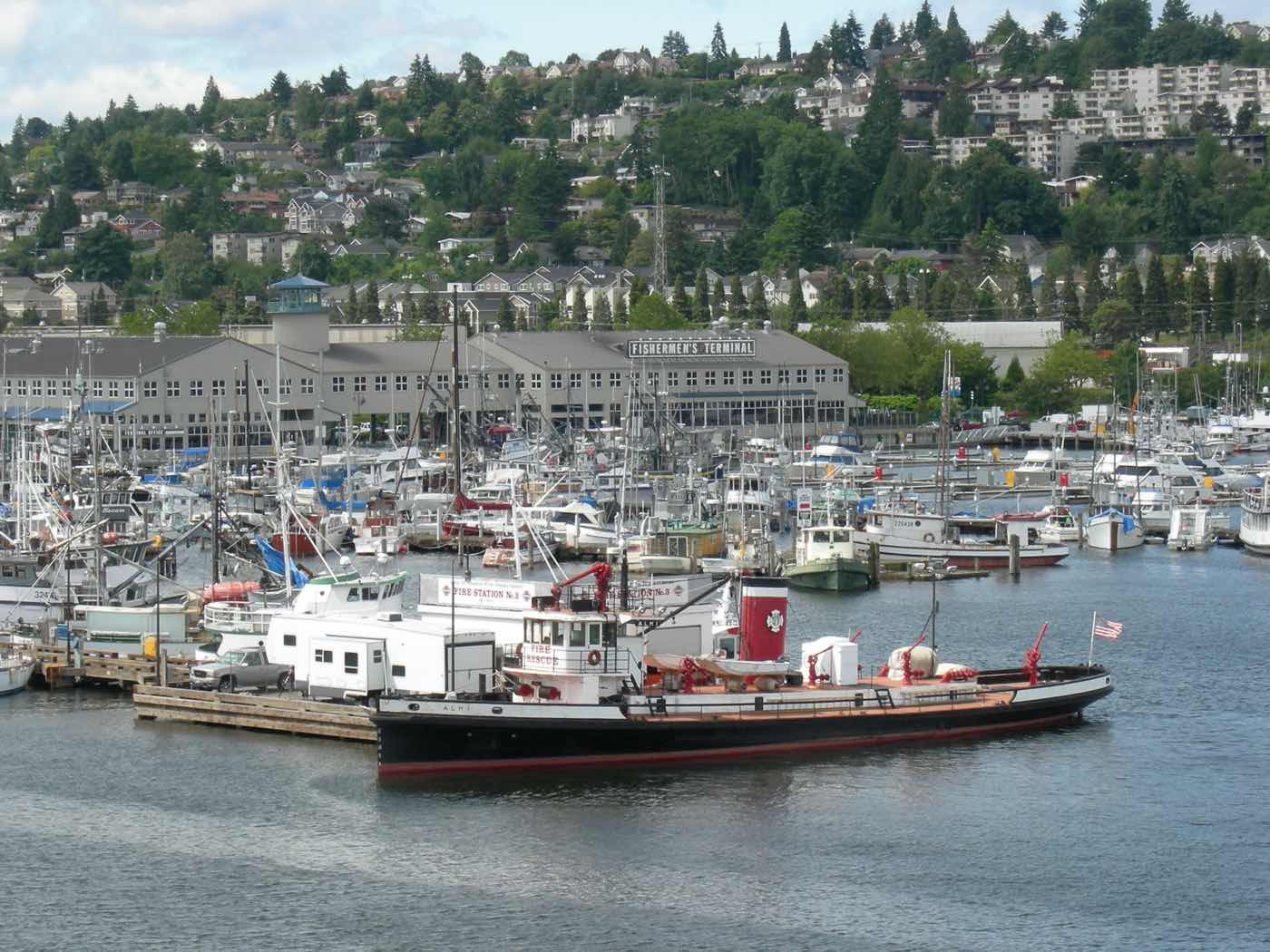
The fish that built the community was halibut. For decades, halibut fishing in these waters was almost exclusively a Norwegian trade, worked first from two- and three-man dories sent out from larger schooners. The boats ranged up the coast to grounds that grew their own Norwegian towns, including the cannery port that became the Norwegian town of Petersburg, Alaska. The Port of Seattle gave the fleet a home in 1914 when it opened Fishermen’s Terminal on the Salmon Bay side facing Interbay, and the boats began wintering there. By then the men reading the charts and running the lines were overwhelmingly sons of Norway.
Ballard at Its Peak
For the first half of the twentieth century, Ballard ran on this rhythm. Men shipped out for the season and came home with the catch money. The mills cut around the clock. Ballard Avenue, its brick blocks built in the 1890s and early 1900s, was the main street of it all, lined with taverns, ship chandlers, and outfitters. Fishermen between trips gathered at places like Ingvard Boe’s Ballard Tavern, known to everyone as Inky’s, where the talk was of weather and price and who had come back light.
The Depression hit the fishing economy hard, and the response was characteristically practical. In 1932 a group of Norwegians founded the Norwegian Commercial Club to help one another find footing, and the club is still going. More telling came in 1946, when about 400 Norwegian fishermen and their wives each put in 300 dollars and bought a shipyard. They organized it as a cooperative on the site of the old Ballard Marine Railway and named it Pacific Fishermen. It still repairs boats on Salmon Bay today.
Daily life was Lutheran churches, lodge halls, and language. Norwegian was spoken on the street and from some pulpits, and bakeries sold the breads of home. Every May the neighborhood turned itself inside out for the seventeenth, the day Norway adopted its constitution in 1814, with children in bunad and flags on every porch. Seattle’s Norwegians had marked the date since 1889, but in 1974 Ballard added a full community parade, and that is when the modern celebration began.
The Change
The mills went first. One by one the shingle and lumber operations along the bay closed or moved, and the smell of cut cedar faded from the air. The fishing endured longer, and endures still, but the fleet shrank, and many of the young men who once would have gone to sea went to college or to software instead.
Then came the part every old neighborhood in a booming city knows. As Seattle grew, Ballard’s cheap waterfront land and low frame houses became valuable. Beloved landmarks closed; the Sunset Bowl alley, a fixture for generations, shut its doors in 2008. The median Ballard home sold for around 303,000 dollars in 2003; two decades later it was near 875,000. Tech workers came to outnumber fishermen, and the Scandinavian accent grew rare on the sidewalk.
What is striking is how much of the Norwegian thread held anyway, knotted now around a museum, a parade, a shipyard, and a fleet that still leaves for Alaska. The community did not vanish. It concentrated into the things it cared about most.
The Landmarks of Norwegian Ballard
Fishermen’s Terminal (3919 18th Ave W, on the Salmon Bay shore facing Ballard). Opened by the Port of Seattle in 1914, this is the home harbor of the North Pacific fishing fleet and the literal anchor of the whole story. Walk the docks today and you read the rosters of the Bering Sea trade, including boats made famous by the television series Deadliest Catch.
Pacific Fishermen Shipyard (5351 24th Ave NW). Founded in 1946 by roughly 400 Norwegian fishing families who each invested 300 dollars, this cooperative-born yard is the oldest working shipyard in Ballard. It is proof that the Norwegian fleet did not just fish here; it built and mended its own.
National Nordic Museum (2655 NW Market St). Begun in 1980 as the Nordic Heritage Museum inside an old schoolhouse, it opened a purpose-built home on Market Street on May 5, 2018, and was designated the National Nordic Museum the following year. Its galleries trace the immigrant journey from the fjords to Salmon Bay, and it is the cultural heart of Nordic Ballard.
Leif Erikson Statue (Shilshole Bay Marina, 7001 Seaview Ave NW). Sculpted by the Norwegian immigrant August Werner and commissioned by the Sons of Norway Leif Erikson Lodge, this bronze Viking was unveiled on June 17, 1962, during the Seattle World’s Fair. Since 1963 it has been listed on maritime charts as a navigational landmark, a sailor pointing the fleet home.
Leif Erikson Hall (2245 NW 57th St). Home to both the Sons of Norway lodge organized in 1903 and the Norwegian Commercial Club founded in 1932, the hall was completed in 1986 with more than 12,000 hours of volunteer labor. It is where the lutefisk dinners happen and where the neighborhood’s Norwegian institutions still keep an address.
Bergen Place (NW Market St and 22nd Ave NW). This triangular park honors Bergen, Seattle’s Norwegian sister city since 1967, and was dedicated in person by King Olav V of Norway on October 19, 1975. A mural of figures from the five Nordic nations watches over a few benches in the old commercial district.
Scandinavian Specialties (6719 15th Ave NW). Founded in 1962 as the Norwegian Sausage Company, this deli and cafe still smokes its own sausage and serves open-faced sandwiches, yellow pea soup, and the groceries of home. It is the kind of working shop, not a museum case, where the food culture of Norwegian Ballard simply continues.
Where the Ballard Norwegians Came From
The Norwegians who filled Ballard came overwhelmingly from the western coast, the long fjord-cut shoreline that faces the open Atlantic. Most sailed from the port of Bergen, the great gateway of western Norwegian emigration, and many came from its hinterland in the counties of Hordaland and Sogn og Fjordane, where the emigrant rolls ran into the tens of thousands. These were people from places where farming was a sideline to fishing, and where a boy learned the sea before much else.
That coastal origin is why the pipeline worked. A halibut schooner out of Ballard wanted men who already knew cold water, small boats, and long lines, and the fishing villages of western Norway produced little else. Immigrants organized themselves around home districts in Seattle, forming regional societies such as a Karmoy Club for people from the island of Karmoy, so that the map of old Norway was reassembled, parish by parish, along Salmon Bay. The same logic settled other Nordic groups down the coast, among them the Finnish fishing community in Astoria, Oregon.
Ballard Today
Ballard in 2026 is a different animal from the mill town. The old industrial blocks now hold one of the densest concentrations of craft breweries in the country, the so-called Ballard Brewery District, and the brick storefronts of the Ballard Avenue Landmark District, protected since 1976, are full of restaurants and boutiques rather than chandlers and taverns. On a Sunday the crowds are there for brunch and beer, not for a berth.
And yet the Norwegian fact refuses to disappear. The fleet still winters at Fishermen’s Terminal and still leaves for the Bering Sea, and Pacific Fishermen still hauls boats out of the water on Salmon Bay. The National Nordic Museum draws visitors from across the country, Scandinavian Specialties still slices its own meats, and every seventeenth of May the whole neighborhood fills with flags for one of the largest Constitution Day parades anywhere outside Norway, behind only Oslo and Bergen.
The mills are gone and the accents have thinned, but the thread runs unbroken from the fjords to the docks to the children waving paper flags on Market Street. As long as the boats leave for Alaska in the dark and come back in the spring, Ballard will stay, in the way that matters most, a Norwegian town.
Frequently Asked Questions
Why did Norwegians settle in Ballard?
Norwegians settled in Ballard from the 1880s because its sawmills, shingle mills, shipyards, and fishing fleet needed exactly the skills they brought from the old country. The saltwater, forest, and mountains also closely resembled western Norway. The fishing trade, especially halibut, became an almost entirely Norwegian domain, drawing the Norwegians in Ballard deeper into the neighborhood with each season.
Is Ballard still Norwegian today?
Ballard has gentrified into a brewery and restaurant district, and Scandinavian accents are now rare on the street. But the Norwegian fishing fleet still operates from Fishermen’s Terminal, the National Nordic Museum and Sons of Norway lodge remain active, and the Syttende Mai parade is still one of the largest in the world. The Norwegians in Ballard are fewer and more dispersed, yet the cultural thread is unmistakably intact.
What are the famous Norwegian landmarks in Ballard?
The key landmarks are Fishermen’s Terminal on Salmon Bay, the National Nordic Museum on NW Market Street, the Leif Erikson statue at Shilshole Bay Marina, Leif Erikson Hall, Bergen Place park, and Pacific Fishermen Shipyard. Scandinavian Specialties, a deli founded in 1962, still operates on 15th Avenue NW. Together they map the working and cultural life of Norwegian Ballard.
Where in Norway did the Ballard Norwegians come from?
Most came from the western coast of Norway, sailing from the port of Bergen and the surrounding fjord counties of Hordaland and Sogn og Fjordane. These were fishing districts where boys grew up on small boats and long lines. That coastal background made them ideal crew for the halibut and cod fleet that built Ballard.
When did Norwegians first arrive in Ballard?
Norwegians began arriving in the Ballard area in noticeable numbers in the 1880s, drawn by the timber and fishing industries, and the Sons of Norway organized a Ballard lodge in 1903. By 1910 more than 7,000 Norwegians lived in the Seattle region, with the Norwegians in Ballard forming one of the densest Norwegian American communities on the West Coast.
Every fishing family in Ballard carries a place name on the other side of the ocean, a fjord or an island where the story began. If your own family followed a similar route from a coast to an American street, the trail is there to be traced.