
On a Saturday morning on Broad Street, the smell reaches you before the door does. Fresh rye, sweet yeast, smoked sausage from a deli case the length of a city block. Inside Polmart, a woman buys pierogi by the dozen and then walks ten steps to mail a parcel home, because the post office counter here greets you with a single word painted overhead: POCZTA. A mile of granite three-deckers runs north from here, and on the lampposts the street signs come in two languages. This is the Polish in New Britain, and it has been here, in one form or another, since the 1880s.
New Britain: The Place
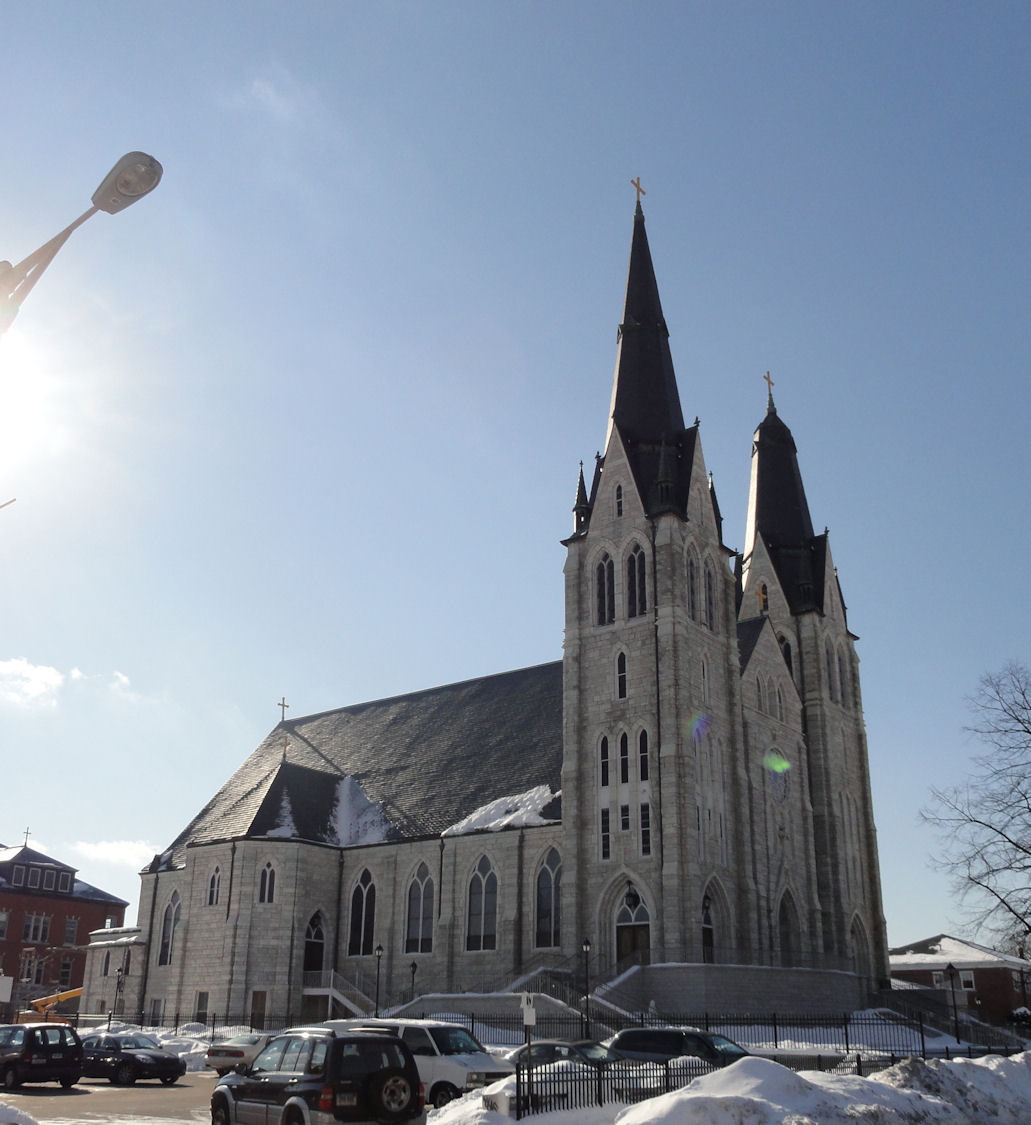
New Britain sits near the dead center of Connecticut, about nine miles southwest of Hartford. For more than a century it was a factory town, the self-styled “Hardware City,” where companies stamped out tools, locks, and builder’s hardware by the trainload. The Polish quarter grew up along Broad Street, a long commercial spine lined with bakeries, markets, and the multi-family wooden houses that gave the working class a place to live. Above it all rise the twin spires of Sacred Heart Church, the granite landmark that has anchored the neighborhood for generations.
How New Britain Became Polish
Before the Polish
New Britain was a colonial Connecticut settlement long before it was an immigrant city. Its fortunes changed in 1843, when Frederick Trent Stanley opened a bolt manufactory that would grow into The Stanley Works. The P. and F. Corbin Company followed close behind, building a national name in locks and door hardware.
By the late nineteenth century the city was a manufacturing engine. North and Judd, Landers, Frary and Clark, Russell and Erwin, and Corbin all needed hands, and lots of them. The first arrivals to fill those benches were Irish and German. The Poles came next, and they came in numbers that would reshape the place.
The Polish Arrive
The first known Polish settler in New Britain was Tomasz Ostrowski, who arrived in the late 1870s. He was a scout for a migration that followed fast behind him. The draw was simple and concrete: steady factory wages in a city that, by 1920, was turning out close to a third of all the builder’s hardware made in the United States.
Migration like this rarely happens at random. It runs along chains. A man got work at North and Judd, sent word to a brother, who sent word to a cousin, who arrived already knowing which boarding house to find and which foreman to ask. The same pattern built Chicago’s Polish Triangle and the Polish wards of half a dozen industrial cities. By 1900 roughly two thousand people of Polish descent were living in the city.
The parish came almost as quickly as the people. On August 10, 1894, the Polish Catholic community was organized as a mission, and in 1895 a young Polish-born priest named Lucyan Bojnowski was made its pastor. He would hold that post until his death in 1960. Bojnowski was not only a priest but an institution-builder, founding a Polish-language newspaper, helping start a savings bank in 1907, and establishing an orphanage and a home for the aged.
The first Sacred Heart church was dedicated in 1896. As the congregation swelled, a far grander building rose at 158 Broad Street, designed by the Holyoke architect George P. B. Alderman and completed in the first years of the new century. A four-story parish school opened nearby, and by the early 1920s its enrollment topped two thousand children.
New Britain at Its Peak
By 1930, a quarter of New Britain’s population claimed Polish ancestry, and the wider immigrant share of the city was higher still. Sacred Heart had grown so large, with a membership reaching roughly nine thousand, that a second Polish parish became necessary. Holy Cross was founded on April 8, 1927, at 31 Biruta Street, with its own school close behind.
This was a self-contained world. There were Polish grocers and Polish butchers, a Polish Falcons athletic nest formed in 1907, mutual-aid societies, and savings institutions run by and for the community. Henry Gwiazda was elected the city’s first Polish-American mayor in 1946, a sign that the immigrant ward had become a civic power.
The neighborhood spoke Polish in its shops and prayed in Polish in its pews. A Saturday school kept the language alive for the American-born, and the church calendar, not the secular one, set the rhythm of the year. The same dense parish life shaped Hamtramck in Michigan and the Broadway-Fillmore district of Buffalo, where the parish church doubled as the heart of the community.
The Change
The factories that built the neighborhood eventually unmade it. As manufacturing contracted through the second half of the twentieth century, the jobs that had drawn the first Poles thinned out. Younger families moved to the suburbs, following the same upward path immigrants everywhere take once they can afford it.
By the 1980s Broad Street had slid into hard times. Storefronts sat vacant, buildings fell derelict, and the street acquired a reputation that kept people away. For a while it looked like the story might simply end there.
It did not, and the reason was a fresh wave of newcomers. After Poland’s return to democracy in 1989, a new generation of Polish immigrants arrived, and this time many came as entrepreneurs rather than laborers. They bought the empty storefronts and filled them with bakeries, delis, markets, restaurants, and travel agencies. By the late 1990s the city was stepping up, and the neighborhood was visibly coming back to life. The revival mirrored what happened in Greenpoint in Brooklyn, where a later generation of Polish arrivals kept an old enclave from fading away.
The Landmarks of Little Poland
Sacred Heart Church, 158 Broad Street. The neo-Gothic mother church of Polish New Britain still stands as the tallest thing on the street, its twin towers visible for blocks. Founded in 1894 and built of pale granite, it remains an active parish in the Archdiocese of Hartford, with Mass still offered in Polish. Step inside and the painted vaults and gilded high altar make plain how much a poor immigrant congregation was willing to give to build a piece of home.
Holy Cross Church, 31 Biruta Street. When Sacred Heart could no longer hold everyone, the overflow built this second Polish parish in 1927. The present neo-Gothic church, designed by Anthony J. DePace, went up in 1936 and houses a Casavant pipe organ beneath a rose window. It too remains open and Polish in character.
Polmart, 121 Broad Street. Billed as one of the largest Polish stores on the East Coast, Polmart is a grocery, bakery, and deli under one roof, with a hair salon and a working United States post office counter besides. That counter is the only one in the country where customers are welcomed by the Polish word POCZTA overhead, a small detail that says a great deal about who this street belongs to.
Roly Poly Bakery, 587 Main Street. A short walk from Broad Street, Roly Poly is bakery, deli, and grocery in one, known for its paczki, its breads, and a hot counter of Polish food to take away. It is one of the businesses that still draws people in from across the state and keeps the daily commerce of the neighborhood humming.
Staropolska, Broad Street. For three decades Staropolska was the sit-down Polish restaurant that visitors were told they had to try, with pierogi and other dishes made fresh each day. A basement fire in September 2023 caused heavy damage, and the owners chose not to reopen, a reminder that even beloved landmarks are not permanent.
Krakus Meat Market and the Broad Street delis. The smoked kielbasa and fresh meats at shops like Krakus, alongside spots such as Kasia’s Bakery, the Belvedere Cafe, and Taste of Poland at 99 Broad Street, make up the everyday backbone of Little Poland. Of the roughly one hundred storefronts on the street, about seventy are owned and run by Polish Americans.
Walnut Hill Park. West of downtown lies a green designed by Frederick Law Olmsted, the landscape architect behind New York’s Central Park. In 2019 Polish President Andrzej Duda addressed a crowd of thousands here, a measure of how much the homeland still claims this small Connecticut city as its own.
Where the New Britain Polish Came From
The Poles who built New Britain did not arrive from a single place, because in their day there was no single Poland to leave. The country had been partitioned among Russia, Austria, and Prussia, and the immigrants came from across those divides. By far the largest share, close to two-thirds, came from Russian Poland, especially the provinces of Grodno, Łomża, and Płock in the country’s northeast.
Most of the rest came from the Austrian partition, the region known as Galicia in the south. Specific home parishes turn up again and again in the records, places like Dąbrowa Białostocka in Grodno province, Myszyniec in Łomża, and Wola Raniżowska in Galicia. Father Bojnowski himself was born in a village within the Dąbrowa Białostocka parish, and where a respected pastor came from, families tended to follow. Migration from the German partition was comparatively slight.
New Britain Today
Little Poland is no museum piece. Walk Broad Street on a weekend and you will hear Polish spoken in the bakeries, see new-world arrivals shopping beside third-generation grandchildren, and find dual-language signage on the lampposts. The city officially named the district Little Poland in 2008. Roughly one in five New Britain residents still claims Polish ancestry, which keeps the city among the most Polish places in the United States.
The neighborhood has its own annual high point. The Little Poland Festival began modestly in 2012, drawing around six hundred people, and now pulls in tens of thousands each spring for folk dancers, food, and music along a closed-off Broad Street. Polish-language Mass continues at Sacred Heart and Holy Cross, and a Saturday school still teaches the language to the young.
The street is changing again, as it always has. Newer Latino neighbors now live and trade alongside the Polish businesses, and a few familiar names, Staropolska among them, have gone dark. Yet the Polish character endures, carried by the bakeries that open early, the parishes that fill on Sunday, and the families who keep choosing to stay. The next chapter of Broad Street is still being written, and it is being written in more than one language.
Frequently Asked Questions
Why did Polish immigrants settle in New Britain?
They came for factory work. From the 1880s, New Britain’s hardware plants, including Stanley Works, Corbin, and North and Judd, needed labor, and the city was producing a huge share of America’s builder’s hardware. The Polish in New Britain settled along Broad Street because it sat close to those factories.
Is New Britain still Polish today?
Yes. Roughly one in five residents claims Polish ancestry, and the Broad Street district officially named Little Poland in 2008 remains the Polish epicenter of Connecticut. About seventy of its hundred storefronts are Polish-owned, and Polish Mass, a Saturday school, and a large spring festival all continue.
What are the most famous Polish landmarks in New Britain?
Sacred Heart Church at 158 Broad Street is the great Gothic anchor of the neighborhood, joined by Holy Cross Church on Biruta Street. Polmart at 121 Broad Street is a sprawling Polish market with its own POCZTA post office counter, and Roly Poly Bakery on Main Street remains a regional draw for Polish baked goods.
Where in Poland did the New Britain Polish come from?
Most came from Russian Poland, especially the northeastern provinces of Grodno, Łomża, and Płock, with a substantial minority from Galicia in the Austrian south. Home parishes such as Dąbrowa Białostocka and Myszyniec recur in the records, reflecting the chain migration that built the Polish in New Britain.
When did Polish immigrants first arrive in New Britain?
The first known Polish settler, Tomasz Ostrowski, came in the late 1870s, and large-scale arrival followed in the 1880s and 1890s. The first Polish parish was organized in 1894. A second major wave of arrivals came after Poland’s return to democracy in 1989, this time as business owners.
Your family may have walked off a factory floor on Broad Street, knelt in a granite church, or carried a name that still hangs over a bakery door. Atlas of Home helps you trace that story back to the village it came from.