
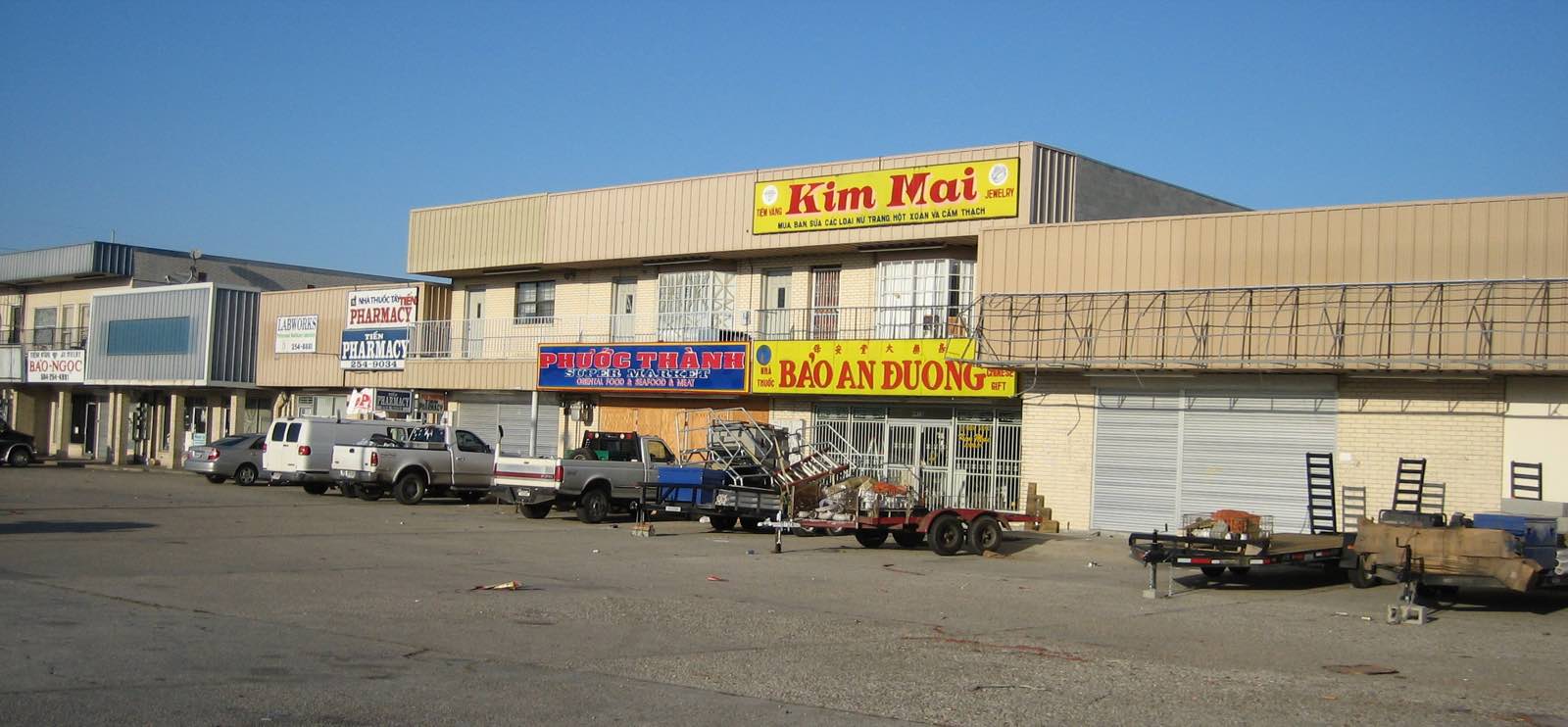
Before the sun clears Bayou Sauvage, the parking lot off Alcee Fortier Boulevard is already busy. Vendors set out blue crabs still snapping in plastic tubs, bundles of water spinach and lemongrass, snake gourds, and trays of dried shrimp. Shoppers move between the tables with flashlights, picking over the catch and the harvest in Vietnamese. This is a Saturday in Versailles, and it is the most visible sign of the Vietnamese in Versailles, New Orleans, one of the densest such communities in the country.
Locals also call this neighborhood Village de l’Est, on the far eastern edge of the city. The market has run like this for more than forty years. It was built by refugees who had already lost one home before they ever reached Louisiana, and who would lose this one to a hurricane and build it back faster than anyone thought possible.
Versailles: The Place
Versailles sits at the far eastern edge of New Orleans East, a flat expanse of drained marshland about twenty minutes from the French Quarter by way of Chef Menteur Highway. The subdivision opened in 1964 on roughly 600 acres reclaimed from the swamp, ringed by canals, bayous, and the long earthen levees that hold back the water. The housing is modest and low: single-story brick ranch homes, garden apartments, and the strip malls along Alcee Fortier that became Little Vietnam. Bayou Sauvage and its wildlife refuge press in on one side, a reminder that the land here was never far from being water again.
How Versailles Became Vietnamese
Before the Vietnamese
New Orleans East was a developer’s dream that never fully arrived. In the 1960s and early 1970s, investors drained the back marsh and platted thousands of lots, betting the city would grow eastward toward the lake and the gulf. The Versailles Arms apartment complex went up along Chef Menteur Highway as part of that bet.
The growth stalled. By the mid-1970s, much of the area was half-built and underpopulated, with blocks of vacant, federally subsidized apartments sitting empty in a neighborhood that was then largely African American. It was cheap, it was open, and it was about to become the unlikely answer to a refugee crisis 9,000 miles away.
The Vietnamese Arrive
Saigon fell in April 1975. Within weeks, the first Vietnamese refugees were arriving in New Orleans by bus. The man who made the city a destination was Philip Hannan, the Archbishop of New Orleans, who understood that a large share of the refugees were Catholic and sent representatives to the resettlement camps to bring them south.
The work on the ground was done by Associated Catholic Charities, which had a resettlement apparatus already in place from earlier Cuban arrivals. The agency found subsidized housing for roughly 1,000 Vietnamese refugees, and a large group of them landed in the empty units at Versailles Arms. The neighborhood took its name from that complex, and the name stuck even after most families moved out of the apartments and into homes of their own.
What happened next is the part that distinguishes Versailles from almost anywhere else. The first arrivals wrote to relatives and former neighbors scattered across other American resettlement sites, telling them there was a warm, low, watery place that looked and felt like home, where you could fish, plant a garden, and find a Vietnamese Mass on Sunday. Chain migration did the rest. Families followed families, parish followed parish, and within a decade Versailles had grown into one of the densest concentrations of Vietnamese people anywhere in the United States.
Faith held the place together from the start. The newcomers first gathered for Mass in a mobile home, then built a small chapel in 1978. In 1983 the Archdiocese established Mary Queen of Vietnam as a full parish, the first Vietnamese Catholic parish in the country, and the church was consecrated in 1986. It became more than a place to pray. It was the town hall, the message board, and the engine of nearly everything the community did.
Versailles at Its Peak
By the turn of the millennium, Versailles was a self-contained Vietnamese town inside an American city. Alcee Fortier Boulevard filled with pharmacies, jewelers, video shops, groceries, and restaurants whose signs were in Vietnamese first and English second. The Saturday morning market drew gardeners and cooks from across the region before dawn.
The land itself went to work. Older residents, many of them farmers and fishers in Vietnam, planted vegetable gardens in their backyards and carved larger market plots into the batture along the levees and canals, irrigating them by hand the way they once had in the river deltas back home. The crops were Vietnamese, the soil was Louisiana, and the result fed the neighborhood and supplied the Saturday tables.
A third of the area’s Vietnamese households made their living on the water before Katrina, shrimping and fishing the gulf in a fleet that came to dominate the regional catch. The community that had fished near Vung Tau became a community that fished off the Louisiana coast, with the church holding an annual Blessing of the Fleet as brown shrimp season opened. For a people twice displaced, it was as close to continuity as history allows.
The Change
On August 29, 2005, Hurricane Katrina put New Orleans East under water, in places more than a dozen feet of it. Versailles was devastated, its homes flooded, its people scattered to Houston and beyond. Most observers assumed the neighborhood, like much of the East, might never come back.
It came back faster than almost anywhere in the city. The pastor of Mary Queen of Vietnam, Father Vien The Nguyen, returned with parishioners by early October, barely a month after the storm. The first Mass in the gutted church drew around 300 people, the next Sunday 800, and within three weeks 2,200. By January 2006, more than half the neighborhood had returned, much of it rebuilt with family money and volunteer labor rather than government aid.
When the utilities stalled, Father Vien gathered more than 500 signatures and negotiated power and water back into the neighborhood himself. Then came a second fight. In February 2006, with the community still drying out, the city opened a landfill for storm debris at Chef Menteur, less than two miles from Versailles, in the wetlands that drained toward its gardens and fishing grounds.
The neighborhood organized. Grandmothers who had never protested in their lives joined younger residents, African American neighbors, environmentalists, and elected officials in a coalition that marched, sued, and refused to back down. The pressure worked. The mayor signed an order to shut the landfill on July 14, 2006, and a court order sealed it the following month. A young attorney who came to prominence in that fight, Anh “Joseph” Cao, would carry the neighborhood’s new political confidence all the way to Congress two years later.
The Landmarks of Vietnamese Versailles
Mary Queen of Vietnam Church, 5069 Willowbrook Drive. Begun as Masses in a trailer in the 1970s and established as a parish in 1983, this was the first Vietnamese Catholic parish in the United States. During Katrina, Father Vien sheltered families inside and stayed through the flood until the last of them was rescued, then made the church the staging ground for the entire neighborhood’s return, generators humming while the city around it sat dark.
The Saturday Morning Market, Alcee Fortier Boulevard. Held for more than four decades in the lot beside Ly’s Supermarket, the open-air market starts around five in the morning and is finished by nine. The Ly family, who long oversaw it, were honored by the Southern Foodways Alliance for keeping the tradition alive, and the tables still carry herbs, live crabs, and garden starts you will not find in any supermarket aisle.
Dong Phuong Bakery, 14207 Chef Menteur Highway. De and Huong Tran opened Dong Phuong in 1982, a few years after arriving, with Huong drawing on pastry skills she had learned in her father’s bakery in Vietnam. The bakery’s small French loaves became the bread of choice for po-boys across the city, and after it started making king cakes in 2008 it became a Carnival institution, winning a James Beard America’s Classics award in 2018.
The Levee and Batture Gardens. Along the canals and earthen levees that ring the neighborhood, older residents planted market gardens that recreated the agriculture of the Vietnamese deltas, hand-watered rows of bitter melon, water spinach, and herbs. These plots fed families, supplied the Saturday market, and gave elders a foothold of dignity and routine in a strange country. Many were ruined by Katrina’s salt water and never fully came back.
VEGGI Farmers Cooperative. Born in 2011 out of the wreckage of the BP oil spill, this cooperative farm gave out-of-work fishers and gardeners a new way to earn, combining greenhouses and aquaponics with the farming knowledge the elders carried from Vietnam. It is the modern descendant of the levee gardens, and it still grows produce for kitchens across New Orleans.
Versailles Arms Apartments, off Chef Menteur Highway. The complex that gave the neighborhood its name housed the first wave of refugees in 1975. Most families moved on to their own homes within a few years, but the name endured, and the apartments remain a quiet origin point for a community that grew far beyond them.
Where the Versailles Vietnamese Came From
Almost everyone in Versailles traces back to a small set of fishing and farming communities in southern Vietnam, chiefly the area around Vung Tau and the village of Phuoc Tinh, in Ba Ria-Vung Tau province roughly 120 kilometers southeast of Saigon. But that was not where their story started either. Many of these families were originally northerners, from the heavily Catholic dioceses of Bui Chu and Phat Diem in the Red River Delta.
When the Geneva Accords split Vietnam in 1954, hundreds of thousands of northern Catholics fled south rather than live under a communist government, resettling along the southern coast as fishers and farmers. Two decades later, in 1975, the same families fled again, this time out of the country entirely. The people who built Versailles had therefore already practiced the hardest thing a community can do, which is to pick itself up whole and start over somewhere new. By the time Katrina came, it was their third time. You can see the same instinct in the way other Vietnamese refugees built their own urban village in Southern California, though New Orleans drew the fishers and farmers rather than the city dwellers.
Versailles Today
Versailles is still unmistakably Vietnamese, and still anchored by the church. Tet draws something like 15,000 people to the grounds of Mary Queen of Vietnam each Lunar New Year, with food stalls, dragon dancers, and visitors driving in from Houston and the Gulf Coast. Dong Phuong ships king cakes nationwide, and the Saturday market still opens in the dark. In 2017, Cyndi Nguyen became the first Vietnamese American elected to the New Orleans City Council, another marker of how far the neighborhood’s voice now carries.
It is also a community in transition, and honest about it. The shrimping economy never recovered its old footing after Katrina and the 2010 BP oil spill, and many in the second generation have left fishing for college and careers in medicine, law, and tech, often settling in the suburbs rather than the old blocks. Hispanic newcomers have moved in alongside the founding families, much as they have across South Louisiana, where the older French-speaking Cajun country to the west has long absorbed new arrivals. The open question hanging over everything is the coast itself, which keeps losing ground to the water that has always defined this place.
The story of the Vietnamese in Versailles, New Orleans was never about staying still. It is the same instinct that turned the old Creole core of the French Quarter downtown into something layered and lasting: people who knew how to rebuild because they had done it before, and who turned an empty corner of New Orleans East into a town that feeds the whole city on a Saturday morning. The next chapter is being written now, by a generation deciding what to keep.
Frequently Asked Questions
Why did the Vietnamese settle in Versailles?
After Saigon fell in 1975, Associated Catholic Charities, working under Archbishop Philip Hannan, resettled about 1,000 mostly Catholic Vietnamese refugees in New Orleans, placing a large group in the vacant Versailles Arms apartments in New Orleans East. The watery, low-lying landscape resembled home, and word of it pulled relatives in through chain migration. That is how the Vietnamese in Versailles, New Orleans, grew so quickly.
Is Versailles still Vietnamese today?
Yes. Versailles, also called Village de l’Est, remains one of the most concentrated Vietnamese communities in the United States, anchored by Mary Queen of Vietnam Church and its annual Tet festival. The second generation has spread into the suburbs and professions, and Hispanic newcomers have arrived, but the neighborhood’s Vietnamese character is still strong.
What are the most famous landmarks in Vietnamese Versailles?
Mary Queen of Vietnam Church on Willowbrook Drive is the heart of the community and the first Vietnamese Catholic parish in the country. The Saturday morning market on Alcee Fortier Boulevard and Dong Phuong Bakery, a James Beard award winner on Chef Menteur Highway, are the other essential stops.
Where in Vietnam did the Versailles community come from?
Most families came from fishing and farming communities near Vung Tau and the village of Phuoc Tinh in southern Vietnam. Many were originally northern Catholics from the Bui Chu and Phat Diem dioceses who had already fled south after the country was partitioned in 1954.
When did the Vietnamese first arrive in Versailles?
The first Vietnamese refugees reached New Orleans by bus in May 1975, weeks after the fall of Saigon, and many were housed in the Versailles Arms apartments. The Vietnamese in Versailles, New Orleans, then grew rapidly through the late 1970s and 1980s as relatives followed.
If your family’s story passed through Versailles, the levee gardens, or a fishing boat on the gulf, those names and places are part of a bigger map worth keeping.