
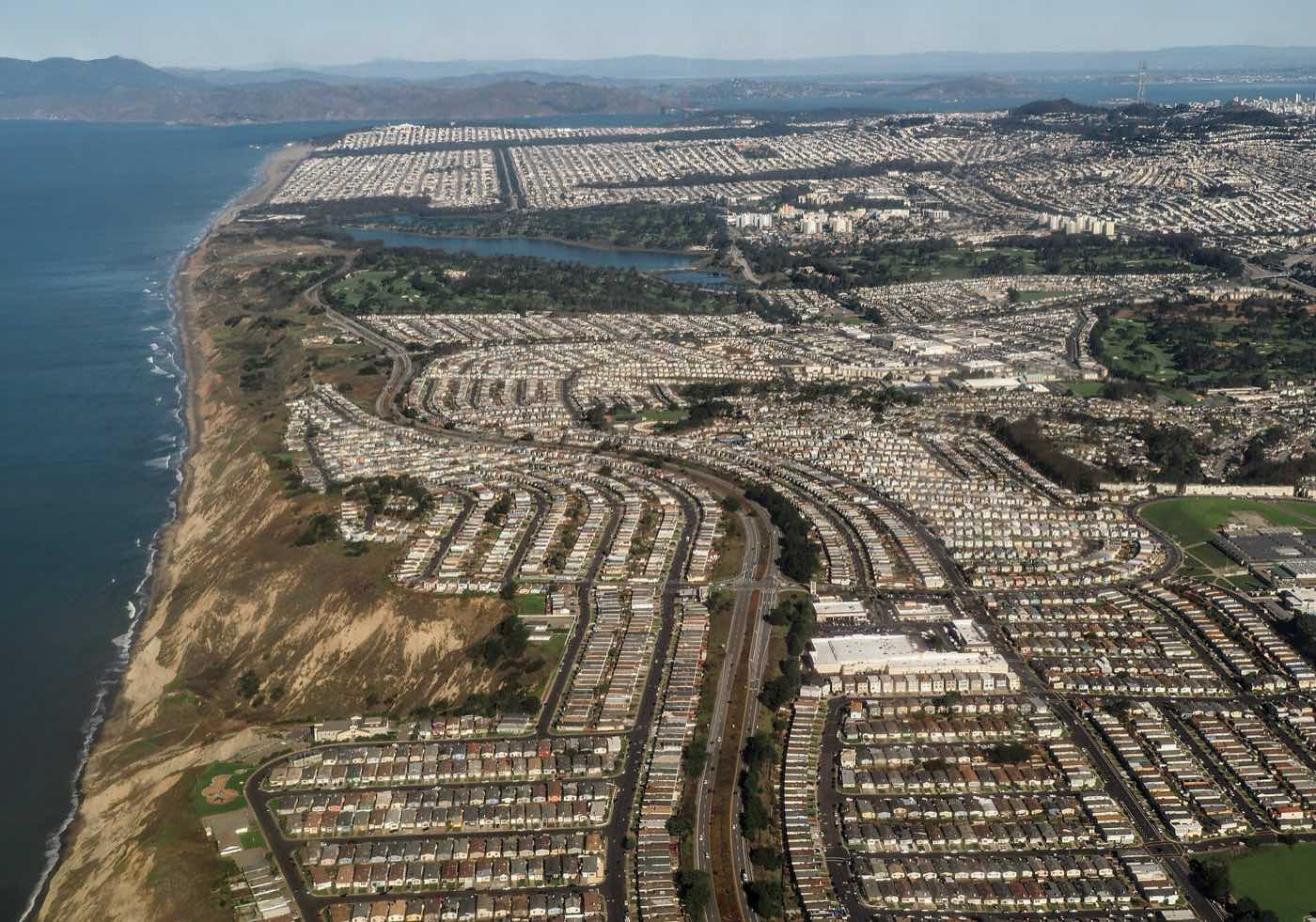
Come off the BART train at the end of the line and the fog is usually waiting. It rolls in off the Pacific and settles over the curving rows of pastel houses, the ones a folk singer once mocked as little boxes made of ticky-tacky. Walk into the food court at Serramonte and the air smells of garlic rice and fried chicken, and the talk slides between Tagalog, Cebuano, and Ilocano. The Filipinos in Daly City built a homeland here on a foggy ridge seven miles south of downtown San Francisco.
They turned a postwar tract suburb into one of the largest Filipino settlements anywhere outside the Philippines, a place that Filipinos across the United States simply call the Pinoy Capital. They did it one petitioned relative at a time.
Daly City: The Place
Daly City sits right against San Francisco’s southern border, a compact seven and a half square miles of hills that catch the marine fog rolling east off the ocean. Residents call themselves people of the fog belt, and on a July afternoon the temperature rarely climbs past the low sixties while the rest of the Bay bakes. The Daly City BART station opened on September 11, 1972, putting the whole transit system within reach without a transfer. Most of the city is covered in the boxy tract homes that developer Henry Doelger threw up across the hills in the late 1940s and 1950s, the famous rows that all look nearly the same from the air.
How Daly City Became Filipino
Before the Filipinos
The city is named for John Donald Daly, a dairyman who arrived in the Bay Area in 1853 and bought up land at the top of the hill that still bears the name Top of the Hill. When the 1906 earthquake leveled San Francisco, refugees streamed south onto the ranches below the ridge, and Daly handed out milk to families sleeping in the open. He carved his land into lots, and the town incorporated on March 22, 1911, by a margin of just two votes.
The suburb that drew the Filipinos came later, after the war. Henry Doelger laid out Westlake in the late 1940s, a planned district of nearly identical homes and a shopping center, and the brothers Carl and Fred Gellert built the Serramonte subdivision nearby. In 1962, the folk singer Malvina Reynolds drove past these hills and wrote “Little Boxes,” a tidy little song that turned the place into a national punchline for suburban sameness.
What the song left out was the redlining. The Westlake homes were sold to white buyers only, locked up by racial covenants that kept Filipinos and other nonwhite families out. That detail matters, because it shaped exactly where the first Filipino homeowners could land.
The Filipinos Arrive
The connection to this fog-bound peninsula ran back decades before the suburbs. From the early 1900s, young Filipino men had crossed the Pacific as farm laborers, and many drifted into San Francisco’s Manilatown along Kearny Street, the bachelor world of the elders later generations would honor as the manong generation, the same generation that built Historic Filipinotown in Los Angeles. Some found work just south, at the Golden Gate Nursery along Hillside Boulevard opposite the Colma cemeteries, cutting flowers for the Bay Area trade. Those nursery families were among the first Filipinos to buy houses in Daly City.
Because the Westlake covenants shut them out, Filipino families bought instead on the east side of Junipero Serra Boulevard beginning in the 1950s. The Fair Housing Act of 1968 finally pried the rest of the suburb open. By then the houses were affordable, the city was minutes from San Francisco jobs, and word was spreading.
The real flood came from a single law. The Immigration and Nationality Act of 1965 abolished the old national-origin quotas and let immigrants in on the basis of family reunification and needed occupations. The Philippines became the largest supplier of nurses to the United States, sending tens of thousands between the late 1960s and the early 1990s. Filipino men who had served as stewards in the U.S. Navy, long the only rating open to them, brought families to the bases ringing the Bay.
Then the chain pulled tight. A nurse or a Navy wife who became a citizen could petition for a sibling, a parent, a grown child, and each new arrival could petition again. Daly City filled household by household through these family petitions, relatives sponsoring relatives until whole branches of a clan lived within a few blocks. Benito Vergara, who chronicled all this in his 2009 book “Pinoy Capital,” found that when he asked people why they came, the answer was almost always the same: family was already here.
Daly City at Its Peak
By the 1990 census, Filipinos made up 27 percent of the city. The number kept climbing, and by 2010 fully 40.7 percent of Daly City residents were of Filipino descent, the highest concentration of any midsized city in North America. The shorthand stuck: the Pinoy Capital, the place where, as University of San Francisco scholar James Zarsadiaz put it, almost every Filipino in the country knows somebody who lives there.
The community moved from kitchens into city hall. Michael Guingona won a seat on the Daly City Council in 1993, the first Filipino American to do so, and in 1995 his colleagues made him mayor at the age of 33. Watching over a generation of candidates was Alice Peña Bulos, a former sociology professor from the University of Santo Tomas who had settled in the area in 1972 and become known across California as the Godmother of Filipino American politics.
Daily life grew its own institutions. Serramonte Center became the unofficial capitol of the new Filipinotown, its food court a place to read the Philippine News and catch up on gossip. The Filipino Channel, the cable lifeline beaming news and teleseryes from Manila into living rooms, set up shop in Daly City, as did Filipinas magazine. The filmmaker Patricio Ginelsa grew up here and shot his cult comedies “Lumpia” and “Lumpia with a Vengeance” on local streets and at Jefferson High School. The way a community plants itself, builds its churches and shops, then sends its children into local office echoes what happened a few miles north among the Chinese in San Francisco’s Chinatown and the Japanese in Japantown.
The Change
The change crept in through rent. California’s Costa-Hawkins Act of 1995 stripped rent control from single-family homes and newer buildings, and over the following decades Daly City rents climbed toward San Francisco levels. By the 2020s a two-bedroom apartment ran around $3,100 a month, and well over half the city’s renters spent more than a third of their income on housing.
The Filipino share began to slip, from that 2010 peak of 40.7 percent down to roughly a third by the 2020 census. Younger families priced out of the fog belt started looking inland, to cheaper towns up the freeway. The Pinoy Capital was not emptying, but it was no longer filling the way it had for fifty years.
The Landmarks of Filipino Daly City
Serramonte Center, 3 Serramonte Center. Built on the Gellert brothers’ postwar subdivision, this mall became the gravitational center of Filipino Daly City, the place people meant when they said they were going to the food court. In 1998 the fast-food giant Jollibee chose a storefront here, at 84 Serramonte Center, for its very first restaurant in the United States, betting correctly that the densest Filipino population outside Manila would line up for Chickenjoy. The line went around the building.
Our Lady of Perpetual Help, 60 Wellington Avenue. Perched on Top of the Hill, this parish has anchored Catholic life in the older part of town for generations and runs one of the city’s two Catholic grade schools. For Filipino families raised on Sunday Mass and the December dawn novena of Simbang Gabi, the church became a fixed point, a place to baptize the American-born children and bury the elders who made the crossing. Its counterpart, Our Lady of Mercy, serves the Westlake side of the city.
St. Francis Square, 1420 Southgate Avenue. This shopping plaza turned into a Filipino commercial strip of delis, bakeries, and video shops, the kind of place where you could buy pandesal and a balikbayan box in the same afternoon. When the Pacific Supermarket that long anchored it closed in 2021, the corner felt the loss. Then in July 2025 the Filipino grocery chain Seafood City opened its first Daly City store in that very space, alongside a Goldilocks and a row of Filipino tenants, and the plaza came back to life.
Golden Gate Nursery, Hillside Boulevard. Long before the malls, this flower-growing operation faced the Colma cemeteries and employed some of the earliest Filipino families on the peninsula. The wages from cutting flowers helped those families buy the first Filipino-owned houses in Daly City, making the nursery a quiet ancestor of everything that followed.
The International Hotel, Kearny Street, San Francisco. This one is a ghost, and it stood just over the line in the city, not in Daly City at all, yet no account of these families is complete without it. On August 4, 1977, sheriff’s deputies and riot police dragged elderly Filipino and Chinese tenants from the I-Hotel in the last block of Manilatown, ending a nine-year fight against eviction. The manongs scattered, some south toward Daly City, and a generation of young Filipino Americans found their political voice on that sidewalk.
Alice Peña Bulos Memorial Highway, State Route 35. In 2020 California named a stretch of Skyline Boulevard through Daly City for the activist who had mentored a generation of Filipino American officeholders. Bulos died in 2016 at the age of 86, and the green sign on the ridge is now one of the few public monuments in the state to a Filipina civil-rights leader.
Daly City Hall, 333 90th Street. Since 2014, when community organizer Perla Ibarrientos started the tradition, the Philippine flag has been raised here every June for Philippine Independence Day. Each October the city throws Kasayahan sa Daly City, billed as its largest community festival of the year, a public stamp on what everyone already knew.
Where the Daly City Filipinos Came From
The oldest roots reach back to the rice country and coast of the northern Philippines and the central islands. The earliest laborers came largely from the Ilocos region of northern Luzon, dry and crowded land that pushed its sons abroad, and from Cebu and Panay in the Visayas. You can still hear it in the city: at Serramonte the languages around you are as likely to be Ilocano or Cebuano as Tagalog.
The later waves, the ones that filled the tract houses after 1965, drew more heavily from Manila and the surrounding provinces of central Luzon, the educated nurses and teachers and clerks who qualified under the new immigration rules. Alice Bulos came from Nueva Ecija in that rice belt; the mother of later mayor Juslyn Manalo arrived in 1973 as a schoolteacher. Once a household took root on a Daly City block, the petitions carried over relatives from the same towns, so a single province could end up clustered along a single street.
Daly City Today
Daly City is still the Pinoy Capital, just an older and more expensive version of it. Roughly a third of the residents remain Filipino, the highest share of any city its size in the country, and the institutions hold: the parishes fill on Sunday, the new Seafood City hums, the flag still goes up at city hall every June. The first wave is aging now, the nurses and Navy families who arrived in the seventies and eighties moving into their seventies and eighties themselves.
Their children and grandchildren are American-born, raised on the Filipino Channel and the December novenas, fluent in the food but not always the language. Some have left for cheaper inland suburbs and drive back on weekends to buy groceries and see their parents. The displacement is real, and rent is the reason, but the gravity of fifty years does not let go quickly.
The story did not end with the founding generation. It is being handed, the way it was always handed, from the people who crossed the ocean to the ones who grew up in the fog. If your own family’s road ran through this ridge above the Pacific, that handoff is part of your inheritance too, and it is still being written.
Frequently Asked Questions
Why did Filipinos settle in Daly City?
Filipinos settled in Daly City because its postwar tract houses were affordable and just minutes from jobs in San Francisco, and because the 1968 Fair Housing Act finally opened the suburb to nonwhite buyers. The 1965 Immigration Act then let earlier arrivals petition for relatives, and the Filipinos in Daly City grew block by block through that family chain. By the time anyone counted, it was the densest Filipino settlement in the country.
Is Daly City still Filipino today?
Yes. Roughly a third of Daly City’s residents are still of Filipino descent, which remains the highest concentration of any midsized city in North America. Rising rents have pushed some younger families inland since the 2010 peak of about 40 percent, but the churches, festivals, and Filipino businesses are very much alive.
What are the most famous Filipino landmarks in Daly City?
Serramonte Center is the best known, home to the first Jollibee in the United States, which opened there in 1998. Other anchors include the St. Francis Square plaza, where Seafood City opened a Filipino grocery in 2025, and the Top of the Hill parish of Our Lady of Perpetual Help. Skyline Boulevard through the city is now signed as the Alice Peña Bulos Memorial Highway.
Where in the Philippines did the Daly City Filipinos come from?
The earliest immigrants came mainly from the Ilocos region of northern Luzon and from Cebu and Panay in the Visayas, which is why Ilocano and Cebuano are still widely spoken. Later waves after 1965 drew more from Manila and central Luzon, including many nurses and teachers. Family petitions often clustered people from the same hometowns onto the same streets.
When did Filipinos first arrive in Daly City?
Filipino families began buying homes in Daly City in the 1950s, mostly east of Junipero Serra Boulevard, since racial covenants barred them from the Westlake tract. The big growth followed the 1965 Immigration Act and the 1968 Fair Housing Act, and the Filipinos in Daly City became the dominant community through the 1970s and 1980s. The roots stretch back further to farm laborers and flower-nursery workers in the early twentieth century.
If your family’s story passed through Daly City, through a Navy posting or a nursing contract or a petition signed by a sister who got there first, the fog and the little boxes are part of where you come from.