
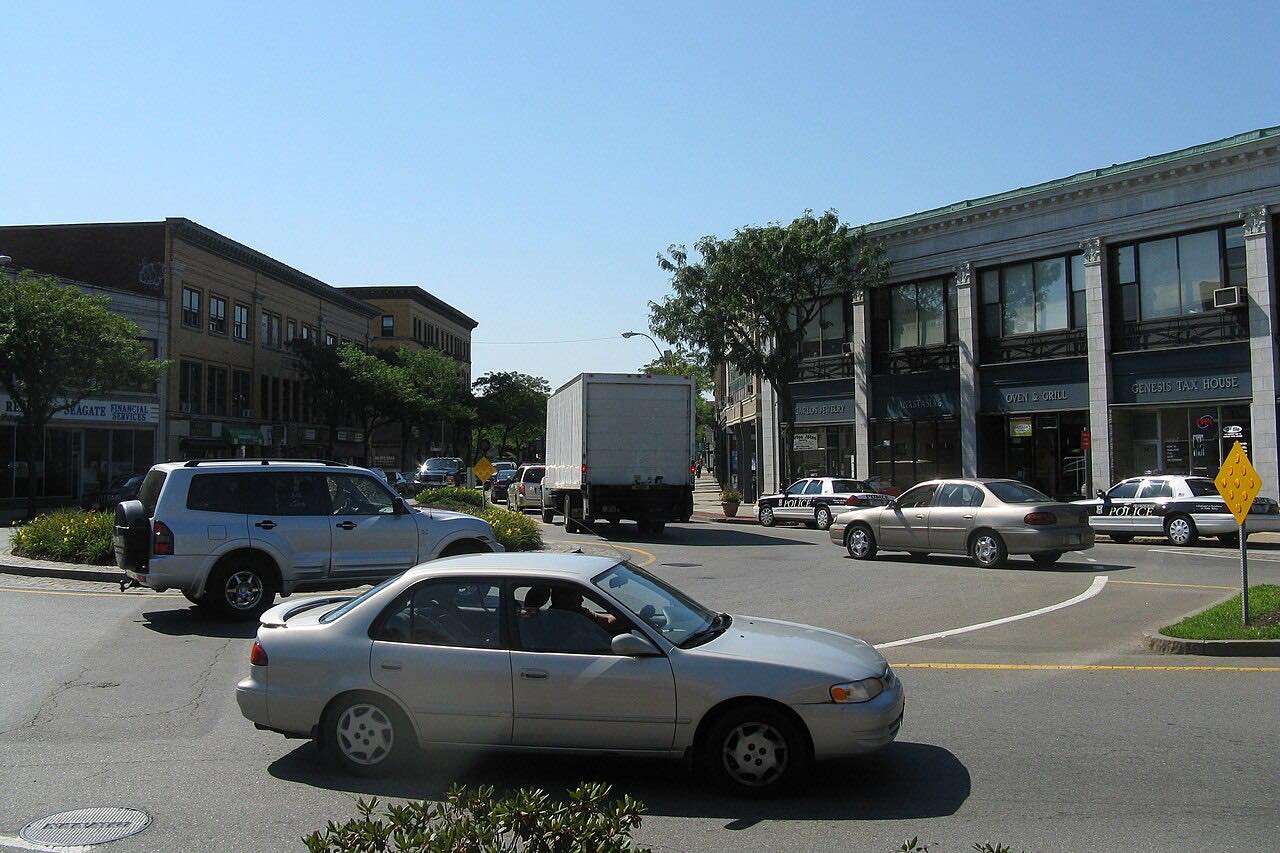
The smell hits you first on Concord Street: warm pão de queijo from the bakery cases, espresso pulled strong and short, grilled picanha turning on spits behind glass. Storefront signs read in Portuguese. The cashier counts change in two languages without thinking about it. A generation ago these same blocks had boarded windows and “for lease” signs nobody answered. Then the Brazilians in Framingham arrived, and the dead center of a struggling Massachusetts mill town learned to live again.
What happened here is one of the most precisely documented migrations in modern America. Not Brazilians in general, but people from one specific city, Governador Valadares in the state of Minas Gerais, who came to one specific place and stayed for decades. The story runs from a wartime mineral deal to the housecleaning vans that still leave South Framingham at dawn.
Framingham: The Place
Framingham sits in the MetroWest region of Greater Boston, roughly halfway between Boston and Worcester, threaded by the Massachusetts Turnpike and Route 9. The MBTA commuter rail runs from its downtown to South Station and Back Bay in well under an hour, which made the town a magnet for people who needed jobs in the city but rent they could afford. South Framingham, the old commercial and industrial core around the rail line, holds dense triple-deckers and brick blocks built for a workforce that once filled its factories. After three failed attempts across decades, Framingham finally voted to leave town-meeting government behind and became a city on January 1, 2018.
How Framingham Became Brazilian
Before the Brazilians
For most of the twentieth century, Framingham ran on factories. The Dennison Manufacturing Company, which made paper goods, tags, and crepe, moved to Framingham in 1897 and at its height employed around 3,000 people, close to a third of the town. A General Motors assembly plant added thousands more jobs through the postwar boom.
Then it unraveled. The GM plant closed in 1989. Dennison, by then merged into Avery, wound down its Framingham operations around 1990. As retail and entertainment drifted north toward the “Golden Mile” strip on Route 9, the old downtown around Concord Street and Hollis Street emptied out.
By the early 1980s the central business district was, by every account, blighted. Store windows were papered over. The Brazilians who would soon transform it walked into a place the rest of the region had written off.
The Brazilians Arrive
The thread back to Brazil starts in an unlikely place: World War II. Boston-area engineers and technicians were sent to Minas Gerais to oversee the mining of sheet mica, used to insulate radio tubes and detonators, around Governador Valadares. When those Americans went home, some brought young Valadarense women north to work as domestic help, and a quiet social network took root between the two places.
That network lay mostly dormant until Brazil’s economy buckled. Hyperinflation and failed stabilization plans through the 1980s gutted the middle and working classes, and Valadarenses who knew someone in Massachusetts began to follow the path their grandmothers had cut. The first real wave reached Framingham in the early-to-mid 1980s, and it kept building into the early 1990s.
Word traveled person to person, family to family. A cousin sent for a brother. A neighbor vouched for a neighbor. Because so many came after the 1986 amnesty deadline had passed, a large share arrived and lived without papers, a fact that shadows the community to this day.
Framingham at Its Peak
The classic first job was housecleaning. Women built routes of suburban homes, then taught arriving relatives the work and eventually the business, until cleaning a few houses became owning a company with a fleet of vans. Men gravitated to landscaping, painting, and construction along the same family lines, hiring the newest arrivals first.
The money those workers earned reshaped two cities at once. So much of it flowed home as remittances that people back in Minas Gerais nicknamed their city “Valadolares,” for the American dollars that built its houses and filled its shops.
In Framingham, the dollars stayed downtown. In 1997, siblings Elias and Tania Fernandes opened Padaria Brasil, billed as the first Brazilian bakery of its kind in all of MetroWest, inspired by the breads their mother Fumia baked at home. Padarias, churrascarias, money-transfer agencies, and Portuguese-language storefronts filled the vacancies on Concord and Hollis Streets one lease at a time. The community that revived these streets also reads, in its own way, like the Portuguese who rebuilt the Ironbound in Newark and the Cape Verdeans who put down roots in Brockton: immigrant labor turning a neglected downtown into a regional destination.
Faith and institutions followed the storefronts. Saint Tarcisius Parish on Waverly Street began offering Portuguese-language Mass, becoming a spiritual anchor for thousands. The relationship between the two cities was made official in 2003, when Framingham and Governador Valadares signed a sister-city agreement. By 2010, Framingham’s Brazilian population had surpassed Boston’s, and one census tract in the south of the city was more than half Brazilian, the densest concentration of Brazilians anywhere outside Brazil itself.
The Change
The first hard contraction came with the 2008 financial crisis. As the American economy stalled and Brazil’s improved, many families weighed the math and went home, thinning the community for the first time in a generation. Migration later resumed, but the era of uninterrupted growth was over.
The institutions matured even as the population fluctuated. In 2012, Father Volmar Scaravelli founded the Brazilian American Center, known as BRACE, in the former Saint Tarcisius school building on Route 135, to help immigrants of every nationality with housing, health insurance, the schools, and the long road to citizenship. A second generation grew up bilingual, American-born, voting and opening businesses of their own.
The newest pressure is the sharpest. Through 2025 and into 2026, intensified federal immigration enforcement has frightened the community badly. Downtown businesses have reported revenue down roughly 40 percent, the school system logged an unprecedented enrollment drop, and Boston’s Brazilian consulate has issued passports at triple its former pace as families prepare, quietly, to leave.
Landmarks of the Brazilians in Framingham
Padaria Brasil, 165 Concord Street. Opened in 1997 by siblings Elias and Tania Fernandes and modeled on their mother Fumia’s home baking, it was the first Brazilian bakery of its kind in MetroWest and became the cornerstone of Brazilian business in the region. It sits directly across from City Hall, and in 2019 it changed hands to a new Brazilian owner, Marcelo Soares, who kept the name and the recipes.
Saint Tarcisius Parish, 562 Waverly Street. This is the spiritual heart of Valadarense Framingham, where Portuguese-language Mass draws families who built their American lives a few blocks away. Its former school building became the home of the community’s largest support organization, tying worship and welfare into one campus.
The Brazilian American Center (BRACE), Waverly Street. Founded in 2012 by Father Volmar Scaravelli, BRACE grew out of the parish into the place people turn to for help with citizenship applications, health coverage, and navigating the schools. In recent years it has become a frontline counselor for families weighing whether to stay or go.
Concord Square and the Memorial Building. The stately civic Memorial Building anchors the square at the top of Concord Street, the spine of the downtown that Brazilian shops brought back from the dead. Walk the blocks below it and the storefronts tell the story: bakeries, restaurants, and remittance offices where empty windows used to be.
Party Flowers, 83 Concord Street. Owned by Nubia Gaseta, this flower and cake shop is one of the small Brazilian-run businesses that turned downtown survival into downtown advocacy, helping organize fellow owners to push the city on parking and investment. It is the kind of storefront that quietly proves the neighborhood is more than restaurants.
Fresscafe, 82 Concord Street. A Brazilian coffee shop and restaurant on the same stretch, it represents the everyday social life of the community: the place to read the news from home over a cafezinho, do business, and be among people who came the same long way you did.
Where the Framingham Brazilians Came From
Overwhelmingly, they came from Governador Valadares, a city of a few hundred thousand in the eastern reaches of Minas Gerais, and from the smaller towns of its surrounding valley. The link is so tight that Valadares is sometimes called the most American city in Brazil, its skyline shaped by houses built with money earned scrubbing floors and pouring concrete in MetroWest. The WWII mica trade lit the fuse; chain migration, neighbor following neighbor for forty years, did the rest.
Not everyone traced back to Valadares. Brazilians from elsewhere in Minas Gerais, and from states like Espirito Santo, Goias, and beyond, joined the flow once Framingham was established as a place where Portuguese was spoken, work could be found, and a newcomer would not be alone. But the gravitational center never moved. Just as Boston’s North End drew specific towns from southern Italy, the way the Italians of the North End mapped old-country villages onto new-world streets, Framingham mapped one Brazilian valley onto a corner of Massachusetts.
Framingham Today
Walk Concord Street today and the Brazilian presence is unmistakable and still the largest of its kind in the state, even as it bends under strain. The bakeries open early, the churrascarias fill on weekends, and Portuguese remains the second language of the south side. But a current of fear runs beneath the ordinary days, and the people who run these shops talk openly about empty tables and quiet streets.
The numbers are real, not rumor. Enrollment in the public schools has fallen sharply, downtown revenue is down by close to half by the business district’s own count, and passports are being renewed at a pace that signals departures rather than vacations. A community that knows the rhythm of arriving and leaving, having lived through it after 2008, recognizes the signs.
And yet the roots are forty years deep. The second generation is American-born and is not going anywhere. The bakeries and the parish and BRACE are institutions now, not improvisations. Whatever the next census records, the city Framingham became cannot be unmade. The story of the Brazilians in Framingham is not closing; it is turning, as it always has, to a page nobody has read yet.
Frequently Asked Questions
Why did Brazilians settle in Framingham?
The Brazilians in Framingham came largely through a chain migration from Governador Valadares in Minas Gerais, a link first forged when Boston-area companies mined mica there during World War II. Framingham offered cheap rent in a struggling downtown, commuter-rail access to Boston jobs, and, crucially, relatives and neighbors who had already settled there. Each arrival made the next one easier.
Is Framingham still Brazilian today?
Yes. Framingham still has the largest Brazilian population in Massachusetts and one of the densest concentrations of Brazilians anywhere outside Brazil. That said, intensified immigration enforcement in 2025 and 2026 has driven a wave of departures, with downtown businesses reporting revenue down around 40 percent and a sharp drop in school enrollment.
What are the most famous Brazilian landmarks and businesses in Framingham?
The best known is Padaria Brasil at 165 Concord Street, opened in 1997 and considered the first Brazilian bakery of its kind in MetroWest. Saint Tarcisius Parish on Waverly Street, with its Portuguese-language Mass, and the Brazilian American Center (BRACE) founded there in 2012, are the community’s anchoring institutions.
Where in Brazil did the Framingham Brazilians come from?
Most came from Governador Valadares, a city in eastern Minas Gerais, and the towns of its surrounding valley. The two cities are so intertwined that they signed a sister-city agreement in 2003, and Valadares earned the nickname “Valadolares” for the American dollars sent home as remittances.
When did Brazilians first arrive in Framingham?
A handful of Valadarense migrants reached the Boston area as early as the 1960s and 1970s, but the first real wave of Brazilians in Framingham came in the early-to-mid 1980s, driven by hyperinflation in Brazil. Migration peaked through the early 1990s, and by 2010 Framingham’s Brazilian population had surpassed Boston’s.
If your family’s story passed through Framingham, through a padaria on Concord Street or a cleaning route that left before dawn or a long flight from the valley of Governador Valadares, that journey deserves to be remembered with the same care it took to make.