
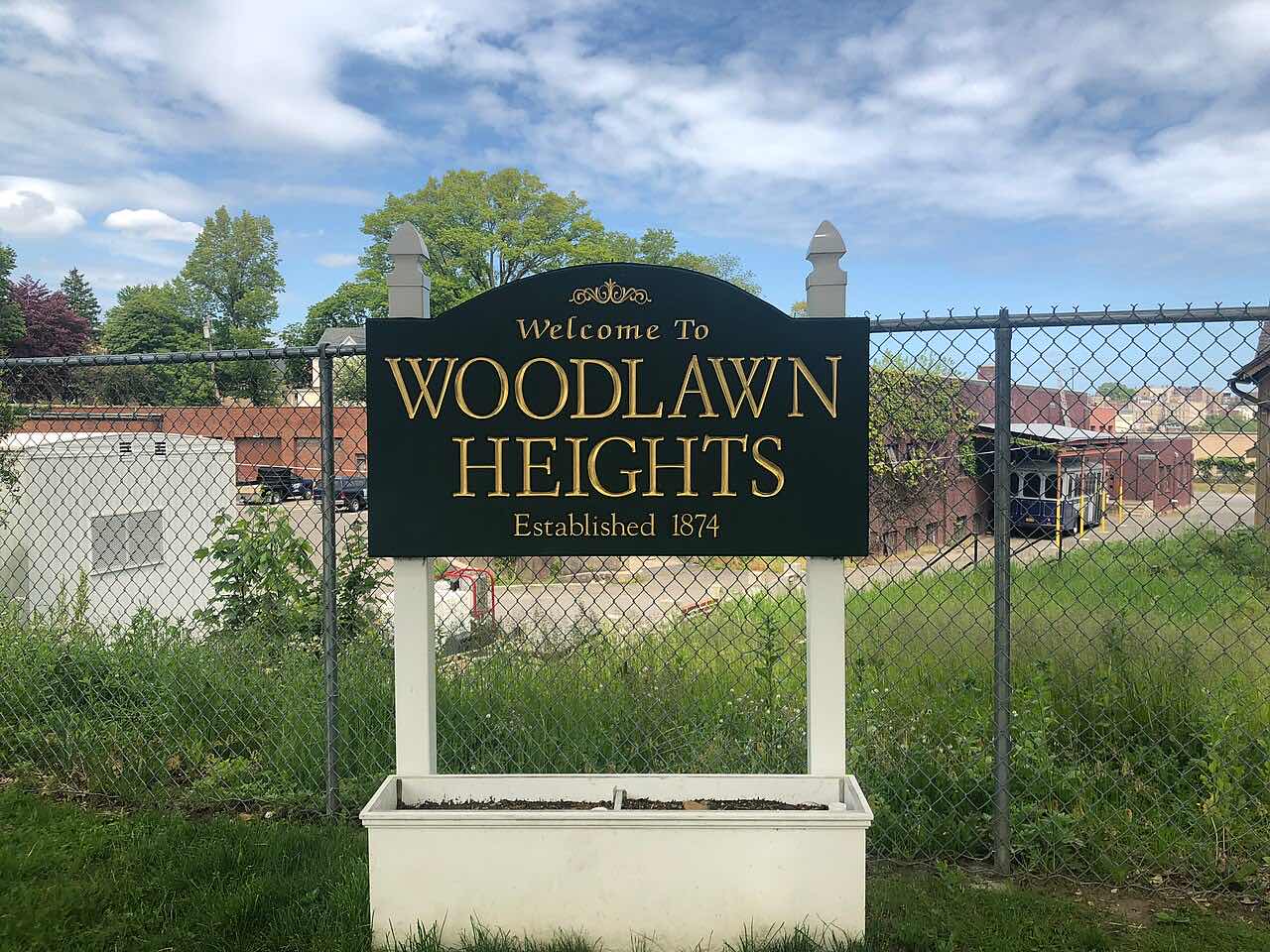
They call it Little Ireland. Not officially: the street signs say Katonah Avenue and the map says Woodlawn Heights. But walk those eight blocks on a Saturday morning and you will hear Galway and Mayo in the air, find Tayto crisps and black pudding on the shop shelves, and pass a union hall where the men who dug New York’s water tunnels still hold their meetings. Roughly half the neighborhood claims Irish blood. No other corner of New York City can say that.
Woodlawn: The Place
Woodlawn sits at the very top of the Bronx, hemmed in by green on three sides: Van Cortlandt Park to the west, the Bronx River to the east, and the rolling acres of Woodlawn Cemetery to the south. McLean Avenue marks the northern edge, which is also the city line. Cross it and you are in Yonkers, though the accents do not change.
The housing is modest and well kept: brick and frame one- and two-family homes with porches and small yards, most built in the decades after the elevated subway reached the area in 1917. No subway enters the neighborhood itself. The 4 train terminates beside the cemetery, Metro-North’s Harlem Line stops at Woodlawn station, and the Bx16 and Bx34 buses do the rest. It is a quiet, working-class pocket at the end of the line.
How Woodlawn Became Irish
Before the Irish
In the eighteenth century this corner of the Bronx was called Washingtonville. George Washington built a redoubt and stored munitions on land that now lies inside the southeast corner of Woodlawn Cemetery. For decades afterward it was farmland, held by families like the Bussings and the Valentines.
The cemetery came first. Incorporated in December 1863 by New York businessmen who needed a burial ground outside the crowded city, Woodlawn Cemetery bought more than 300 acres of farmland beside the Harlem Railroad, thirty-five minutes from Grand Central. The first burial took place in January 1865.
In 1873, developer George Opdyke laid out a village on part of the old Valentine farm and named it after the cemetery. The area was annexed to New York City in 1874. Through the early twentieth century it was a largely German neighborhood, with Irish and Italian laborers settling in alongside.
The Irish Arrive
Irish labor in this part of the Bronx is older than the neighborhood. In the early 1840s, Irish immigrants dug the Old Croton Aqueduct, the engineering marvel that carried fresh water down through the Bronx to Manhattan. When the cemetery and the railroad came, Irish hands cut the stone, laid the track, and dug the graves. Many of those laborers stayed.
The community got its anchor in 1910, when the Archdiocese established St. Barnabas parish under its first pastor, Father Michael Reilly. The church went up the following year, sitting almost exactly on the line separating the Bronx from Yonkers, a fitting address for a parish that would always serve both sides of the border. The elementary school opened in 1914 and the high school followed in 1928.
Woodlawn also became the home of the sandhogs, the tunnel workers of Local 147, whose union hall stands on Katonah Avenue. These were the men who dug the city’s subways, sewers, and water tunnels, working in pressurized caissons where a wrong move meant the bends or worse. In 1916 a sandhog named Marshall Mabey was blown clean through the bed of the East River and survived, shot to the surface in a geyser of mud and water. He was back at work within weeks. His workmates were not so lucky, and a memorial near Van Cortlandt Park lists 23 sandhogs killed between 1970 and 2000 on Water Tunnel No. 3 alone.
Woodlawn at Its Peak
Through the 1960s and 1970s, Irish families moved north to Woodlawn from older Bronx strongholds like Highbridge, Kingsbridge, and Norwood as those neighborhoods changed. The Germans gradually gave way, and Katonah Avenue filled with Irish butchers, bakeries, and bars.
Then came the wave that made Woodlawn famous. Ireland’s economy collapsed in the 1980s, and by 1987 some 30,000 people a year were leaving the country. Thousands of them, young and often undocumented, landed in New York and split between two neighborhoods: Woodside in Queens and Woodlawn in the Bronx. They worked off the books on building sites and in bars, nannied and waitressed, and packed the avenue’s pubs at the weekend.
The community organized. In 1988 the Emerald Isle Immigration Center, born out of the Irish Immigration Reform Movement, opened its Bronx office at 4275 Katonah Avenue to help the new arrivals with visas, green cards, bank accounts, and driver’s licenses. The campaign that followed helped win the Donnelly and Morrison visas, which gave tens of thousands of Irish a legal path to stay.
By the mid-1990s the neighborhood had a second institution. A drop-in center founded by Sister Edna McNicholas and Father Tom Flynn, first called Tir na nOg, moved in 1996 to 990 McLean Avenue and became the Aisling Irish Community Center. McLean Avenue itself earned a nickname: the Emerald Mile.
The Change
The Celtic Tiger ended mass emigration in the late 1990s. For the first time in modern history, young Irish people could stay home, and the pipeline that had fed Woodlawn for a decade slowed to a trickle. The 2008 crash sent one more brief wave across the Atlantic, but tighter American visa rules meant it never matched the eighties.
The census tells the story plainly. In 2000, around 60 percent of Woodlawn’s residents claimed Irish ancestry. Recent estimates put the figure closer to 45 percent of roughly 7,500 people. Homeowners who bought in the seventies are aging, property taxes are climbing, and the children of the New Irish have scattered to Yonkers, Westchester, and beyond.
But unlike Inwood or Highbridge, where the Irish presence faded to memory, Woodlawn’s infrastructure never disappeared. The parish, the immigration center, the GAA clubs, and the pubs all still stand, and they still have a community to serve.
The Landmarks of Irish Woodlawn
St. Barnabas Church, East 241st Street. Founded in 1910 and built directly on the city line, St. Barnabas remains one of the largest parishes in the Archdiocese of New York. It has baptized, schooled, married, and buried four generations of Woodlawn Irish, and it still offers Irish language classes and outreach for new immigrants.
Katonah Avenue. The eight-block commercial spine of the neighborhood, where the pubs run shoulder to shoulder: the Rambling House with its live music sessions, Behan’s, Keane’s, the Heritage. Between them sit Irish butchers and mini markets selling rashers, sausages, and the newspapers from home.
Emerald Isle Immigration Center, 4275 Katonah Avenue. Opened in 1988 with a 30,000 dollar grant won by the Irish Immigration Reform Movement, it guided thousands of undocumented Irish through the Donnelly and Morrison visa programs and still handles green cards and citizenship cases today.
The Sandhogs’ Hall, Katonah Avenue. Headquarters of Local 147, the Compressed Air and Free Air Workers, the union of the men who dug the Brooklyn Bridge caissons, the subways, and the 60-mile Water Tunnel No. 3, begun in 1970 and worked by fathers and sons from this neighborhood.
Aisling Irish Community Center, 990 McLean Avenue. The cultural heart of the Emerald Mile since 1996, offering everything from set dancing and Irish classes to counseling for the newly arrived. The community bought the building outright in 2018 and reopened it, fully renovated, in 2022.
Gaelic Park, West 240th Street and Broadway. Bought by the New York GAA in 1926 and run for decades by the legendary Kerryman John “Kerry” O’Donnell, it sits across Van Cortlandt Park from Woodlawn and remains the home of Gaelic football and hurling in New York. For generations of Woodlawn families, Sunday meant Mass and then Gaelic Park.
Woodlawn Cemetery. The 1863 burial ground that gave the neighborhood its name and its first Irish jobs. Its 320,000 graves include Duke Ellington, Miles Davis, Herman Melville, and Celia Cruz, resting a short walk from the avenue.
Where the Woodlawn Irish Came From
The Bronx Irish have always drawn heavily from the west of Ireland. The farms of Galway, Mayo, Sligo, Leitrim, Roscommon, Donegal, Kerry, and Cork sent their sons and daughters along well-worn chains: a cousin’s couch on East 238th Street, a start on a building site, a shift behind a bar on the avenue.
The 1980s generation came from everywhere, Dublin included, but the western accents still dominate the avenue. Ask around any pub on Katonah and you will find Mayo and Galway within two stools.
Woodlawn Today
Woodlawn in 2026 is still the most Irish neighborhood in New York, and it knows it. The J-1 students arrive every summer. The Emerald Isle Immigration Center still takes appointments. The St. Patrick’s season still fills McLean Avenue with pipe bands, and lately the neighborhood has gone viral, as a new generation of New Yorkers discovers an Irish main street twenty minutes from Manhattan.
It is also changing, honestly and visibly. Puerto Rican, Italian, and newer immigrant families share the blocks now. The Kitchen on Katonah Avenue serves curry chips alongside burritos, a menu that could only exist here. Fewer new Irish arrive than in the eighties, and the ones who do find Yonkers rents friendlier than Bronx ones.
But Woodlawn never became a museum. It is still the first phone call for an Irish arrival with a duffel bag and a number scribbled on a boarding pass. The chain that started with aqueduct diggers in the 1840s has never actually broken. It just keeps adding links.
Frequently Asked Questions
Why did the Irish settle in Woodlawn, Bronx?
Irish laborers first came to the area in the 1840s to dig the Old Croton Aqueduct, and later to build Woodlawn Cemetery and the Harlem Railroad. Affordable housing, steady union work, and the founding of St. Barnabas parish in 1910 turned the Irish in Woodlawn, Bronx into a permanent community, reinforced by chain migration from the west of Ireland.
Is Woodlawn still an Irish neighborhood today?
Yes. Around 45 percent of Woodlawn’s roughly 7,500 residents claim Irish ancestry, the highest concentration in New York City. It remains one of the few US neighborhoods where new Irish immigrants and J-1 students still arrive every year, though the community is smaller than at its 1980s peak.
What are the most famous Irish landmarks in Woodlawn?
St. Barnabas Church on East 241st Street, the pubs of Katonah Avenue including the Rambling House and Behan’s, the Emerald Isle Immigration Center at 4275 Katonah Avenue, the Aisling Irish Community Center at 990 McLean Avenue, and Gaelic Park, home of the New York GAA since 1926.
Where in Ireland did the Woodlawn Irish come from?
Mostly the western counties: Galway, Mayo, Sligo, Leitrim, Roscommon, Donegal, Kerry, and Cork. Chain migration brought relatives and neighbors from the same parishes across generations, while the 1980s wave drew young people from all over Ireland, including Dublin.
When did the Irish first arrive in Woodlawn?
Irish laborers worked in the area from the early 1840s, digging the Old Croton Aqueduct, and settled as the cemetery and railroad brought work in the 1860s and 1870s. The neighborhood became strongly Irish through the mid-twentieth century and peaked with the arrival of the New Irish in the 1980s.
If your family’s story passed through Woodlawn, or any of the places the Irish made home, Atlas of Home can trace that journey. From a townland in Mayo to a porch off Katonah Avenue, to wherever you are now.