
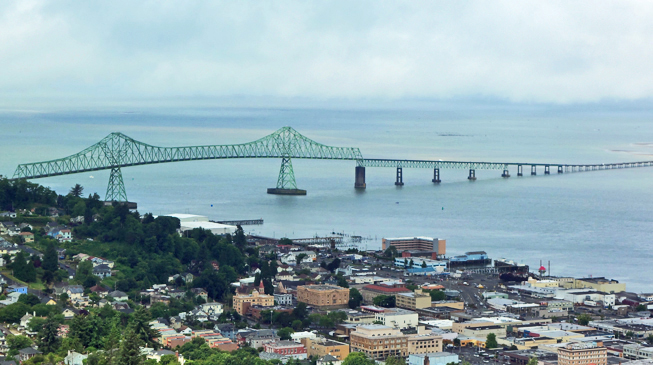
They called it Finn Town. Officially it was Uniontown, the west end of Astoria where the streets slope down toward the Columbia River bar. But from the 1880s into the 1930s, if you walked the planked sidewalks below Marine Drive you were inside a Finnish-speaking world. The salmon cannery whistle, the steam rising off a backyard sauna, the front page of Toveri on a kitchen table. At its peak, more than one in six Astorians was Finnish-born.
The Place
Astoria sits at the mouth of the Columbia, where the river meets the Pacific in a bar so violent it has wrecked more than two thousand ships. The town clings to a hillside on the Oregon side, with Washington across the water and the Astoria-Megler Bridge spanning four miles between them. Today the city has about ten thousand residents. Uniontown lies at the west end of the downtown grid, along the river, around West Marine Drive.
The hills above hold the Astoria Column. The riverfront still runs canneries, fishing boats, and a working port. The houses are mostly turn-of-the-century frame, packed close on narrow lots, the kind built fast for cannery workers and gillnetters.
How It Became Finnish
Before the Finns
Astoria was founded in 1811 by John Jacob Astor’s Pacific Fur Company, the first American settlement on the Pacific coast. By the 1870s it was a salmon town. The Columbia River chinook run was one of the richest fisheries on earth, and a string of canneries lined the south bank. The work was brutal, year-round, and constantly hungry for hands.
Before the Finns came in numbers, the canneries leaned heavily on Chinese labor inside the packing houses and on Scandinavian and Anglo fishermen on the river. Uniontown took its name from the short-lived Union Cannery that once stood at its west end.
The Finns Arrive
Finnish immigration to Astoria began as a trickle in the 1870s and became a flood after 1880. The pull was specific. Gillnet salmon fishing on the Columbia paid well, demanded the kind of seamanship Finnish coastal men already had, and ran on a season that let a fisherman take a logging or cannery job in winter. Word travelled back to Finland, and one cousin pulled the next across.
By 1900, Finns were the single largest foreign-born group in Astoria. By 1905, the Finnish population numbered 2,027, more than 18 percent of the town. The 1910 census recorded 9,599 people in Astoria, of whom roughly 35 percent identified as Scandinavian when you grouped Finns, Swedes, Norwegians, and Danes together.
Most of these new arrivals settled in Uniontown. They built the saunas in their back gardens before they finished their kitchens. They opened boarding houses, a Finnish meat market, a co-op store, and the social halls that did the real work of holding the community together.
Astoria at Its Peak
The community at peak was loud, organised, and politically distinct. Astoria’s Finns were not, on the whole, the quiet Lutheran farmers of the Midwest stereotype. Many had left Finland under Russian-imperial repression, carrying socialist and labor politics with them. They organised early and they organised hard.
The Finnish Socialist Club of Astoria was founded in November 1904. In December 1907 the community launched Toveri, “The Comrade,” a Finnish-language socialist newspaper printed by the Western Workmen’s Co-operative Publishing Company on Duane Street. By 1916, Toveri‘s circulation hit 4,000 copies, more than every other Astoria newspaper combined. A sister paper for women, Toveritar, “The Woman Comrade,” launched in 1911.
The Finnish Brotherhood, the United Finnish Kaleva Brothers and Sisters Astoria Lodge No. 2, had been founded in 1886. By 1912, Astoria was the headquarters of the Finnish Grand Lodge, which spanned 34 lodges from Wyoming to Alaska. Suomi Hall on West Marine Drive, built in 1893 by the Finnish Temperance Society, hosted the dances, the choir nights, the political meetings, and the Finnish school on Saturday mornings.
By 1920, Clatsop County held some 4,000 Finns, more than 2,500 of them in Astoria itself. The community had its own newspaper, its own halls, its own meat market, its own co-op, its own steam baths, its own gillnet fleet. You could be born, raised, married, employed, and buried in Astoria without speaking much English at all.
The 1922 Fire and What Followed
At about two in the morning on December 8, 1922, a fire broke out under a building on Commercial Street. Within hours it had consumed roughly thirty blocks of downtown Astoria, including most of the wooden cannery district. About 2,500 residents lost their homes. One person died.
The fire did not destroy Uniontown directly, but it gutted the commercial heart of the town. Many Finnish businesses on the downtown grid burned. The community rebuilt, in brick this time, but the fire marked the beginning of a slower change. Through the late 1920s and 1930s, immigration restrictions, the Depression, mechanised canneries, and the gradual ageing of the first generation began to thin the community out.
Toveri kept printing through the worst of it. The paper ran until 1931, when the Western Workmen’s Co-operative Publishing Company was wound up amid declining circulation and Communist Party USA consolidation. The Finnish Brotherhood bought Suomi Hall outright in 1929, paying off the mortgage in 1934, and the building became their permanent home.
The Landmarks
Suomi Hall, 244 West Marine Drive. Built in 1893 by the Finnish Temperance Society, bought by the Finnish Brotherhood in 1929, still standing and still active. The hall hosts Finlandia Day, midsummer celebrations, the Tarmo choir, and Friday-night dinners. It is the single most important Finnish building on the West Coast of the United States, and it survives because volunteers keep pulling it back from the edge of disrepair, fundraiser after fundraiser.
The site of the Western Workmen’s Co-operative Publishing Company. The press that printed Toveri and Toveritar stood on Duane Street in downtown Astoria. The building is gone, but for a quarter century this block was the loudest Finnish socialist voice on the Pacific coast.
Astoria Pioneer Cemetery, Niagara Avenue. Walk the old section and the Finnish surnames stack up. Many headstones carry inscriptions in Finnish. The cemetery was the community’s final shared address, where the gillnetters, the cannery women, and the socialist editors are buried together.
Saint Mary, Star of the Sea Catholic Church, 1465 Grand Avenue. Founded in 1881, primarily Irish in origin, the parish also drew Catholic Finns and Scandinavians who did not fit into the Lutheran or socialist halls. It is one of the oldest parishes on the north Oregon coast.
The Astoria Column, on Coxcomb Hill. Dedicated in 1926, four years after the fire, the column was meant to symbolise an Astoria that had survived. From the observation platform you can see the whole footprint of Uniontown, the Columbia bar, and the ships that built the cannery economy. It is not a Finnish landmark, but it watches over a Finnish town.
The Astoria Scandinavian Heritage Park grounds and festival site. The Astoria Scandinavian Midsummer Festival has been held since the late 1960s. The festival is the largest pan-Scandinavian celebration on the West Coast, with Finland, Sweden, Norway, Denmark, and Iceland each represented. For many fourth- and fifth-generation Finnish-Americans in Astoria, this is the weekend their heritage becomes visible again.
The Astoria-Megler Bridge. Opened in 1966, the bridge connects Astoria to the Washington side and to Naselle, Deep River, and Ilwaco. When Astoria itself thinned out, many Finnish-American families moved north across that water. The bridge is, in a small way, a map of the second Finnish migration: out of Uniontown, into the rural communities of Pacific County.
Where They Came From
The Finns who built Uniontown came mostly from the western coast of Finland, the Ostrobothnia region around the Gulf of Bothnia. Vaasa, Kokkola, Jakobstad, and the rural parishes between them sent the largest waves. A crop failure in 1867 had already pushed Ostrobothnian families across the sea, first to Norway and then onward to America. By the 1880s, Astoria was a known destination.
Smaller numbers came from Lapland in the far north and from Karelia in the east. Before 1917, all of them left a Finland that was a Grand Duchy of the Russian Empire, with no independent state, conscription into the tsar’s army hanging over young men, and political organising of any kind treated as a threat. That context explains a lot about the Astoria community. The socialist hall and the Lutheran church and the Brotherhood lodge were not contradictions. They were three answers to the same question of how to be Finnish in a country that did not yet exist.
Astoria Today
The Finnish-American population in Astoria today is small and largely third, fourth, or fifth generation. The language has mostly thinned out. The gillnet fleet that drew the first arrivals is a fraction of its old size. Most Finnish-surnamed families in the area now live across the bridge in Pacific County, Washington, in towns like Naselle, Deep River, and Ilwaco, where farmland was cheaper and the saunas could be bigger.
Suomi Hall still hosts dinners and dances on West Marine Drive. The Astoria Scandinavian Midsummer Festival still draws thousands every June, and the Finnish flag still flies alongside the four other Nordic flags. The Tarmo choir still sings.
Astoria itself is changing again. The downtown that burned in 1922 has been rebuilt twice. The canneries have given way to breweries, the riverfront to a tourist trolley, and Hollywood has used the town as a film location often enough that the local economy now leans on visitors as much as on fish. But walk west on Marine Drive past the trolley tracks, and the names on the cemetery stones, the hall on the corner, and the steam still rising from one or two backyard saunas in winter tell you the town is older than the brand on it.
Frequently Asked Questions
Why did Finns settle in Astoria, Oregon?
Finns came to Astoria for the salmon. Gillnet fishing on the Columbia River paid well, suited the seamanship Finnish coastal families already had, and ran on a season that fit alongside cannery and logging work. Once a few Ostrobothnian fishermen settled in the 1870s and 1880s, chain migration brought cousins, neighbours, and whole villages in their wake, and Uniontown became known back home as a Finnish town.
Is Uniontown still a Finnish neighbourhood?
Not in the way it was. The first-generation Finnish-speaking community is gone, and most Finnish-American families have spread out across Clatsop County or moved across the river to Pacific County, Washington. Uniontown still holds Suomi Hall, the Finnish section of the Pioneer Cemetery, and a quietly persistent Finnish-American identity, but it is no longer a Finnish-speaking enclave.
What are the most famous Finnish landmarks in Astoria?
Suomi Hall at 244 West Marine Drive, dating to 1893, is the central landmark. The Astoria Pioneer Cemetery holds a large Finnish section. The Astoria Scandinavian Midsummer Festival, running since the late 1960s, is the largest living expression of Finnish heritage in the town. The downtown site of the Western Workmen’s Co-operative Publishing Company, which printed Toveri and Toveritar, marks the era of Finnish socialist publishing.
Where in Finland did the Astoria Finns come from?
The great majority came from Ostrobothnia on the west coast of Finland, especially the regions around Vaasa, Kokkola, and Jakobstad. Smaller numbers came from Lapland and Karelia. Most arrived before Finnish independence in 1917, when Finland was still a Grand Duchy of the Russian Empire.
When did Finns first arrive in Astoria?
The first Finnish immigrants appeared in Astoria in the 1870s. The major wave came between 1880 and 1914, with Finnish numbers peaking in the first two decades of the twentieth century. By 1905, Finns were already more than 18 percent of Astoria’s total population.
What happened to the Finnish socialist community in Astoria?
The Finnish Socialist Club of Astoria, founded in 1904, made the town one of the most radical Finnish-American communities in the United States. Its newspaper Toveri ran from 1907 to 1931, when declining circulation, immigration restrictions, the Great Depression, and political consolidation inside the Communist Party USA closed the press. The Finnish Brotherhood, which had its own non-socialist tradition, bought Suomi Hall in 1929 and outlasted the political halls.
Trace Your Astoria Roots
If your family’s story passed through Uniontown, or any of the salmon towns the Finns made home on the Columbia and the Pacific, Atlas of Home can trace that journey. From the Ostrobothnian coast to the gillnet fleet at the mouth of the Columbia, to wherever you are now.