
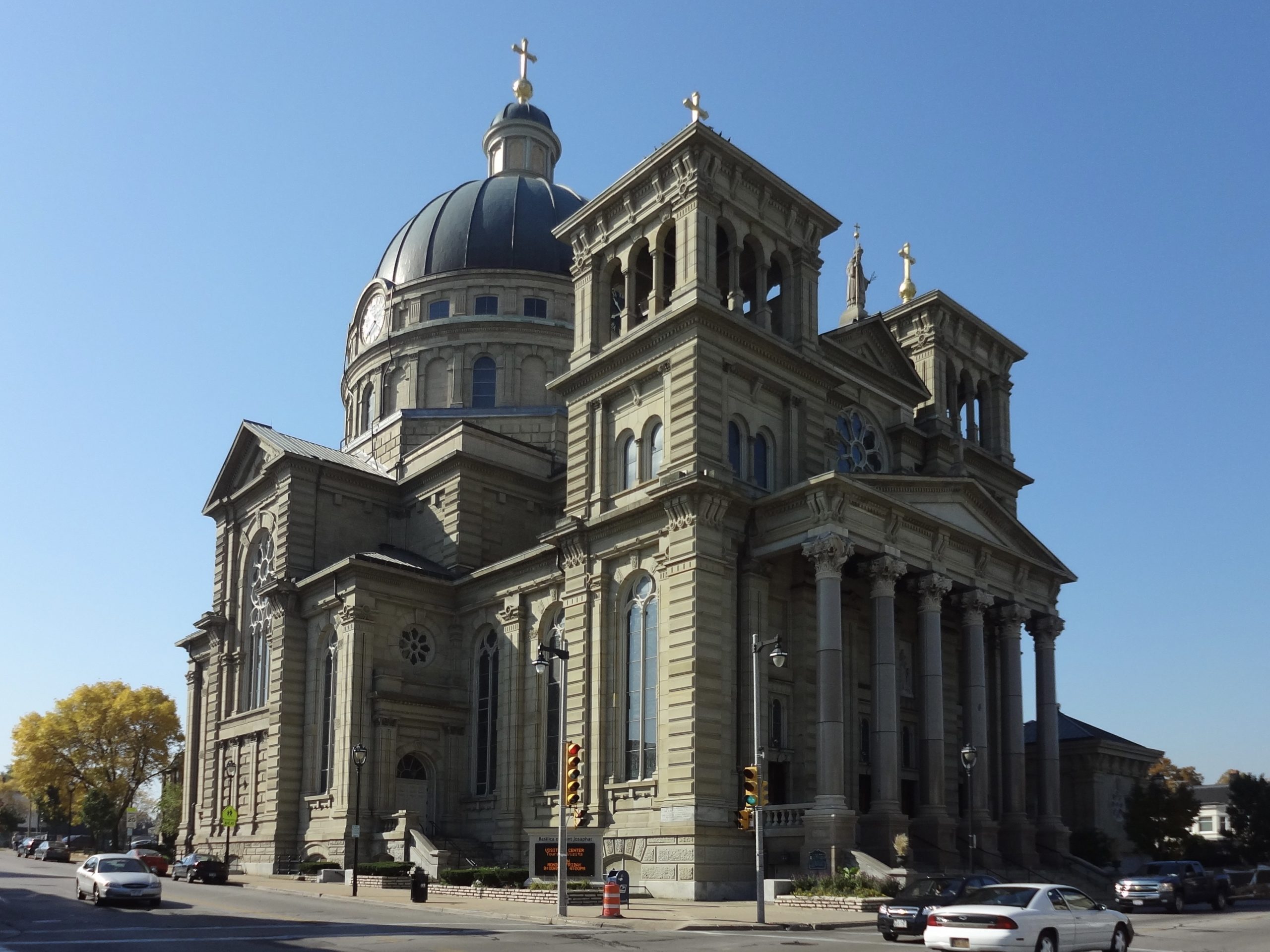
At dusk, the copper dome of the Basilica of St. Josaphat goes the colour of an old penny held up to a streetlight. It rises over the South Side of Milwaukee like a borrowed piece of Rome, because that is more or less what it is. The men who paid for it worked the tanneries on the Menomonee River, the rolling mills, the slaughterhouses, the railroad yards. They had come from villages in Posen and Pomerania and Silesia, and they wanted a church large enough to hold the future they were building.
In the early 1900s, Milwaukee had the third-largest Polish-American population in the United States, after Chicago and New York. The dome was the proof.
The Place
Lincoln Village sits on Milwaukee’s near South Side, roughly bounded by Becher Street to the north, Cleveland Avenue to the south, the I-94 freeway on the east, and 16th Street to the west. It is a flat grid of narrow lots and Cream City brick, with the Polish flats and bungalows packed close enough that you can hear a neighbour’s radio through a kitchen window.
West Lincoln Avenue runs through its centre, with the basilica at 6th Street and Kosciuszko Park a few blocks east. A short walk north sits the old commercial spine of Polish Milwaukee, the Mitchell Street corridor, which residents called the Polish Grand Avenue for the better part of a century. Bay View lies to the east across the freeway, and Walker’s Point further north toward downtown.
How It Became Polish
Before the Poles
Milwaukee’s South Side started as German country. The first wave of nineteenth-century immigrants to the city were Germans fleeing the failed revolutions of 1848, and they built the breweries, the singing societies, and the Lutheran churches that gave the city its early reputation as the German Athens of America.
By the 1860s the South Side was still mostly farmland and frame cottages, with German market gardens running down to the Kinnickinnic River. The Poles, when they came, would slip into the spaces between the German parishes, and would buy their first church from a German Lutheran congregation that was moving on.
The Poles Arrive
The first Polish families trickled in during the late 1850s, but the real wave broke in the 1860s and 1870s. They came overwhelmingly from the German-partitioned portion of historic Poland: from the province of Posen, from Pomerania along the Baltic coast, and from Silesia. A 1905 Wisconsin census found that more than 80 percent of Milwaukee’s Poles traced their origins to those three territories.
They came because conditions at home had become impossible. Prussian conscription pulled their sons into a foreign army. Bismarck’s Kulturkampf in the 1870s tried to push the Polish language out of schools, parishes, and public life. Land in the old country was scarce and expensive, and the price of a steerage ticket to Hamburg, and from Hamburg to New York, was within reach of a saved-up year of work.
What they found in Milwaukee was work. The tanneries along the Menomonee Valley needed strong arms, and Poles were among the first wave of newer immigrants hired into the leather industry, beginning around 1870. The breweries hired Poles too, and the rolling mills, and the meat-packing plants, and the railroad shops. Wages were poor, the work was brutal, and an entry-level tannery hand could expect to come home smelling of lime and dog hair. But it was paid in dollars, and the dollars could be saved.
The catalyst moment came in 1866. That year a group of South Side Poles bought an old frame Lutheran church from St. Stephen’s congregation for $4,500 and reconsecrated it as St. Stanislaus. It was the first Polish parish in Milwaukee, and the first urban Polish parish anywhere in the United States. Rural Polish parishes had been founded earlier in Texas and central Wisconsin, but St. Stanislaus was the one in a city, on a paved street, with a congregation that worked for wages rather than for the land.
The South Side at Its Peak
By 1910 the South Side was a working Polish city inside an American city. Polish was the daily language of the parish, the corner store, the union hall, and the saloon. Polish-language newspapers circulated. Polish-language theatre played in the Modjeska and three other Mitchell Street venues. Polish builders had their own architects, their own carpenters, their own savings and loans, and could put up a house, a corner tavern, and a parish hall without leaving the neighbourhood.
Mitchell Street between roughly 6th and 16th was the commercial spine. Three department stores anchored it. Goldmann’s at 9th, Schuster’s at 11th, and Sears at 14th. In between sat bakeries, butchers, cobblers, candy makers, banks, bridal shops, and the great Juneau Building with its twelve-hundred-seat theatre. For decades, Mitchell Street was the third-busiest retail district in Milwaukee, behind only Wisconsin Avenue downtown and North Third Street on the near North Side.
Chain migration did the rest. A man would come over, find a tannery job, take a room in a Polish boarding house, and within a year or two he would send for his brother. The brother would send for a cousin. The cousin would write home that there was a parish on Mitchell Street where the priest preached in Polish and the choir sang the old Christmas carols, and the next ship out would carry two more from the same village. Whole streets of the South Side ended up populated by people from the same district in Posen.
The parishes kept splitting and multiplying as the population grew. St. Stanislaus became the mother church of more than twenty Polish parishes in greater Milwaukee. St. Josaphat broke off in 1888. St. Hyacinth followed. St. Casimir. Each new parish took a corner of the South Side and made it Polish-speaking, with a school attached and the Felician or Franciscan sisters teaching the children.
The Change
Mitchell Street stayed Polish into the 1950s, but the cracks were already showing. The 1924 Immigration Act had cut off the steady flow of new arrivals from Posen and Silesia, and the children born in Milwaukee were growing up speaking English to each other in the schoolyard. After the Second World War, the families who could afford it began moving out to the southern suburbs: Greenfield, West Allis, Cudahy, Oak Creek, Franklin.
Between 1955 and 1960 the patronage on Mitchell Street collapsed. The new shopping centres in the suburbs were closer to where the customers now lived, and the streetcars that had brought working-class shoppers downtown had been pulled up. By the 1970s the department stores were gone. By the 1980s the new arrivals on Mitchell Street were Mexican families, who had been working their way west out of Walker’s Point for a generation, and who would in turn rebuild the corridor in their own image.
The Landmarks
Basilica of St. Josaphat, 2333 S 6th Street. The South Side Poles broke off from St. Stanislaus in 1888 and founded their own parish under the patronage of the Ruthenian martyr Josaphat Kuncewicz. The first church burned in 1889. The pastor, Father Wilhelm Grutza, then made one of the great improvisational deals in American Catholic history: he bought the demolished Chicago Federal Building wholesale, 200,000 tons of stone, columns and ornament, for $20,000 and had it shipped to Milwaukee on five hundred railroad flatcars. The Renaissance Revival basilica, dedicated in 1901, seats around 2,400. Pope Pius XI raised it to a minor basilica in 1929, the third in the United States.
St. Stanislaus Catholic Church, 524 W Historic Mitchell Street. The mother parish, founded 1866. The current Victorian Gothic Revival church, with its twin spires and its golden-domed towers visible from blocks away, was completed in 1872 to a design by Polish-born architect Leonard Schmidtner. Today St. Stanislaus is run by the Institute of Christ the King and celebrates the traditional Latin Mass, but the building, the bells, and the towers still belong to the same skyline the parish helped to make.
Historic Mitchell Street, between roughly 6th and 16th. The Polish Grand Avenue. The 1920s and 1930s storefronts, many designed by Polish-American architects Leon and Francis Gurda, still line the corridor, even if the names on the awnings now run to panadería and taquería. Walk the street with old photographs in hand and the bones of the Polish downtown are still all there.
Kosciuszko Park, South 9th Street and West Becher. Locally still called Kosy, the park dates to the late nineteenth century and centres on a memorial to the Polish-born American Revolutionary general Tadeusz Kosciuszko. For decades it was where South Side weddings took their photographs and South Side boys learned to ice-skate. It anchors Lincoln Village.
Polish Center of Wisconsin, 6941 S 68th Street, Franklin. Opened by the Polish Heritage Alliance, the centre sits in the southern suburbs where many of the South Side’s grandchildren now live. It hosts language classes, folk-dance practice, the annual Christmas oplatek sharing, and meetings of the Polish-American genealogical society. It is the institutional heir to what the South Side parishes used to do every day of the week.
Polish Fest, Henry Maier Festival Park, Milwaukee lakefront. Founded in 1982 by the Polish Heritage Alliance and organisers Conrad Kaminski and Adrian Choinski. The first edition drew nearly fifty thousand people over Labor Day weekend. It is now held every June and is the largest Polish festival in the United States, anchored by the same lakefront grounds that host Summerfest.
Where They Came From
The Polish state did not exist when most of Milwaukee’s Poles emigrated. It had been carved up between Prussia, the Russian empire, and Austria in three partitions ending in 1795, and the people of those territories were officially Prussian or Russian or Austrian subjects until 1918. What made them Polish was the language, the church, and a deep memory of having been a country.
The South Side Polish community came overwhelmingly from the Prussian-partition lands. The province of Posen, around the city of Poznan, sent the largest contingent. Pomerania on the Baltic, including Kashubian-speaking villages around Gdansk, sent thousands more. Silesia, in what is now southwestern Poland and parts of the Czech Republic, sent a third stream.
Later, smaller waves came from Russian-partition Poland, sometimes called Congress Poland, and from Galicia in the Austrian partition, mostly after 1890. These later arrivals tended to be poorer, often single men, and they sometimes settled in different corners of the South Side or in Polonia neighbourhoods in Riverwest and on the near North Side. But the founding character of Milwaukee Polonia was Prussian-partition: parishioners who could read Polish, sing Polish hymns, and remembered exactly which Prussian functionary had banned which book.
The South Side Today
The basilica is still on its hill at 6th and Lincoln, and Mass is still said there every Sunday. St. Stanislaus is open. The twin spires and the great green dome still mark the South Side skyline. Kosciuszko Park is still a gathering place, and the Polish-American genealogical society still meets out at the Polish Center in Franklin.
But the daily Polish presence on the streets is gone. The grandchildren of the tannery hands moved out to Greenfield and West Allis and Cudahy and Oak Creek and Franklin decades ago, and they did not move back. The corner taverns where Polish was the working language closed one by one through the 1980s and 1990s. Mitchell Street today is largely a Mexican-American commercial strip, with the storefronts that once read Sklep and Piekarnia now reading Carniceria and Joyeria. The Polish dome and the new awnings sit on the same block, and they do not contradict each other.
The anchor for the community now is Polish Fest in June, when the children and grandchildren and great-grandchildren come back to the lakefront for pierogi and Chopin and polka and a Mass said partly in Polish. Forty-odd years in, it is still the largest Polish festival in America, and it is still organised by people who can trace a great-grandparent back to a village in Posen and a job in a tannery on the Menomonee.
The community moved. It did not end.
Frequently Asked Questions
Why did Poles settle on Milwaukee’s South Side?
Poles settled on Milwaukee’s South Side from the 1860s onward because the tanneries along the Menomonee Valley, the breweries, the rolling mills, and the railroad shops were hiring. The South Side had cheap residential lots on a flat grid, and once St. Stanislaus parish opened in 1866 it became the institutional anchor that drew more Polish families in through chain migration from Posen, Pomerania, and Silesia.
Is Lincoln Village still Polish today?
Not in daily life. Lincoln Village and the wider Mitchell Street corridor are now largely Mexican-American, with Polish descendants having dispersed to Greenfield, West Allis, Cudahy, Oak Creek, and Franklin. The Polish landmarks remain. The Basilica of St. Josaphat and St. Stanislaus are both still active churches, and the community returns each June for Polish Fest.
What are the most famous Polish landmarks on Milwaukee’s South Side?
The Basilica of St. Josaphat at 2333 S 6th Street, dedicated 1901 and raised to a minor basilica in 1929, is the headline landmark. St. Stanislaus Catholic Church at 524 W Mitchell Street, founded 1866 as the first urban Polish parish in the United States, is the historic mother church. Historic Mitchell Street itself, the Polish Grand Avenue, and Kosciuszko Park round out the core landmarks.
Where in Poland did Milwaukee’s Poles come from?
The great majority, more than 80 percent according to a 1905 Wisconsin census, came from the German-partitioned territories of historic Poland: Posen (Poznan), Pomerania, and Silesia. Smaller later waves arrived from Russian-partition Poland and from Galicia in the Austrian partition, mostly after about 1890.
When did Poles first arrive on Milwaukee’s South Side?
The first Polish families trickled into Milwaukee in the late 1850s. The community reached the size to organise its own parish in 1866 with the founding of St. Stanislaus, and the mass arrival period ran from the 1860s through the 1920s, ending with the 1924 Immigration Act.
What festival celebrates Polish heritage in Milwaukee?
Polish Fest, held each June at Henry Maier Festival Park on the Milwaukee lakefront, is the largest Polish festival in the United States. It was founded in 1982 by the Polish Heritage Alliance and continues to draw Polish-Americans from across Wisconsin and the Chicago region.
Trace Your Story
If your family’s story passed through Milwaukee’s South Side, through a tannery shift and a parish hall and a flat on Lincoln Avenue, Atlas of Home can trace that journey. From a village in Posen or Pomerania or Silesia, to a pew at St. Stanislaus, to wherever you are now.