
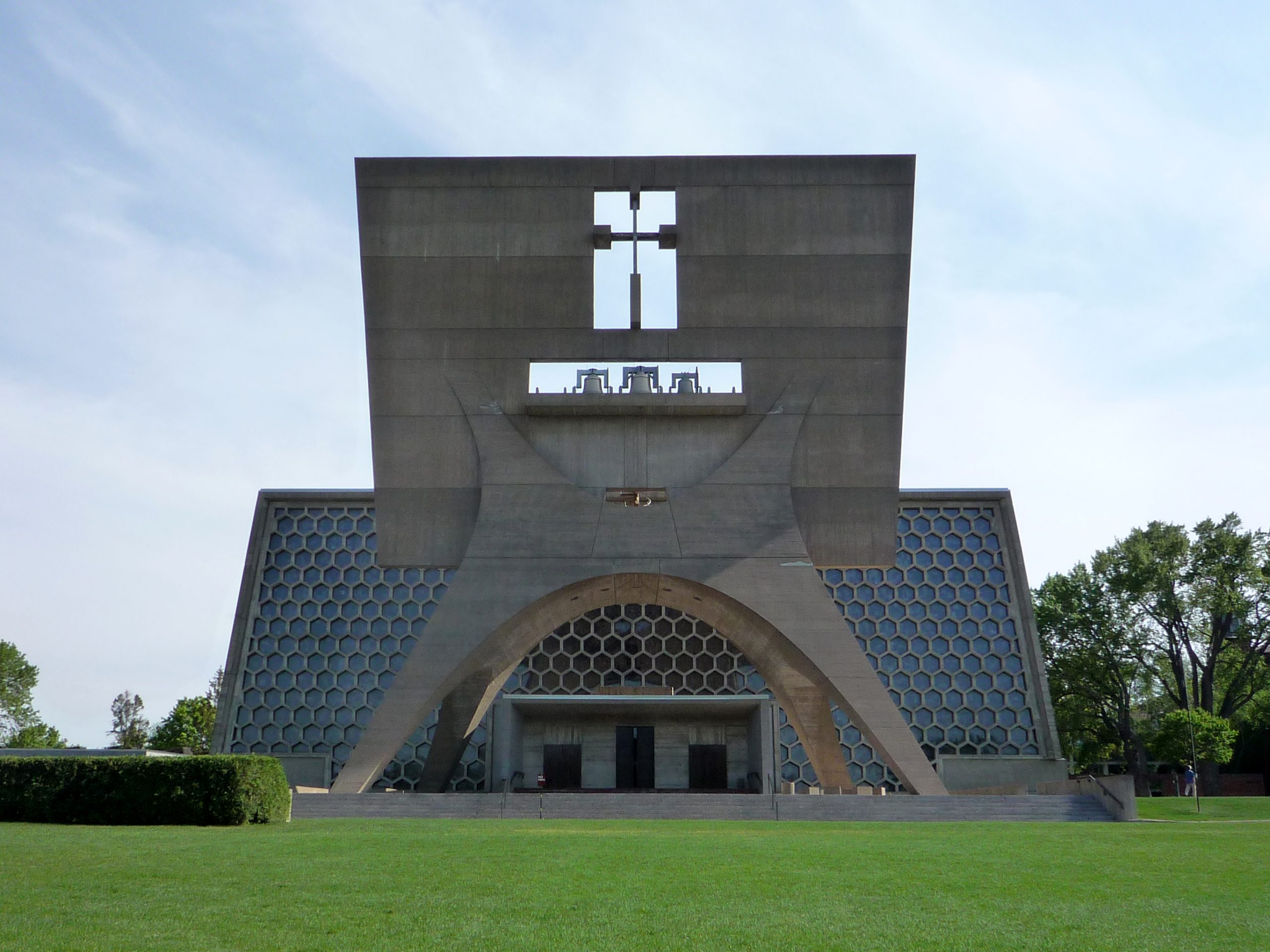
They called it the Holy Land. Not the Holy Land of pilgrim song, but the one that rose out of central Minnesota prairie in the 1850s, when German Catholic immigrants began carving farm towns out of Stearns County and naming each one after a saint. Drive the back roads west of St. Cloud today and the towns still come in litany: St. Joseph, St. Augusta, St. Martin, St. Stephen, St. Anna, St. Rosa, St. Wendel, St. Anthony. Above them all, on a bluff above the Mississippi, the granite cathedral and the long concrete bell banner of an abbey church mark the centre of what is still the most German Catholic county in the United States.
The Granite City on the Mississippi
St. Cloud sits about seventy miles northwest of Minneapolis, where the Mississippi River bends through a shelf of pink and grey granite. The city of around 70,000 anchors three counties (Stearns, Benton, and Sherburne) and serves as the regional hub for the farm towns scattered through what locals still half-jokingly call the Holyland.
The downtown core runs along the river, with low brick storefronts on St. Germain Street and the green dome and twin towers of the Cathedral of St. Mary rising a few blocks back from the water. Out beyond the city limits, the quarry pits cut deep into the granite shelf that gave St. Cloud its nickname, the Granite City. Stone from those pits sits in the Minnesota State Capitol, in monuments across the country, and in a thousand parish churches that still stand on the prairie.
How It Became German
Before the Germans
Before the 1850s, the land along this stretch of the Mississippi belonged to the Dakota and Ojibwe. After the Treaty of Traverse des Sioux in 1851, the United States declared much of central Minnesota open to white settlement, and the federal land office in St. Cloud began drawing the kind of speculators and traders who follow any frontier. A handful of New England Yankees laid out the town in 1854. They were not the ones who stayed.
Father Pierz and the Newspaper Campaign
The man who turned central Minnesota German was a small, energetic Slovenian missionary named Francis Xavier Pierz. From 1851 onward, working out of Crow Wing, he sent letters back to German Catholic newspapers in the eastern states and in Europe, particularly to Der Wahrheitsfreund of Cincinnati. He described the climate, the soil, and the price of land, and he argued that central Minnesota could be a Catholic homeland for German-speaking settlers fleeing crowded cities and failed harvests.
The letters worked. In May 1855, the first wave of German, Luxembourger, and Slovenian families began staking claims through the future Stearns, Benton, and Morrison counties. Many had reached the United States in the years after the failed Revolutions of 1848. Others were chain migrants pulled across by relatives already in Ohio, Indiana, and Wisconsin who had read Pierz’s articles and decided to push west one more time.
The Monks Arrive
In 1856, Bishop Joseph Cretin of St. Paul wrote to Abbot Boniface Wimmer at St. Vincent Archabbey in Pennsylvania, asking for German-speaking Benedictines to serve the immigrants who were now flooding in. Wimmer was himself Bavarian, sent from Metten Abbey in 1846 to build the American Benedictine mission. On April 5, 1856, he dispatched one priest, two clerics, and two brothers to Minnesota.
They founded the priory that would become St. John’s Abbey, the first Benedictine abbey in the Upper Midwest. Raised to abbey status in 1866, the monastery quickly became the spiritual and educational engine of the German Catholic settlement. The school it founded in the 1850s grew into Saint John’s University by 1883, and the monks fanned out across the prairie planting parishes.
The Benedictine women followed close behind. In 1857, six sisters from St. Marys, Pennsylvania, themselves descended from Mother Benedicta Riepp’s original 1852 foundation from Eichstatt, Bavaria, arrived in St. Cloud. They moved to nearby St. Joseph in 1863 and built what became Saint Benedict’s Monastery. At its 1946 peak it counted 1,278 sisters, the largest Benedictine community of women in the world, and over the decades it staffed 163 schools in the diocese.
Granite, Railroads, and Parish Towns
The first granite quarry opened near St. Cloud in 1868. The railroad reached town in 1866 and pushed onward, and quarry crews multiplied through the 1880s and 1890s as architects across the country discovered St. Cloud’s pink granite. German immigrants worked the pits alongside Swedes, Norwegians, Scots, and Italians, though German Catholic families dominated the surrounding farm townships almost completely.
Each township revolved around its parish. By 1890 there were more than twenty Catholic parishes in Stearns County, each anchoring its own crossroads village. The pattern was simple and stubborn: a stone or brick church, a parochial school staffed by Benedictine sisters from St. Joseph, a parish hall, a saloon, a creamery, and rings of family farms spreading outward. Most of those parishes still stand. Many still hold Mass.
The Diocese
In 1889, Pope Leo XIII detached central and northern Minnesota from the St. Paul archdiocese and erected the Diocese of St. Cloud. The first bishop, Otto Zardetti, was a Swiss-German theologian, and the early diocesan priesthood was overwhelmingly German-speaking. The pastoral letters, the parish bulletins, and the school catechisms ran in German for two generations, and in many Stearns County parishes German remained the language of the pulpit well into the 1920s.
The Landmarks
Cathedral of St. Mary (25 8th Avenue North, St. Cloud). Founded as a parish in 1855 by Father Pierz, who said the first Mass in the home of John and Catherina Schwarz. The current Italianate church, modelled on the sixth-century Basilica of Sant’Apollinare in Classe near Ravenna, was completed in 1931 after the previous Gothic church burned in 1920. It was elevated to cathedral status in 1937 after a fire damaged the diocese’s prior cathedral, Holy Angels. Its green-domed campanile is the city’s tallest religious silhouette.
Saint John’s Abbey Church (Collegeville, twelve miles west of St. Cloud). The Bavarian-founded monastery commissioned the Hungarian-born modernist Marcel Breuer in 1953 to design a new abbey church. Built between 1958 and 1961, its cast-in-place concrete shell, hexagonal honeycomb stained glass, and freestanding bell banner became one of the most important works of twentieth-century religious architecture in North America. It is still the daily prayer space of the monks.
Saint Benedict’s Monastery (104 Chapel Lane, St. Joseph). Five miles west of St. Cloud, on a low rise above the prairie. Founded by Bavarian-descended Benedictine women in 1857, the monastery’s red-brick Sacred Heart Chapel and Romanesque mother house anchor the village. The community ran the parochial school system that taught most of central Minnesota’s Catholic farm children for a century, and it still operates the College of Saint Benedict (founded 1913) in partnership with Saint John’s University.
The Granite Quarries (Pleasant Lake, Rockville, and Waite Park, west and south of St. Cloud). The pink granite that gave the city its nickname was first quarried in 1868 and is still cut from open pits along the river shelf. The Minnesota State Capitol, the State Library of Pennsylvania, and the granite slabs at the Federal Reserve Bank of Minneapolis all came from these quarries. German and Scandinavian stonecutters once shared the yards by the hundreds.
The Parish Belt of Stearns County (Holdingford, St. Anna, St. Martin, Spring Hill, Lake Henry, Meire Grove, Greenwald). Drive the county roads west of Albany and the steeples cluster every few miles. Most of these parishes were founded between 1858 and 1880 by German immigrants who pooled labour to raise brick churches twice the size their tiny villages required. The phrase Holy Land of Minnesota describes this belt, not St. Cloud itself.
The Pioneer Place on Fifth (22 5th Avenue South, St. Cloud). A restored 1913 vaudeville and movie house downtown that today serves as the city’s small live-theatre venue. It sits in the heart of the old commercial strip that German Catholic farm families used to drive into on Saturdays to sell butter, buy hardware, and gather at the bishop’s cathedral the next morning.
St. Cloud Wurst Fest (held annually, downtown). A weekend festival of bratwurst, beer, polka, and a sausage-eating contest. It is modest by Munich standards and unapologetic about what it is: a Stearns County reminder that the descendants of the 1855 wave have not entirely let go of the old country.
Where They Came From
The Germans who built Stearns County did not come from one region. They came from three. Westphalia, in the northwest of the German-speaking lands, sent farmers from the Munster and Paderborn dioceses who were used to working heavy clay soil and living in tight parish villages. The Rhineland and the Moselle valley sent Catholic farming families pushed off small holdings by inheritance laws and crop failures. Bavaria sent both farmers from the Upper Palatinate and the spiritual backbone of the whole project: the Benedictine current that runs from Metten Abbey through Boniface Wimmer at St. Vincent’s in Pennsylvania to Collegeville, and from Eichstatt’s Saint Walburg Abbey through Mother Benedicta Riepp to St. Joseph.
Luxembourgers, who spoke a German dialect and were Catholic in the same parish patterns, often settled side by side with the Westphalians and were generally counted as German in census records. A smaller current of Slovenes followed Father Pierz from Carniola. The result was a settlement that was overwhelmingly Catholic, overwhelmingly German-speaking, and so tightly knit by parish boundaries that non-Catholic settlers tended to move on within a generation, leaving Stearns County almost monocultural by 1900.
St. Cloud Today
The German Catholic core has not vanished, but it has loosened. Sunday Mass in German ended decades ago, the parochial school network has contracted as the farm population aged, and many of the smaller Stearns County parishes now share a single circuit-riding priest. Stearns County is still the most Catholic county in Minnesota, at roughly four in ten residents, and the surnames on the mailboxes (Schmidt, Kremers, Wermerskirchen, Klaphake, Hellermann) still tell you who built the place.
St. Cloud itself has become a more layered city. Since the late 1990s, Somali refugees fleeing civil war have resettled here in significant numbers through Catholic Charities and Lutheran Social Services, drawn by jobs in the meatpacking and granite industries and by the same Catholic-charitable infrastructure that once supported the German Catholic immigrants. The Somali community is now visible across the city’s east side and downtown, a second wave of refugees received by descendants of the first. The relationship has been complicated, sometimes contested, and unmistakably part of the present.
Out at Collegeville, the abbey continues. Marcel Breuer’s bell banner still rises out of the trees by Lake Sagatagan, the monks chant the hours in English now, and the abbey runs ecumenical institutes and prints the Saint John’s Bible. Five miles east, at St. Joseph, the Benedictine sisters of Saint Benedict’s are fewer than they once were but still teach, write, and run the college. The Holy Land is older. It is not gone.
Frequently Asked Questions
Why did Germans settle in St. Cloud, Minnesota?
German Catholic settlement of St. Cloud and Stearns County began in 1855 after the Slovenian missionary Father Francis Xavier Pierz published articles in German-language Catholic newspapers urging German-speaking families to settle central Minnesota. Cheap farmland after the 1851 Treaty of Traverse des Sioux, the railroad, and granite-quarry and farm work all pulled them in. The arrival of Bavarian Benedictine monks at St. John’s Abbey in 1856 cemented the settlement as a German Catholic homeland.
Is St. Cloud still German today?
Yes, in heritage and architecture. Stearns County remains the most Catholic county in Minnesota and German surnames still dominate the small farm towns. German-language Mass and parochial schooling have largely ended, but the parishes, the monasteries, and the annual St. Cloud Wurst Fest keep the heritage visible. The city itself is now more diverse, including a substantial Somali community.
What are the most famous German Catholic landmarks in St. Cloud?
The Cathedral of St. Mary in downtown St. Cloud (1931, raised to cathedral 1937), Saint John’s Abbey Church at Collegeville (Marcel Breuer, 1961), and Saint Benedict’s Monastery at St. Joseph (founded 1857) are the three pillars. The ring of parish villages west of St. Cloud, known locally as the Holy Land of Minnesota, also draws visitors.
Where in Germany did the St. Cloud Germans come from?
Primarily from three regions: Westphalia (the Munster and Paderborn dioceses), the Rhineland and Moselle valley, and Bavaria. The Benedictine monastic tradition arrived specifically from the Bavarian abbeys of Metten and Eichstatt by way of Pennsylvania. Luxembourgers and a smaller Slovenian contingent settled alongside them.
When did Germans first arrive in St. Cloud?
The first wave of German, Luxembourger, and Slovenian Catholic families began claiming land in Stearns County in May 1855. The Bavarian Benedictine monks who founded St. John’s Abbey arrived in April 1856. German Catholic immigration to the region continued in steady waves through the 1880s.
What is the Holy Land of Minnesota?
The Holy Land of Minnesota is the informal name for the ring of German Catholic farm parishes west of St. Cloud in Stearns County. Each small village, including St. Joseph, St. Martin, Spring Hill, St. Anna, and Meire Grove, was organised around a single parish in the 1850s to 1880s by German immigrant families. The parishes are unusually close together and unusually large for the village populations they served.
If your family’s story passed through St. Cloud, through the Stearns County parish belt, or through any of the German Catholic communities that built so much of the American Midwest, Atlas of Home can trace that journey. From a Westphalian village or a Bavarian parish to a Mississippi River prairie town, to wherever you are now.