
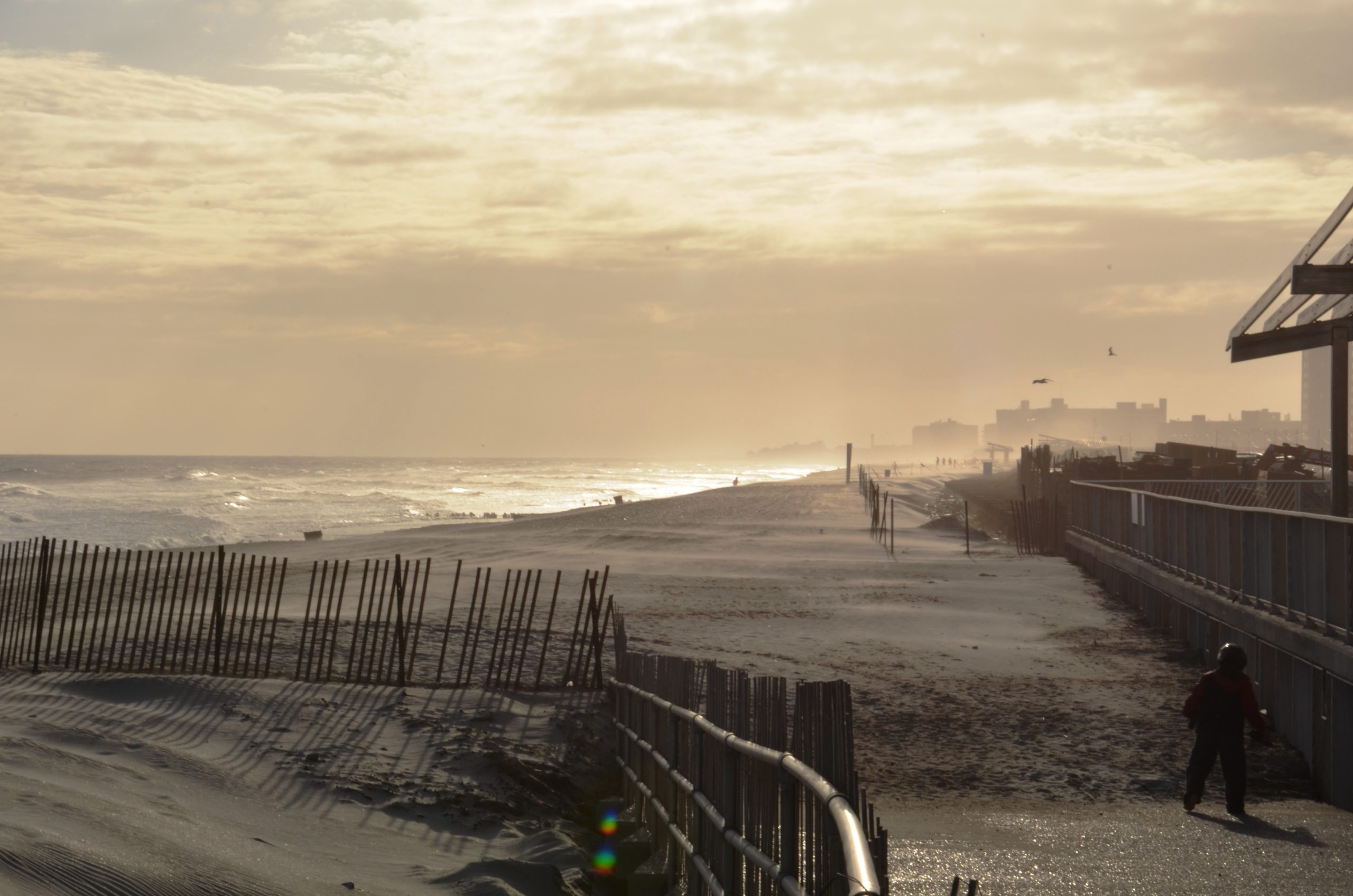
They called it the Irish Riviera. Not on any subway map, not in any tour book. But from the 1920s through to the new century, if you took the A train south past Howard Beach, crossed the bridge over Jamaica Bay, and stepped off onto a peninsula of bungalows and salt air, you were standing in a strip of Galway, Mayo and Cork laid out along eleven miles of Atlantic sand. The smell of salt and Coppertone. A bar with the door open and Clancy Brothers on the jukebox. And on a Sunday in summer, more Irish-American families on a single block than you would find in most counties of Ireland.
The Place
The Rockaway peninsula is a thin barrier strip on the southern edge of Queens, separated from the rest of New York City by Jamaica Bay. Eleven miles long, often only a few blocks wide, it carries the Atlantic on one side and the bay on the other. The A train and the Q53 bus connect it to the city; the Marine Parkway Bridge ties it to Brooklyn at its western tip.
The Irish story sits at the western half of the peninsula. Rockaway Beach proper, then Rockaway Park around Beach 116th Street, then Belle Harbor and Neponsit with their tidy brick and frame houses, and finally Breezy Point at the very tip, a private cooperative of small, close-set homes ringed by sea on three sides.
How It Became Irish
Before the Bungalows
For most of the nineteenth century, the Rockaways were a wealthy resort. Manhattan money built grand wooden hotels at Far Rockaway, and society families rode the new railroad down for the sea air. The western end of the peninsula, where Breezy Point sits now, was scrubland and dunes, used by gunning clubs and a handful of fishermen.
That world ended after 1900. The grand hotels burned or fell out of fashion, the railroad opened the beach to anyone who could pay a nickel, and developers carved the dunes into tiny lots. By 1906, Playland and a six-mile boardwalk were drawing day-trippers in their thousands. By the late 1930s there were more than seven thousand small summer bungalows on the peninsula.
The Tenement Escape
The Irish came as renters first. Working-class Irish-American families packed into the tenements of Hell’s Kitchen, the West Side, Inwood, Washington Heights and the South Bronx had no air conditioning and no garden. A bungalow at Rockaway, even a one-room shack with a shared outdoor shower and a communal kitchen, was a place to send the children for the summer while the father stayed in the city and came down at weekends.
Whole streets of bungalows organised themselves by parish and county. Marcell’s Court, off Beach 67th Street, drew Irish families from Hell’s Kitchen and the Bronx. Other courts were heavily Galway or Mayo. The same neighbours from West 49th Street or 207th Street would meet again every June on the same stretch of sand, year after year.
The Irish pubs followed the renters. Bars opened along Rockaway Beach Boulevard, the boardwalk, and the side streets off the beach, and the strip became known up in the city as Irish Town. By midcentury the local joke was that the peninsula had more parishes than counties in Connacht.
From Summer People to Year-Rounders
After the Second World War, the bungalows began to convert. Returning GIs, many of them Irish-American sons of those Manhattan and Bronx tenements, used the GI Bill to buy modest year-round homes in Belle Harbor and Rockaway Park. Families that had spent twenty summers in a Marcell’s Court shack started insulating it, adding a furnace, and staying through the winter.
Breezy Point made the same move on a larger scale. The land at the western tip had been a private summer colony since the 1910s. In 1960, after a developer tried to flatten the bungalows for high-rise apartments, the residents pooled their savings and bought the land themselves, forming the Breezy Point Cooperative. Roughly 2,800 small homes sit on the cooperative’s land today, every household a shareholder.
The FDNY and NYPD Pipeline
The same generation that bought the bungalows joined the Fire Department and the Police Department in extraordinary numbers. Civil-service jobs gave Irish-American families in New York a way into the middle class without a college degree, and the Rockaways gave them a place where they could afford a house, walk to the beach, and live next door to a hundred neighbours from the same firehouse or precinct.
By the 1980s, Breezy Point and Belle Harbor were known across the FDNY as the place where the captains lived. The local volunteer fire department, still active today, was a feeder for the city’s career service. Sons followed fathers in. Whole streets in Breezy were named after lost firefighters from earlier disasters long before the names of 2001 were ever called out.
The Landmarks
St. Francis de Sales Church, 129-16 Rockaway Beach Boulevard, Belle Harbor. The parish was organised in 1907 to serve the new year-round Catholic population. The first wooden church was destroyed by fire in 1935 and replaced by the current building the following year. On 12 November 2001, the engine of American Airlines Flight 587 came down in the parking lot of this church. The parish has buried generations of its own firefighters and police, and it still anchors the Belle Harbor strip.
St. Camillus Church, 99-15 Rockaway Beach Boulevard, Rockaway Park. Founded in 1908 to serve the growing Irish Catholic population of Seaside, St. Camillus marked more than a century of weddings, funerals, food pantries and the annual Rockaway Irish Festival before closing its doors in late 2025. Its loss was felt across the peninsula, a sign of the wider thinning of the year-round Irish-American population.
The Breezy Point Cooperative, western tip of the peninsula. A gated community of roughly 2,800 cottages, privately owned, with its own volunteer fire department, its own security and its own beaches. By the 2000 census, the cooperative’s ZIP code had the second-highest concentration of Irish-American residents in the United States, just over sixty per cent self-reporting Irish ancestry. Walk the lanes on a July evening and the surnames on the doorbells read like a roll call from Mayo, Galway and Kerry.
Connolly’s, 155 Beach 95th Street, Rockaway Beach. A small Irish dive bar half a block from the boardwalk, famous for its frozen piña coladas in paper cups and for being the unofficial parish hall of the peninsula’s summer crowd. Open since the 1960s, Connolly’s is the bar where Manhattan and Brooklyn meet the Rockaways, where firefighters’ kids work the door, and where every Saturday in summer feels like a wedding.
The Sugar Bowl, 15 Bedford Avenue, Breezy Point. A neighbourhood pub inside the cooperative gates, the kind of place where a stranger gets noticed and a regular’s pint is poured before they sit down. The Sugar Bowl and a handful of its neighbours have functioned for decades as Breezy’s living room.
Tribute Park, Beach 116th Street and Beach Channel Drive, Rockaway Park. A small waterfront garden built on the lot where neighbours had stood and watched the towers fall on 11 September 2001. The pavilion’s arched dome holds forty thousand pieces of coloured glass, etched with the names of the seventy Rockaway Park residents killed that morning, with a granite stone nearby carrying the names of all 343 firefighters lost. It is the most quietly devastating memorial in the city.
The Rockaway Boardwalk, ocean side. Rebuilt in concrete after Hurricane Sandy washed away the old wooden one in 2012, the boardwalk still threads the peninsula end to end. Runners, surfers, FDNY families, and tourists from the new ferry mix on it from May to October.
Where They Came From
Most of Rockaway’s Irish-American families are second, third or fourth generation, descended from the great post-Famine wave that filled the Manhattan and Bronx tenements between the 1850s and the 1920s. The origin counties were the standard ones for New York: Cork, Galway, Kerry, Mayo, Tipperary, Sligo, Roscommon.
But the Rockaways also drew a second, smaller wave directly from the West of Ireland in the 1980s and 1990s, when economic emigration from Galway, Mayo and Donegal sent young men and women to construction sites and pubs across Queens and the Bronx. Many of them washed up at the Rockaways in summer and stayed. The accents in Connolly’s on a July night are still not entirely American.
Rockaway Today
Three things have shaped the peninsula in the twenty-first century, and the Irish-American community has lived through all of them.
The first was 11 September 2001. Roughly seventy residents of Belle Harbor, Neponsit, Rockaway Park and Breezy Point died at the World Trade Center, a disproportionate share of them firefighters and police. Every street on the western half of the peninsula lost someone.
The second came two months later, on 12 November 2001, when American Airlines Flight 587 broke up shortly after takeoff from JFK and fell on a residential block of Belle Harbor. All 260 people on board were killed, along with five residents on the ground. A community that was still burying its 9/11 dead buried five more neighbours and watched a row of houses on Beach 131st Street burn.
The third was Hurricane Sandy in October 2012. The storm surge flooded thousands of homes on the peninsula. At the height of the storm a six-alarm fire ignited in Breezy Point and burned out of the firefighters’ reach for hours, destroying around 127 cottages in a single night and damaging dozens more. The community that had built itself rebuilt itself again.
Breezy Point’s Irish character is still extraordinary. Census figures and resident surveys have put the cooperative’s Irish-American share above ninety per cent in some years, and well above half by the most conservative national counts. The FDNY t-shirts are not for sale, they are off-duty uniforms. The peninsula is also one of the few places in greater New York where the Irish surnames on the doorbells line up with the Irish surnames on the firehouse roster across the bay.
Rockaway has also become a surfing town. The dedicated surf beach at Beach 67th Street, the ferry from Wall Street, the breweries and taco trucks, the Brooklyn renters with bikes, all of it has reshaped the strip in the last fifteen years. Some of the children of those FDNY families now run the surf shops. Many of the bungalows have been rebuilt taller and stronger after Sandy. A few are owned by their fourth Irish-American generation.
The peninsula is not only Irish. Far Rockaway, at the eastern end, is a Black and Caribbean community with deep roots of its own, and a growing Latino population fills the blocks between. The Irish Riviera was always one chapter of a longer story. But on the western end, between Beach 116th Street and the tip at Breezy Point, the story is still being written by the same families, in the same houses, with the same names on the mailboxes their grandparents painted.
Frequently Asked Questions
Why is Rockaway Beach called the Irish Riviera?
From the 1920s onward, working-class Irish-American families from Manhattan and the Bronx rented summer bungalows on the Rockaway peninsula to escape the heat of the tenements. So many came, year after year, that the strip of beach, boardwalk and bars became known across the city as the Irish Riviera.
Is Rockaway Beach still Irish today?
The western end of the peninsula, especially Breezy Point, Belle Harbor and Rockaway Park, remains heavily Irish-American. Breezy Point’s ZIP code has long ranked among the most Irish places in the United States, with a majority of residents reporting Irish ancestry, and the FDNY and NYPD families that built the community are still there in numbers.
What are the most famous Irish landmarks in Rockaway Beach?
St. Francis de Sales Church in Belle Harbor, St. Camillus Church in Rockaway Park, the Breezy Point Cooperative, Connolly’s bar on Beach 95th Street, the Sugar Bowl pub in Breezy Point, and Tribute Park at Beach 116th Street, which commemorates the seventy Rockaway residents lost on 9/11.
Where in Ireland did the Rockaway Irish come from?
Most Rockaway Irish-American families descend from the post-Famine wave that filled the Manhattan and Bronx tenements: Cork, Galway, Kerry, Mayo, Tipperary, Sligo and Roscommon. A later wave of direct emigrants from Galway, Mayo and Donegal arrived in the 1980s and 1990s and many settled on the peninsula.
When did Irish families first come to Rockaway Beach?
Irish-American families began renting Rockaway bungalows in significant numbers in the early 1900s, peaking in the bungalow era of the 1920s and 1930s. Year-round Irish-American settlement in Belle Harbor, Rockaway Park and Breezy Point accelerated after the Second World War, with Breezy Point Cooperative formally founded in 1960.
What did 9/11, Flight 587 and Hurricane Sandy do to the community?
The Rockaways lost around seventy residents on 11 September 2001, many of them FDNY and NYPD. Two months later, American Airlines Flight 587 crashed into Belle Harbor, killing all 260 on board and five on the ground. In October 2012, Hurricane Sandy flooded thousands of homes and a six-alarm fire in Breezy Point destroyed roughly 127 cottages in one night. The community rebuilt after each.
If your family’s story passed through Rockaway, or any of the places the Irish made home in America, Atlas of Home can trace that journey. From a one-room cottage in Mayo to a Marcell’s Court bungalow to a Belle Harbor brick semi, to wherever you are now.