
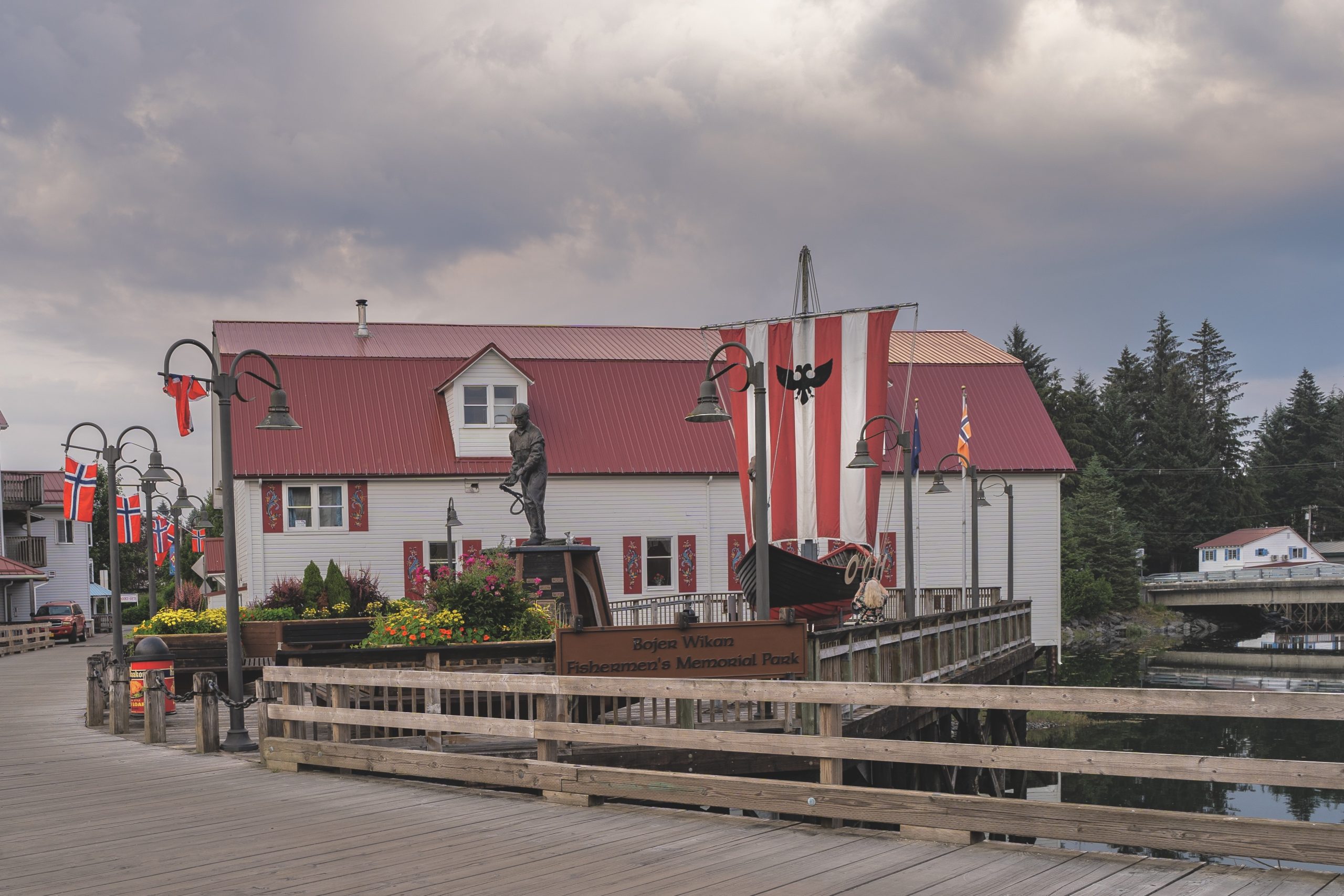
The Norwegian flag flies legally over Petersburg, Alaska. Not in front of a consulate or a cultural centre, but over the harbour, the school, the boatyards, the porches on Sing Lee Alley. From the air, on a clear day, you can see the rosemaling on the eaves of houses built on pilings above Hammer Slough. This is a town of three thousand people on a fogbound island in the Inside Passage, and the people who built it came from the fjords.
They called it Little Norway. They still do.
The Place
Petersburg sits at the northern tip of Mitkof Island in Alaska’s southeast panhandle, hard against the narrow tide-race of Wrangell Narrows. The town is part of the Inside Passage, the long chain of fjords and forested islands that runs from Puget Sound to Glacier Bay. There is no road in. You arrive by ferry, by floatplane, or by fishing boat.
The harbour is the centre of everything. Salmon seiners, halibut longliners, and crab boats tie up four-deep along the docks. The houses behind them are wood-frame and brightly painted, built in the early decades of the last century by Norwegian fishermen who knew how to make a home on water.
How It Became Norwegian
Peter Buschmann and the Glacier Ice
In 1897, a Norwegian immigrant named Peter Buschmann homesteaded forty acres on the northern point of Mitkof Island. He had come west by way of the Norwegian-American fishing communities of the Pacific Northwest, with his wife Brigitte and their nine children. The location was deliberate. The tides through Wrangell Narrows were rich with salmon and halibut, the timber for a cannery and a sawmill was standing on the bluff, and twenty-five miles to the east the LeConte Glacier was calving icebergs into a deep saltwater fjord.
That glacier ice was the founding idea. Buschmann harvested it to pack salmon for shipment to markets in Seattle and beyond, an innovation that made his cannery, his sawmill, and his dock viable from the first season. He named the place after himself. The cannery he built in 1899 is still operating today as Petersburg Fisheries.
The Chain Migration from Norway
What followed was a quiet, deliberate movement of people. Buschmann wrote home, and his Norwegian friends and relatives followed. Many came from the inner fjords of western Norway, places like Sognefjord, Hardanger, and the Romsdal coast, where families had been fishing herring and cod for generations. Others were second-generation Norwegian-Americans who had first settled in the fishing towns of Puget Sound, Ballard, Poulsbo, and Anacortes, and then moved north for better grounds.
Smaller numbers came by way of the Norwegian-American farming belt of Minnesota and the Dakotas, often men who had grown tired of the prairies and wanted to be back on a boat. The Pacific Northwest was the pivot. Most of the men who built Petersburg had a relative in Seattle or Bellingham before they had a cabin on Mitkof Island.
The town was officially incorporated on April 20, 1910. By that point it was already, to anyone walking down the main street, a Norwegian town. The languages on the docks were Norwegian and English. The cooking smelled of salt cod, butter, and cardamom. The houses had bargeboards painted in folk-art curlicues.
The Lodge and the Hall
In 1912, sixty charter members of the Sons of Norway Fedrelandet Lodge No. 23 borrowed money, sold five-dollar shares, and built a hall with their own hands. It was the first Sons of Norway lodge building constructed in Alaska. They put it on pilings over Hammer Slough, on a wooden alley that would become known as Sing Lee Alley.
The hall was a community building first, a fraternal building second. It hosted weddings, dances, funerals, school plays, and, during World War II, served as an armoury. In the 1960s it was used as a National Guard headquarters. It was listed on the National Register of Historic Places in 1979, and it is still the centre of Petersburg’s Norwegian life.
The Landmarks
Sons of Norway Hall (Fedrelandet Lodge No. 23), 23 Sing Lee Alley. Built in 1912 by sixty volunteer charter members and still the most active Sons of Norway lodge on the Pacific coast. The gambrel-roofed white building, trimmed with hand-painted rosemaling, sits on pilings over the tidewater. This is where the Little Norway Festival opens every May, where Leikarringen folk dancers rehearse, and where the Valkyries get into their bunader before the parade.
Sing Lee Alley. A short wooden street, much of it built on pilings over Hammer Slough, lined with frame buildings from the 1910s. The alley is named for Sing Lee, a Chinese merchant who lived in Petersburg in the cannery era. The Sons of Norway Hall anchors one end. The other end opens onto the harbour, with views of fishing boats and, on a clear day, the snow on the Coast Range across the water.
Clausen Memorial Museum, 203 Fram Street. Founded in 1967 and dedicated to the local story. The displays cover Norwegian heritage, the salmon and halibut fisheries, the logging industry, and the Tlingit and Haida people whose territory this is. The museum’s most famous exhibit is a 126.5-pound chinook salmon, the world-record fish caught in a Petersburg fish trap in 1939. The thirty-minute film shown on a loop is called The Town Fish Built.
Petersburg Fisheries / Icy Strait Packing Company site, North Harbor. The cannery Peter Buschmann built in 1899, still processing salmon a hundred and twenty-seven years later. It is now part of the Ocean Beauty / Icicle group, but the location and the function have not changed. If you walk past on a July evening, you can hear the lines running.
The Fishermen’s Memorial, Hammer Slough. A small bronze and granite memorial near the Sons of Norway Hall, listing the names of Petersburg fishermen and mariners lost at sea. The list goes back to the founding decade and is added to, quietly, every few years. Most of the names are Norwegian.
The Bojer Wikan Fishermen’s Memorial Park, Sing Lee Alley boardwalk. A small waterside park with a bronze statue called Valhalla, sculpted by Norwegian-American artist Bojer Wikan in 1999. It depicts a Petersburg fisherman, weather-coat open, looking out to sea. It is the photograph everyone takes.
The Little Norway Festival, town-wide, every May 17th weekend. Run continuously since 1958, when two local women, Bernadine Trones and Alma Wallen, chaired the first festival to mark Norwegian Constitution Day. The town fills with bunader, Viking longships built for the parade, lutefisk and lefse dinners, herring tossing, and the Valkyries in costume. For four days, Petersburg is the most Norwegian place in the United States.
Where They Came From
The deepest roots are in western Norway. Sognefjord, the country’s longest and deepest fjord, sent fishermen to Petersburg by way of the Pacific Northwest from the 1890s through the 1920s. So did Hardanger and the smaller fjord communities along the Romsdal coast. These were people from a culture where the sea was the road and the boat was the family business.
The route was rarely direct. A young man from a farm above Balestrand would sail to New York, take a train to St. Paul, work a season in the wheat, and end up in Ballard or Poulsbo with a cousin who already had a boat. The next move north, to Petersburg, was the second or third leg of the journey. By the time a Sognefjord family arrived on Mitkof Island, they had been in America for ten or twenty years already.
That layering matters. Petersburg’s Norwegian-ness is not a frozen 1897 thing. It is a culture that was carried across the prairies and the Pacific Northwest and arrived in Alaska already adapted to fishing salmon, not herring, and to building wood-frame houses, not stave farms. The bunader hanging in Petersburg closets were sewn in Minnesota as often as in Bergen.
Petersburg Today
The 2020 census counted 3,043 people in Petersburg and 3,398 in the wider borough. Norwegian remains the largest single ancestry at 13.2 percent, followed by Irish, Tlingit, Scottish, and Swedish. Filipino and Mexican families round out the modern town. The Tlingit are not newcomers. This is their country. The Filipinos came in waves through the cannery work of the twentieth century. They are part of the story now.
But the surface culture is still substantively Norwegian. The Sons of Norway hall is full on Sunday afternoons. The Little Norway Festival in May still draws bunad-clad Valkyries, rosemaling workshops, and lutefisk feeds. Children at Petersburg High School learn Norwegian as a foreign language option. There are still people in town who speak Norwegian at home, mostly elders, but enough of them to keep the language audible at the post office.
The fishing economy persists, which is the deeper reason the culture has held. As long as the boats are running out of North Harbor and Middle Harbor on a July morning, Petersburg will keep being the town its founders built. The salmon are still here. The halibut are still here. The men and women working the lines have grandparents named Knudsen, Skogstad, Lunde, and Hagerup. The names on the boats have not changed much.
Walk down Sing Lee Alley on a quiet evening in March, with the tide running under the boardwalk and the rosemaling glowing on the Sons of Norway Hall, and you understand what kind of place this is. Not a museum. Not a theme park. Just a small Alaskan fishing town that happens to be, after a hundred and thirty years, still Norwegian.
Frequently Asked Questions
Why did Norwegians settle in Petersburg, Alaska?
Petersburg was founded in 1897 by a Norwegian immigrant named Peter Buschmann, who built a cannery, a sawmill, and a dock at the north tip of Mitkof Island. His success drew Norwegian fishermen and cannery workers from western Norway and from the Norwegian-American communities of the Pacific Northwest, who came north for the salmon and halibut grounds of the Inside Passage. Within a decade, Petersburg was overwhelmingly Norwegian and had earned the nickname Little Norway.
Is Petersburg, Alaska still Norwegian today?
Yes, substantively. Norwegian is the largest single ancestry in the 2020 census, the Sons of Norway hall is one of the most active in North America, and the Little Norway Festival has run every May since 1958. Filipino, Tlingit, and other communities are part of modern Petersburg, but the Norwegian heritage remains the dominant cultural through-line.
What are the most famous Norwegian landmarks in Petersburg?
The Sons of Norway Hall (Fedrelandet Lodge No. 23) on Sing Lee Alley, built in 1912 and on the National Register of Historic Places, is the centrepiece. The Sing Lee Alley boardwalk, the Clausen Memorial Museum, the original Petersburg Fisheries cannery, and the Bojer Wikan Fishermen’s Memorial Park are the other essential stops.
Where in Norway did Petersburg’s settlers come from?
Most came from western Norway, particularly the inner fjord communities of Sognefjord, Hardanger, and the Romsdal coast. Almost all of them passed through the Norwegian-American fishing towns of the Pacific Northwest, places like Ballard, Poulsbo, and Anacortes in Washington State, before making the second move north to Alaska.
When did Norwegians first arrive in Petersburg?
Peter Buschmann arrived and homesteaded in 1897. The cannery opened in 1899 and the town was incorporated on April 20, 1910. By 1912, when the Sons of Norway Hall was built, Petersburg was already a recognisably Norwegian community.
What is the Little Norway Festival in Petersburg?
The Little Norway Festival is a four-day celebration of Norwegian Constitution Day held every May 17th weekend in Petersburg, Alaska. It has run continuously since 1958, when local women Bernadine Trones and Alma Wallen organised the first one. It features a parade with Viking longships, bunad-clad Valkyries, rosemaling and folk-dance workshops, herring tossing, and lutefisk and lefse dinners at the Sons of Norway Hall.
If your family’s story passed through Petersburg, or through any of the Norwegian-American fishing towns of the Pacific Northwest, or back further to the fjords of Sogn and Hardanger, Atlas of Home can trace the journey. From a farm above Balestrand to a cannery on Mitkof Island, to wherever you are now.