
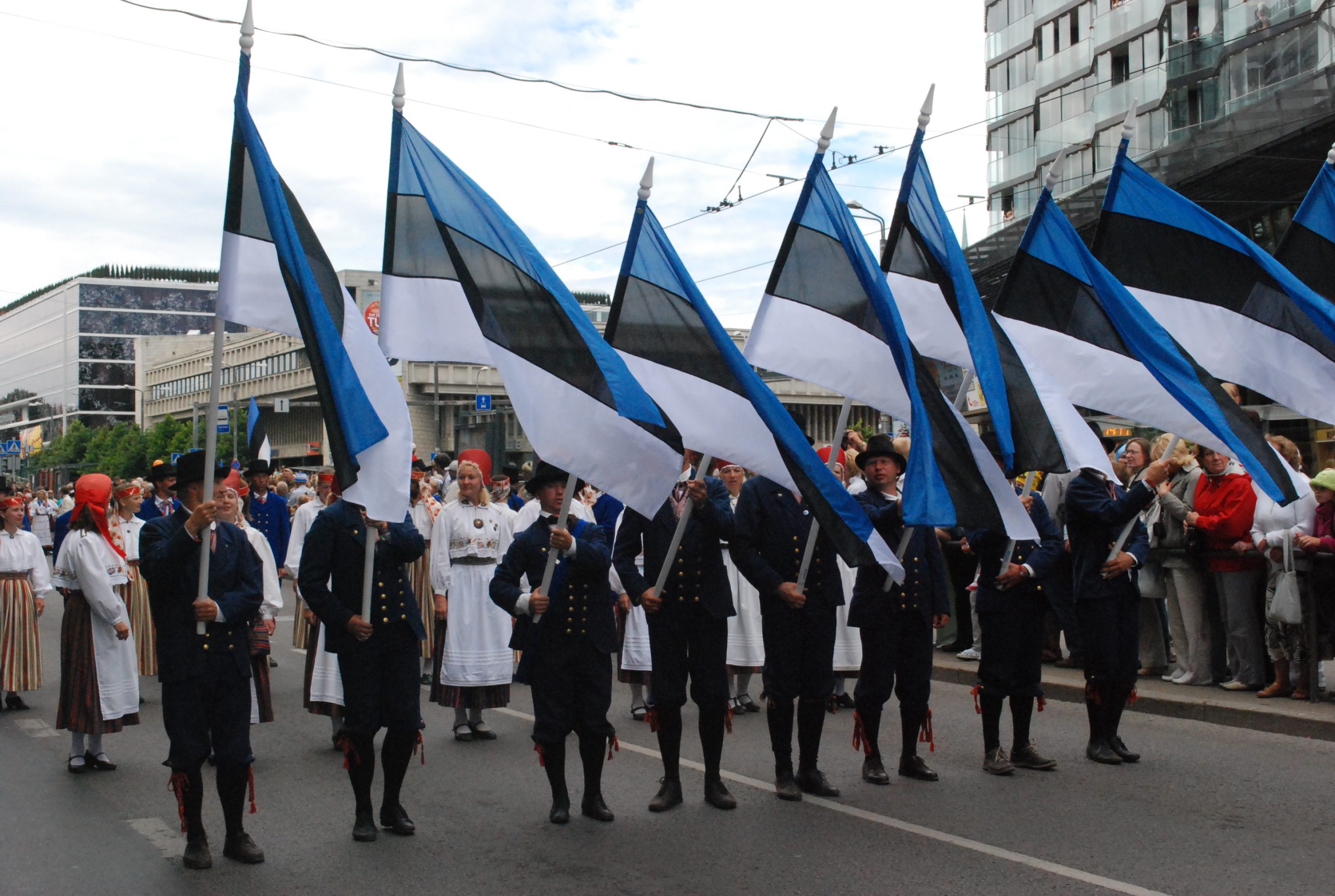
They called it Eesti Lakewood. Not on any New Jersey road sign, not on the Garden State Parkway exit boards. But for two generations after the Second World War, if you turned off Route 9 onto Cross Street and kept going, you would hear the same songs that had been sung in Tartu and Pärnu before the Red Army crossed the border. Children reciting Estonian grammar on Friday evenings. Mid-summer parties under pine trees. A blue, black and white flag raised over a low concrete-block hall a hundred miles from the Atlantic coast, four thousand miles from home.
The Place Itself
Lakewood sits in Ocean County, inland from the Jersey Shore, about an hour and a half south of New York City on Route 9 and the Garden State Parkway. Once a Gilded Age health resort with grand hotels and lakeside estates, by the mid-twentieth century it had settled into a quiet, wooded New Jersey township. The Estonian community’s hub is actually just over the township line in Jackson, on a wooded lot at 4 Cross Street and Veterans Highway. Locals still call the whole network “Lakewood Estonian” anyway. The town itself was chosen for the same reason every other refugee community of that era chose somewhere outside the cities: cheap land, pine forest, and the feeling of room to breathe.
How It Became Estonian
Before the Refugees
A handful of Estonians had filtered through Lakewood since the early twentieth century, often after a first landing in New York. References to an Estonian “society” in the town go back as far as 1904. Through the 1930s a small group moved out from Manhattan and Brooklyn looking for land, summer weekends and a Sunday escape from the boarding houses of the Lower East Side.
It was a quiet pre-war presence. A handful of families, a few picnics, an occasional choir rehearsal. The catalyst was still in the future, on the other side of the Atlantic.
The Põgenikud Arrive
In the autumn of 1944, as the Red Army pushed back into Estonia for the second time in the war, roughly 80,000 Estonians fled. They left on fishing boats across the Baltic to Sweden, on packed German transports across the Baltic to East Prussia, on foot through Latvia and Lithuania. They are remembered in Estonian as the põgenikud, the runaways. Most of them ended up in displaced persons camps in occupied Germany, in places like Geislingen, Augsburg and Lübeck, where they waited.
The wait lasted years. The United States was slow to open its doors, and when Congress finally passed the Displaced Persons Act in 1948, the rules excluded anyone with tuberculosis and anyone who had been conscripted into the German army, which removed many young Estonian men by default. Even so, between 1949 and the early 1950s thousands of Estonians left the German camps for the United States, sponsored by churches, by relatives, by farm employers, by anyone who would sign for them.
One of the largest single landings was in New Jersey itself. From April 1949, more than 650 Estonian displaced persons were resettled at Seabrook Farms in Cumberland County, a frozen-food operation that recruited Baltic refugees by the trainload. From Seabrook, and from the New York docks, families filtered out across the state. A great many of them went north to Lakewood.
Lakewood at Its Peak
The Lakewood Estonian Association was founded in 1945 by twenty-eight people, before most of the post-war wave had even arrived. Its first president was Konstantin Lacht, who donated the land at Cross Street and New Egypt Road for a clubhouse. The original Estonian House was built in 1947, mostly by volunteer labour, on a wooded lot that has since been expanded and added to many times.
When the refugees from the DP camps arrived between 1949 and the early 1950s, the house was already standing. They had a place to come to on the first Sunday. They had a place to register their children for the Lakewood Estonian School, which has run continuously since 1950. They had a sauna, a stage, a kitchen, a bar, and a tenting area for the bigger summer gatherings.
By the mid-1950s the community had layered into the rhythm familiar to every post-war refugee enclave. School on Friday evenings. Choir practice. Bridge club, garden club, chess club, stamp club, a senior citizens’ group, a teen group. Independence Day on the 24th of February, with the flag raised and the anthem sung as though Tallinn might be listening. Midsummer, jaanipäev, with bonfires in the woods behind the house.
The Change
Two things shifted in slow motion. First, the founders aged. The men and women who had been in their thirties when they walked out of the DP camps in 1949 were in their seventies by the late 1980s, and the second generation, born in New Jersey, never had quite the same hunger for the house every Friday night. Many moved to Princeton, to North Jersey for engineering and law jobs, to New York suburbs, to Boston, to the West Coast.
Second, Estonia regained its independence in 1991. For decades the community in Lakewood had functioned partly as a government-in-exile of culture: hold the language, hold the songs, hold the flag, until the country comes back. When it did come back, the urgency softened. Younger Estonian Americans began visiting Tallinn instead of inheriting it.
The Landmarks
Lakewood Estonian House (Lakewoodi Eesti Maja), 4 Cross Street and Veterans Highway, Jackson. The clubhouse built in 1947 on land donated by Konstantin Lacht, expanded several times since. Kitchen, two banquet halls, stage, indoor and outdoor bar, performance area, sauna, tenting area. Still in operation, still the spine of the community, with the Lakewood Estonian Association running cultural, youth, sports and social programmes from inside it.
Lakewood Estonian School (Lakewoodi Eesti Kool), at the Estonian House. Founded in 1950 and still operating on Friday evenings. Director Külli Rannamäe oversees lessons in Estonian language, history and culture for children of the community, plus newer arrivals from Estonia itself.
Estonian Evangelical Lutheran Church of the Holy Spirit, 607 East 7th Street, Lakewood. The Lakewood Estonian Lutheran congregation was established on 12 February 1949, at the exact moment the DP-camp arrivals needed somewhere to baptise children, marry, mourn, and pray in Estonian. The altar painting depicts the fate of the Estonian people, with Christ standing over those deported to Siberia, those fighting in the forests, and those escaping by sea to a new country.
Estonian Archives in the United States, 607 East 7th Street, Lakewood. Co-located at the church, the archives hold letters, photographs, parish records, choir scores and personal papers from the diaspora, curated for decades by volunteers. It is the closest thing the American Estonian community has to a national memory bank.
Järvemetsa Scout and Guide Camp, Jackson. The Estonian Boy Scouts and Girl Guides camp on 82 wooded acres a short drive from the Estonian House, opened in 1957 and run by the Federation of Associations for the Advancement of Estonian Youth. The statutes for the federation were approved at the Lakewood Estonian House on 5 September 1954. Generations of Estonian American children spent two weeks each summer at Järvemetsa learning the language, the folk dances, and the songs.
The Estonian Independence Day flag raising, 24 February each year. Not a building, but the most reliable annual gathering of the Lakewood community for the better part of seventy years. The blue, black and white flag goes up at the Estonian House and the anthem is sung, regardless of weather, regardless of who is in town.
Where They Came From
The Lakewood Estonians did not come from a single county or village. The 1944 flight pulled people from across Estonia: the capital Tallinn, the university town of Tartu, the coastal cities of Pärnu and Haapsalu, the islands of Saaremaa and Hiiumaa, the rural parishes of Viljandi and Võru. What they had in common was not a hometown, it was a route. Most spent four to five years in displaced persons camps in the American zone of occupied Germany, in Geislingen, Augsburg, Lübeck and similar places, before being sponsored to the United States after 1948.
A smaller stream came via Sweden, where about 25,000 Estonians had crossed in fishing boats in the autumn of 1944. Some of those families later moved on to the United States in the 1950s and 1960s when American immigration rules eased. A few Lakewood old-timers can still trace a sea crossing in a leaking trawler, then a Swedish village, then a transatlantic liner, then a bus down Route 9.
Lakewood Today
The Estonian community in Lakewood today is small and quiet. The Estonian House is still there, still running events, still hosting the school, the choir and the independence day flag-raising. Membership of the Lakewood Estonian Association sits just above a hundred, with a wider circle of friends and second- and third-generation descendants who come back for the bigger gatherings. The Lutheran congregation on East 7th Street still holds services. The archives are still being added to. Järvemetsa still fills with children every July.
Around them, the town itself has changed beyond recognition. Lakewood is now best known nationally as one of the largest Orthodox Jewish communities in the United States, anchored by the Beth Medrash Govoha yeshiva, which was relocated from White Plains by Rabbi Aharon Kotler in 1943 and has since grown into one of the largest centres of Talmudic study in the world. The Orthodox population of Lakewood Township exploded after 2000 and the town’s overall population has grown by more than 45 per cent in a single decade. The Estonian layer is now a small heritage thread in a town with a very different dominant identity.
That is not a tragedy. The Lakewood Estonians never set out to take over a town. They set out to hold a country together in exile, in a Friday-night classroom and a Sunday choir, until the country itself was free again. By that standard, what they built has outlasted its assignment. The songs are still being sung at Järvemetsa each summer, in the same key as Tallinn, four thousand miles away.
Frequently Asked Questions
Why did Estonians settle in Lakewood, New Jersey?
A small Estonian presence existed in Lakewood from the early twentieth century, drawn by cheap land and pine forest within reach of New York. The community grew dramatically after the Second World War, when Estonian refugees fleeing Soviet occupation arrived from displaced persons camps in Germany. By 1945 the Lakewood Estonian Association had been founded and by 1947 the Estonian House was open, ready to receive the larger DP wave that arrived between 1949 and the early 1950s.
Is Lakewood still Estonian today?
The Estonian community in Lakewood is small but active. The Lakewood Estonian House, the Estonian School, the Estonian Evangelical Lutheran Church of the Holy Spirit and the Estonian Archives in the United States are all still operating. The town itself, however, is now nationally identified with its large Orthodox Jewish community centred on the Beth Medrash Govoha yeshiva.
What are the main Estonian landmarks in Lakewood?
The key landmarks are the Lakewood Estonian House at 4 Cross Street and Veterans Highway in Jackson, the Estonian Evangelical Lutheran Church of the Holy Spirit at 607 East 7th Street in Lakewood, the Estonian Archives in the United States at the same address, and Järvemetsa Scout and Guide Camp on 82 acres in Jackson. Together they form the Lakewood Estonian network.
Where in Estonia did the Lakewood community come from?
The Lakewood Estonians came from across Estonia rather than a single region. The 1944 flight from the advancing Red Army pulled people from Tallinn, Tartu, Pärnu, Haapsalu, the islands of Saaremaa and Hiiumaa, and the rural parishes of southern Estonia. Most spent several years in displaced persons camps in occupied Germany before being sponsored to the United States after the 1948 Displaced Persons Act.
When did Estonians first arrive in Lakewood?
Individual Estonians settled in Lakewood from the early twentieth century, with references to an Estonian society in the town as early as 1904. The community took its modern shape in the 1940s, with the Lakewood Estonian Association founded in 1945 and the Estonian House built in 1947. The largest wave of arrivals came between 1949 and the early 1950s, as Estonian refugees from the German DP camps were resettled to the United States.
What happened to the Estonian community in Lakewood?
The founding generation has aged and many of their descendants have moved to Princeton, North Jersey, New York and beyond. After Estonia regained independence in 1991 the urgency of holding a culture in exile softened, and the community shrank. The institutions persist, but the active membership of the Lakewood Estonian Association now sits just above a hundred people.
If your family’s story passed through Lakewood, or any of the places the Estonian põgenikud made home in the long years between 1944 and 1991, Atlas of Home can help you trace that journey. From a fishing boat across the Baltic in the autumn of 1944, to a DP camp in Geislingen, to a Friday-night classroom on Cross Street, to wherever you are now.