
They called it Hell’s Kitchen, and for a hundred years they meant it. From the 1850s through the 1980s, if you walked west of Eighth Avenue between 34th and 59th Street, you were in working-class Catholic Ireland. The smell was tanneries and slaughterhouses and the coal smoke off the New York Central freight cars. The accent was Cork, Kerry, Galway, Mayo.
Two priests, a hundred saloons, the Gophers in the cellars, the Westies in the back rooms, and Sacred Heart bells over it all. By 1900, this was the densest Irish quarter in Manhattan. Today, fewer than one resident in ten claims any Irish heritage at all.
Hell’s Kitchen, The Place
Hell’s Kitchen sits on the West Side of Midtown Manhattan, running roughly from 34th Street to 59th Street, between Eighth Avenue and the Hudson River. For more than a century it was the working flank of the island, hemmed in by the Hudson River piers to the west, the New York Central freight yards along Tenth and Eleventh Avenues, and the slaughterhouses and tenements in between.
The housing is tenement brick, five and six storey walk-ups, with newer apartment towers wedged between since the 1980s. The A, C and E trains run under Eighth Avenue and the 7 reaches 34th Street and Eleventh. Times Square is its eastern doorstep, and the Lincoln Tunnel exits straight onto Tenth Avenue. The Theatre District sits inside it.
How Hell’s Kitchen Became Irish
Before the Irish
Before it had a name, the area west of Eighth Avenue was farmland, market gardens and a scattering of squatter shanties. The shoreline of the Hudson ran along what is now Eleventh Avenue. Old Dutch and English landowners held the larger parcels through the early nineteenth century.
The change began in 1851, when the Hudson River Railroad pushed its tracks up the West Side along Tenth and Eleventh Avenues. The piers expanded with it. The land between, cheap, smoky and unwanted, was about to find its tenants.
The Irish Arrive
Famine Ireland reached Hell’s Kitchen by the back door, walking uptown. The Great Hunger of 1845 to 1852 had driven more than a million Irish to North America, and New York took the largest share. The first arrivals crowded into Five Points and the Lower East Side. By the mid-1850s, rents downtown were rising and the new docks and rail yards uptown were hiring.
Irish labourers and their families moved north along Eighth and Ninth Avenues into the cheap blocks west of the train line. They built the shantytowns first, on bedrock outcrops where rents could be skipped. Then the tenement landlords arrived, and the shanties became four storey walk-ups crammed twelve families to a building.
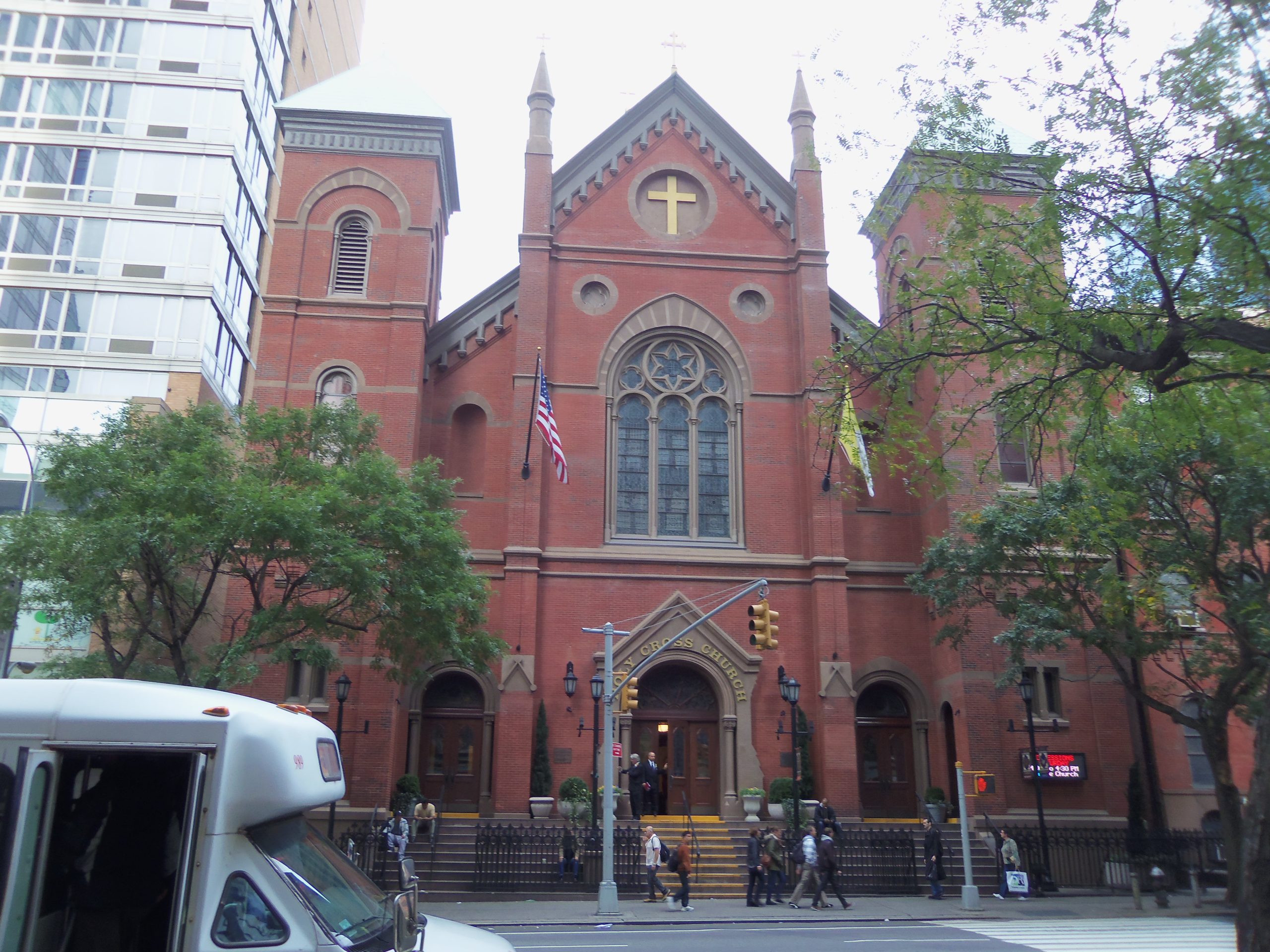
The anchor went up in 1852. The Church of the Holy Cross on West 42nd Street was founded that year to serve the Irish Catholics moving up from Five Points. A chapel was put up almost immediately, outgrown within two years, and replaced with the present church in 1870 after a lightning strike destroyed the second building. Holy Cross became the parish that announced the neighbourhood: Irish, Catholic, working, here to stay.
The work followed the men off the boat. The Hudson piers needed longshoremen. The slaughterhouses along Eleventh Avenue needed butchers and bone-haulers. The New York Central yards needed brakemen, switchmen, freight handlers. The tanneries off Twelfth Avenue needed anyone with hands. By 1880 the West Side was the largest Irish employer in Manhattan outside the police force.
Hell’s Kitchen at Its Peak
By the turn of the twentieth century the West Side was a city inside a city. Sacred Heart of Jesus on West 51st Street, founded in 1876, took the northern half of the neighbourhood. Holy Cross took the southern half. Between them, six parish schools educated a generation of West Side Irish.
The blocks each had their own character. The dock blocks west of Tenth were Cork and Kerry. The tenements east of Tenth had more Galway and Mayo. Sunday Mass at Holy Cross or Sacred Heart was followed by a walk back along Ninth Avenue, where the bakeries and saloons had been open since dawn.
The street gangs that came with the poverty are now folklore, but they were real. The Gophers ran the blocks from 14th to 42nd Street in the 1890s and 1900s, named for the tenement basements where they held court. One Lung Curran led them first. Owney Madden took over in the 1910s and ran them until prison and Prohibition turned him into a Cotton Club bootlegger. A women’s auxiliary, the Lady Gophers, operated under Battle Annie Welsh, whose specialty, the historians say, was a thrown brick.
The Catholic parish, the saloon and the Tammany ward club between them carried the neighbourhood. A new arrival from Ireland would find lodging through a cousin on the same block, a job through the foreman at the church door, and a vote through the ward heeler at the bar. Father Francis Patrick Duffy walked into the middle of this in 1921 and became its public face.
Duffy had been chaplain to the 69th Infantry Regiment, the Fighting 69th, an almost entirely Irish-American New York unit, on the Western Front from 1917 to 1918. He came home the most decorated military chaplain in United States Army history, holding the Distinguished Service Cross, the Distinguished Service Medal, the Legion of Honour and the Croix de Guerre. He was made pastor of Holy Cross in 1921 and held the post until his death in June 1932.
He was unmistakable on 42nd Street: a stocky, gruff, beloved priest who knew the printers, longshoremen, cops and chorus girls of his parish by name. He won a special dispensation from Rome to celebrate a 2:30 a.m. Sunday Printer’s Mass for the nocturnal compositors of the New York Times, Daily News and Herald Tribune. When he died, twenty-five thousand people filed past his coffin at Holy Cross.
The Change
The fall of Irish Hell’s Kitchen came in two long waves. The first was the slow attrition of the postwar years. From the 1950s onwards, the children and grandchildren of Famine immigrants moved out to Inwood, Woodside, Yonkers, the Rockaways, and across the Hudson to Bergen County. The 1965 Immigration Act ended the European-quota system that had once channelled new Irish arrivals here.
The second wave was sharper and uglier. From the late 1960s, a remnant Irish-American crew calling themselves the Westies took over what was left of the West Side rackets. Mickey Spillane held the territory until 1977, when he was killed in a hit set up by James “Jimmy” Coonan, who then ran the gang with his second in command Francis “Mickey” Featherstone. Federal prosecutors later attributed at least thirty murders to the Westies. Coonan was convicted under the RICO Act in 1988 and sentenced to seventy-five years. Featherstone had already turned state’s evidence in 1986.
While the Westies were burning what remained of the old neighbourhood, the real estate market was rebranding it. From the late 1950s, business owners and city officials had tried to rename the area Clinton, after DeWitt Clinton Park at 52nd Street and Eleventh Avenue. The Clinton name took hold on tax maps and rental listings. On the street it never stuck.
Gentrification accelerated through the 1980s and 1990s, then ran hot from 2000 onwards. The piers closed. The slaughterhouses closed. The freight yards became Hudson Yards. The walk-ups filled with theatre kids, restaurant workers and tech employees. By the early 2020s, a one-bedroom in Hell’s Kitchen rented for more than the entire weekly wage of a 1950s longshoreman.
The Landmarks of Irish Hell’s Kitchen
Church of the Holy Cross, 329 West 42nd Street. Founded in 1852, the present church completed in 1870 to a design by Henry Engelbert, Holy Cross is the oldest building on 42nd Street and the spiritual root of the Irish neighbourhood. Father Francis Patrick Duffy was its pastor from 1921 to 1932 and is the reason most New Yorkers still know its name. The parish merged with St. John the Baptist in recent years but Holy Cross remains open for Mass, across the street from the Port Authority Bus Terminal.
Father Duffy Square, Times Square, Broadway between 46th and 47th Streets. The northern triangle of Times Square was renamed Father Duffy Square in 1937, five years after his death. The bronze statue of Duffy in his army chaplain’s overcoat, sculpted by Charles Keck and unveiled in May 1937, stands with a Celtic cross at his back. It is the closest thing the Irish of the West Side have to a permanent monument in Manhattan, and a million people pass it every week without knowing whose feet they are standing at.
Sacred Heart of Jesus Church, 457 West 51st Street. Founded in 1876 with Father Martin J. Brophy as the first pastor, Sacred Heart anchored the northern half of Hell’s Kitchen. Its Romanesque red brick and terra cotta facade, designed by Napoleon LeBrun and Sons, still stands above 51st Street. The congregation was Irish and German for most of its first century and is Latino and African today, but the building, the school next door and the food pantry are continuous threads to 1876.
Landmark Tavern, 626 Eleventh Avenue at 46th Street. Opened in 1868 by Patrick Henry Carley, a Famine-era immigrant, the Landmark sat right on the Hudson shoreline before Twelfth Avenue was filled in. Carley lived above the bar with his family and turned the third floor into a speakeasy during Prohibition. The saloon fed and watered Hell’s Kitchen dockworkers and merchant seamen for over a century, was a known Westies hangout in the 1970s and 1980s, and still pours pints and serves shepherd’s pie in 2026. It is one of the oldest continuously operating bars in New York City.
The Hudson River Piers and the New York Central Freight Yards, Twelfth Avenue. The working ghosts of Irish Hell’s Kitchen are the piers and rail yards themselves. From the 1850s into the 1960s, two and three generations of West Side Irish men worked the longshore. The piers are now Hudson River Park, the freight yards are now Hudson Yards, and the elevated High Line is the last visible trace of the New York Central infrastructure that paid the rent on every tenement east of Eleventh Avenue.
The 69th Regiment Armory, 68 Lexington Avenue. Strictly across town in Gramercy, but inseparable from Hell’s Kitchen Irish identity. The Fighting 69th, almost entirely Irish-American, drew its enlisted men from the West Side and the East Side tenements alike. Father Duffy went to France with them, came home to Hell’s Kitchen with them, and is still claimed by the regiment as their priest. The armory remains an active National Guard facility and an annual gathering point on St. Patrick’s Day.
Rudy’s Bar & Grill, 627 Ninth Avenue. A working-class West Side dive in continuous operation since 1933 (and a speakeasy through Prohibition before that), Rudy’s is the closest thing the neighbourhood has to a living museum of pre-gentrification Hell’s Kitchen. Free hot dogs, red vinyl booths held together with duct tape, and a pig statue out front. Generations of Irish longshoremen, stagehands and printers drank here. Theatre crews still do.
Where the Hell’s Kitchen Irish Came From
The Irish of Hell’s Kitchen were Famine emigrants and the chain that followed them. The first wave, from roughly 1846 to 1855, was overwhelmingly the rural Catholic poor of the west and south of Ireland, the regions hit hardest by the potato blight. County Cork sent the largest share, with County Kerry, County Galway and County Mayo close behind, and smaller groups from Limerick, Clare and Tipperary.
Later arrivals followed family. A brother in a Tenth Avenue tenement would put up a sister, a cousin, a neighbour from home, and the same parish or townland would seed an entire block. By the 1880s and 1890s, the chain reached deep into Connacht, with Mayo and Galway families well represented. The pattern continued, thinner each decade, into the mid-twentieth century, when post-Independence economic migration brought a final small wave of Irish from the rural West.
Hell’s Kitchen Today
Hell’s Kitchen in 2026 is one of the most expensive zip codes in the country and looks nothing like the neighbourhood Father Duffy walked. The piers are a park. The freight yards are Hudson Yards. The slaughterhouses are condos. The theatre district has spilled west of Eighth Avenue and the tech industry has filled in behind it. The Westies are a Wikipedia article and a Mickey Featherstone documentary.
The Irish community that built all of this is mostly gone, scattered to Inwood, Woodside, the Bronx and the Jersey suburbs, or to grandchildren who have never set foot here. Real estate listings still try to call it Clinton. Locals still call it Hell’s Kitchen. The theatre and tech newcomers do too.
What remains is concentrated and stubborn. Holy Cross still opens its doors on 42nd Street. Sacred Heart still rings its bells over 51st. The Landmark still pours pints in a Famine-era saloon. Rudy’s still hands out free hot dogs. Father Duffy still stands in bronze above Times Square, in his army overcoat with a Celtic cross at his back, looking down at a million tourists a week and recognising none of them. The neighbourhood he served has moved out to the boroughs and the suburbs. The buildings he served from are still here.
Frequently Asked Questions
Why did the Irish settle in Hell’s Kitchen?
Famine-era Irish immigrants moved up from Five Points and the Lower East Side in the 1850s for cheap rent and steady work on the new Hudson River piers, the slaughterhouses along Eleventh Avenue, the tanneries, and the Hudson River Railroad (later the New York Central) freight yards on Tenth and Eleventh. The founding of Holy Cross parish in 1852 gave the Irish community an anchor, and chain migration from Cork, Kerry, Galway and Mayo did the rest. By 1900, Hell’s Kitchen was the densest Irish quarter in Manhattan.
Is Hell’s Kitchen still Irish today?
Barely. A century of suburbanisation, the closure of the West Side piers and rail yards, the violence of the Westies era, and forty years of gentrification have emptied the neighbourhood of its working-class Irish population. What remains is a handful of surviving Irish bars, two historically Irish parishes, and the Father Duffy statue in Times Square. The descendants live in Inwood, Woodside, the Bronx, Bergen County and further afield.
What are the most famous Irish landmarks in Hell’s Kitchen?
The Church of the Holy Cross at 329 West 42nd Street, where Father Francis Patrick Duffy served as pastor from 1921 to 1932, is the spiritual heart of Irish Hell’s Kitchen. Sacred Heart of Jesus at 457 West 51st Street is the second historic parish. The Landmark Tavern at 626 Eleventh Avenue, opened by Patrick Henry Carley in 1868, is the oldest surviving Irish saloon in the neighbourhood. Father Duffy Square in Times Square holds the Charles Keck bronze of Father Duffy, unveiled in 1937.
Where in Ireland did the Hell’s Kitchen Irish come from?
The first Famine wave from 1846 to 1855 was dominated by rural Catholics from the west and south of Ireland, with County Cork sending the largest share, followed by Kerry, Galway and Mayo, and smaller numbers from Limerick, Clare and Tipperary. Chain migration through the late nineteenth and early twentieth centuries pulled in more families from Connacht, particularly Mayo and Galway. A final, smaller wave came from rural western Ireland in the mid-twentieth century.
When did the Irish first arrive in Hell’s Kitchen?
Significant Irish settlement in Hell’s Kitchen began in the 1850s, after Famine refugees crowded out of Five Points and the Lower East Side and followed the new Hudson River Railroad and the expanding piers up the West Side. The community took institutional shape with the founding of Holy Cross parish in 1852, peaked in size and density between 1880 and 1920, and held the neighbourhood as a working-class Irish quarter until the postwar suburban exodus and the gentrification of the 1980s.
What happened to the Westies?
The Westies were a small but extremely violent Irish-American crew that controlled the West Side rackets from the late 1960s through the 1980s. Federal prosecutors attributed at least thirty murders to the gang. Mickey Featherstone turned state’s evidence in 1986. Jimmy Coonan was convicted under the RICO Act in 1988 and sentenced to seventy-five years. The gang did not survive the convictions, and the gentrification of Hell’s Kitchen finished what the courts started.
If your family’s story passed through Hell’s Kitchen, or any of the places the Irish made home in the United States, Atlas of Home can trace that journey. From a Cork townland or a Mayo parish to a Tenth Avenue tenement, to wherever your story continues now.