
They called it Polonia. Not officially, but if you stepped off a streetcar on Broadway in 1925 and walked east past Fillmore, every shop sign, every overheard conversation, every steeple on the horizon told you the same thing. You were in Poland. The bells of St. Stanislaus rang the noon Angelus. The bakeries smelled of rye and butter. And by 1940, over 75,000 people of Polish descent lived in Buffalo, most of them packed into the streets around this one corner.
The Place Itself
Broadway-Fillmore sits on Buffalo’s East Side, about two miles east of downtown and roughly a mile inland from the Buffalo River. The neighbourhood is bounded loosely by Genesee Street to the north, the railroad corridor to the south, and centres on the intersection of Broadway and Fillmore Avenue.
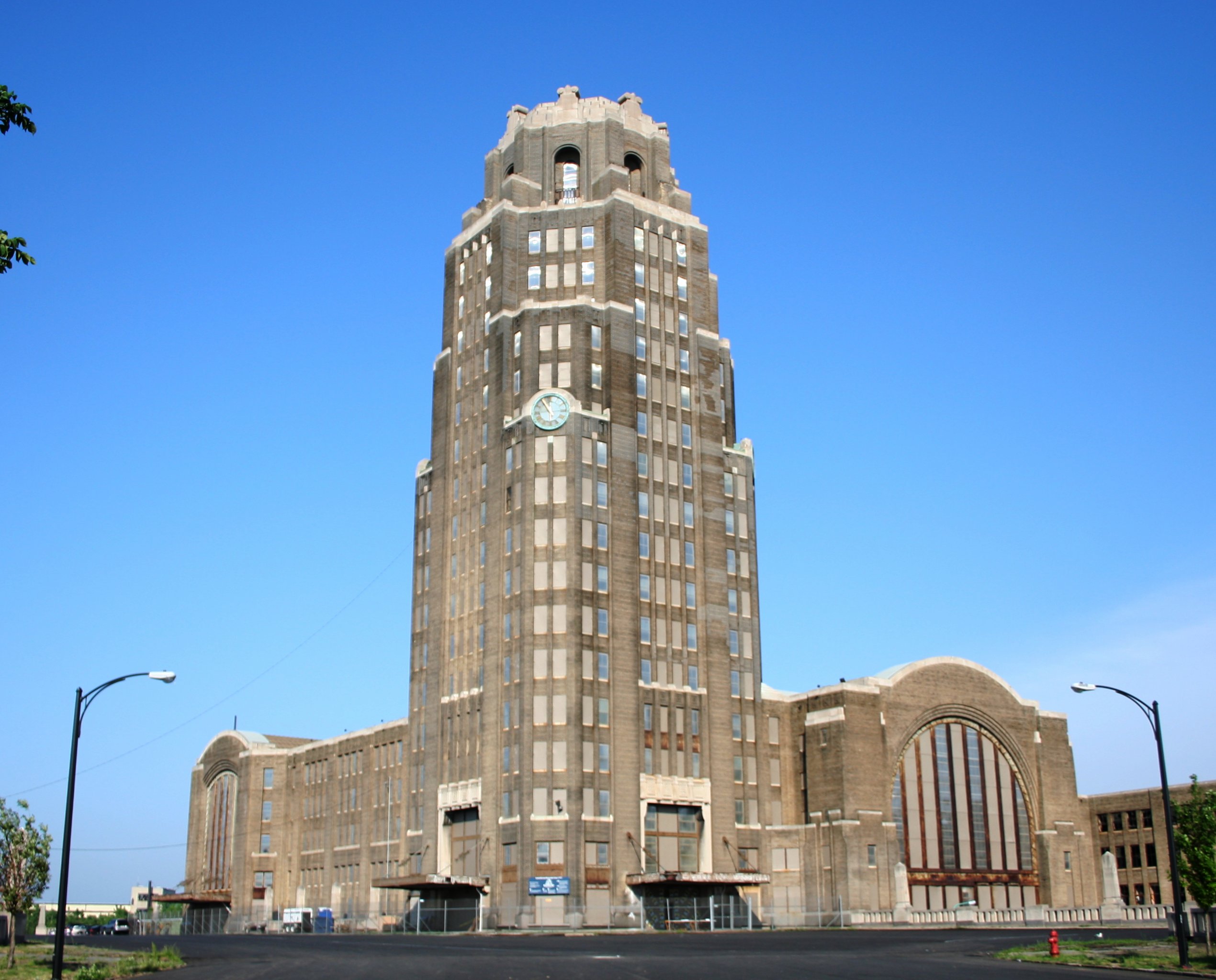
Its housing is dense and mostly wood-frame. Two-storey workers’ cottages line narrow lots laid out for families who walked to work at the rail yards, foundries, and grain elevators of the lower East Side. The Art Deco silhouette of the Buffalo Central Terminal rises over everything, visible from blocks away.
How It Became Polish
Before the Poles
Before the 1870s, the land east of Fillmore was farmland and scattered German homesteads. Germans had been Buffalo’s dominant Catholic group through mid-century, and the first Catholic parishes on the East Side served them. The arrival of the railroads and the expansion of the lakefront grain trade pulled industry eastward, and with industry came a need for cheap labour.
The First Polish Families Arrive
The first Polish families came to Buffalo in the late 1860s and early 1870s. They were largely from the Prussian partition, the region around Poznań known to the German authorities as Posen. Bismarck’s Kulturkampf and the Germanisation policies of the 1870s made life unbearable for Polish Catholics, and the steamship companies in Bremen and Hamburg made the Atlantic crossing affordable for the first time.
By 1873 there were already 500 Polish people clustered around what is now Townsend Street. That summer, Reverend Jan Pitass, a young priest newly arrived from Poland, founded the parish of St. Stanislaus, Bishop and Martyr. It became the mother church of Buffalo Polonia, and Pitass himself helped establish roughly twenty more Polish parishes across Western New York over the next forty years.
Polonia at Its Peak
The 1890s brought the largest wave. Poles now came not just from Prussian Posen but from Congress Poland under Russian rule and from Austrian Galicia. Chain migration did the rest. A brother sent for a brother, a husband sent for a wife, a village in Wielkopolska or near Kraków emptied house by house into the same few streets off Broadway.
Most men found work in the rail yards of the New York Central, in the iron foundries along the lakefront, in the tanneries, and at the great grain elevators that fed the Erie Canal trade. Women took piecework in the ready-made clothing factories or kept boarders. Wages were thin and the work was brutal, but a man could buy a wood-frame cottage on a narrow East Side lot within a decade of arrival.
By 1910 Polonia held over 2,900 Polish-owned businesses and fourteen community banks. There were Polish-language newspapers, Polish theatres, Polish funeral homes, Polish saloons on every other corner. Children walked to parochial schools where the morning prayers were in Polish and the afternoon lessons in English. At its peak, Buffalo’s Polonia was one of the largest Polish settlements in the United States, comparable only to Chicago and the steel valleys of western Pennsylvania.
The Change
The Immigration Act of 1924 slammed the door on new arrivals. The flow of Polish families across the Atlantic, which had been a torrent for three decades, slowed to a trickle. The neighbourhood lived on its own internal growth for another generation.
Then came the post-war suburban migration. Returning GIs took VA loans and bought new houses in Cheektowaga, Depew, and Lackawanna. The factories that had anchored the East Side closed or moved. By the 1970s the rail yards were quiet and the Central Terminal was running its last passenger trains. In 1979 Amtrak abandoned the terminal entirely. The grandchildren of Polonia had already left for the suburbs, and the houses they left behind began the long decline that defines the neighbourhood today.
The Landmarks
St. Stanislaus Bishop and Martyr Church, 123 Townsend Street. Founded by Reverend Jan Pitass in June 1873, this is the mother church of Buffalo Polonia. The present brick basilica was completed in 1886, and its twin 217-foot towers, fitted with their bells and clocks in 1908, remain the tallest landmark in the neighbourhood. Generations of Polish families were baptised, married, and buried from here.
Corpus Christi Church, 199 Clark Street. Founded in 1898 by Franciscan friar Hyacinth Fudzinski, Corpus Christi was the seventh Polish parish in Buffalo and grew so fast that the present Romanesque Revival church, of Onondaga limestone and red Medina sandstone, had to be built within ten years. Dedicated in 1909 by Bishop Pawel Rhode, the first Polish bishop in America, it remains an active parish today under the Pauline Fathers from the Shrine of Our Lady of Częstochowa.
The Broadway Market, 999 Broadway. The market traces its origins to an 1888 petition by Polish housewives who were tired of walking two miles to the Washington Street Market. The City Council yielded, and the open-air Broadway Market opened on 24 March 1890. The current indoor hall dates to 1956. Every spring the market fills with Buffalonians buying pierogi, kielbasa, rye breads, and the famous butter lambs that Malczewski’s has been hand-shaping for Easter baskets since Dorothy Malczewski invented the form in 1963.
Buffalo Central Terminal, 495 Paderewski Drive. The Art Deco station opened on 22 June 1929 with a grand celebration for 2,200 guests. Designed by Fellheimer and Wagner for the New York Central Railroad at a cost of $14 million, its seventeen-storey tower was meant to anchor a new commercial district. The trains stopped in 1979, the building was stripped piece by piece by speculators, and it stood as a haunting ruin for decades. The non-profit Central Terminal Restoration Corporation now owns the site and has begun the long work of bringing it back.
Pączki Day at the Broadway Market. Not a place but an annual ritual. On Fat Tuesday the queues snake out the door for pączki, the rich filled doughnuts traditionally eaten to use up the lard and eggs before Lent. Families who left for Cheektowaga two generations ago still drive back for them.
Where They Came From
There was no country called Poland in the years Polonia was built. The Polish state had been partitioned in 1772, 1793, and 1795 between Prussia, Russia, and Austria, and it would not reappear on a map until 1918. The Poles who arrived in Buffalo carried passports from one of those three empires, but they thought of themselves as Polish and they thought of home as a village.
The earliest waves came from the Prussian partition, especially the province of Posen around Poznań and the wider region of Wielkopolska. They were leaving Bismarck’s anti-Catholic Kulturkampf and the forced Germanisation of the schools. Later waves came from Congress Poland under Russian rule, from villages around Warsaw, Łódź, and Płock, escaping conscription into the Tsar’s army and the grinding poverty of the countryside. The last large group, arriving from the 1890s through the 1910s, came from Austrian Galicia, from the hills around Kraków, Tarnów, and Rzeszów, places that gave the world the word “Galician” as a near-synonym for poor.
Broadway-Fillmore Today
Broadway-Fillmore today is one of the most disinvested neighbourhoods in Buffalo. Whole blocks have been demolished. Vacant lots outnumber occupied houses on some streets. The Polish population that once defined every corner has scattered to Cheektowaga, Depew, and the southern suburbs, and the neighbourhood is now home to a smaller, mostly African American and refugee community that has inherited the streets without inheriting the steeples.
And yet the bones of Polonia are still here. St. Stanislaus still rings its bells. Corpus Christi still holds Mass. The Broadway Market still fills with the smell of kielbasa and yeasted dough every spring, and the queues at Easter still bring back the third and fourth generations from the suburbs. The Central Terminal Restoration Corporation has stabilised the tower and reopened parts of the concourse for events, and in 2021 the neighbourhood received a $10 million state grant for revitalisation.
For the descendants who left, Broadway-Fillmore is a place you drive back to once or twice a year, to buy a butter lamb on Holy Saturday or to walk a grandparent’s old block. The neighbourhood is no longer Polish in the way it was in 1925. But it is still, in a quieter and more stubborn way, Polonia.
Frequently Asked Questions
Why did Poles settle in Broadway-Fillmore?
Polish immigrants began arriving on Buffalo’s East Side in the 1860s and 1870s because of the cheap land east of Fillmore Avenue and the demand for labour in the nearby rail yards, foundries, tanneries, and grain elevators. The founding of St. Stanislaus parish in 1873 created an anchor that pulled chain migration directly to those few streets.
Is Broadway-Fillmore still Polish today?
No, not in the way it was. The Polish population mostly moved to suburbs like Cheektowaga and Depew across the second half of the twentieth century, and the neighbourhood is now smaller and more diverse. The Polish heritage is preserved through landmark churches, the Broadway Market, and active preservation groups, and descendants still return for major holidays.
What are the most famous Polish landmarks in Broadway-Fillmore?
The four essential landmarks are St. Stanislaus Bishop and Martyr Church at 123 Townsend Street, the mother church of Buffalo Polonia founded in 1873; Corpus Christi Church at 199 Clark Street, dedicated in 1909; the Broadway Market at 999 Broadway, which traces back to an 1888 Polish petition; and the Buffalo Central Terminal at 495 Paderewski Drive, the Art Deco rail station opened in 1929.
Where in Poland did the Broadway-Fillmore Poles come from?
The earliest families came from the Prussian partition, especially the Posen region around Poznań in Wielkopolska. Later waves came from Russian-ruled Congress Poland around Warsaw and Łódź, and from Austrian Galicia around Kraków and Tarnów. All three regions sent people to the same East Side streets.
When did Polish immigrants first arrive in Buffalo?
The first Polish families settled in Buffalo in the late 1860s and early 1870s, and the community grew rapidly enough that St. Stanislaus parish was founded in 1873 to serve 500 Polish residents on the East Side. The peak years of arrival were the 1890s through the early 1910s, and immigration effectively ended with the Immigration Act of 1924.
What happened to the Polish community in Broadway-Fillmore?
Polonia hit its peak around 1910 to 1930 with over 75,000 Buffalo residents of Polish descent. After the 1924 Immigration Act cut off new arrivals and post-war prosperity pulled families into the suburbs, the neighbourhood emptied across the 1950s, 60s, and 70s. The community persists today through Cheektowaga, Depew, and Lackawanna, with the historic churches and Broadway Market as the surviving anchors.
If your family’s story passed through Broadway-Fillmore, or any of the parishes the Poles built across the American steel and rail towns, Atlas of Home can trace that journey. From a village in Poznań or Galicia, to the cottages off Broadway, to wherever you are now.