
They called it The Hill. From the 1880s through the 1920s, if you stepped off the streetcar at the top of Atwells Avenue, you were not in Rhode Island anymore. You were in Campania, in Calabria, in Sicily. The talk on the sidewalk was dialect, the bread came from wood-fired ovens, and the saints’ feast days emptied the tenements into the street.
By 1905, roughly twenty thousand Italians lived on a tightly packed slope west of downtown Providence. It was the densest Italian neighbourhood in New England, and one of the most concentrated in the country.
The place itself
Federal Hill sits immediately west of Downtown Providence, separated from the city centre by the trench of Interstate 95. The neighbourhood runs along the high ground above the Woonasquatucket River, bounded by Westminster Street to the south and Route 6 to the north.
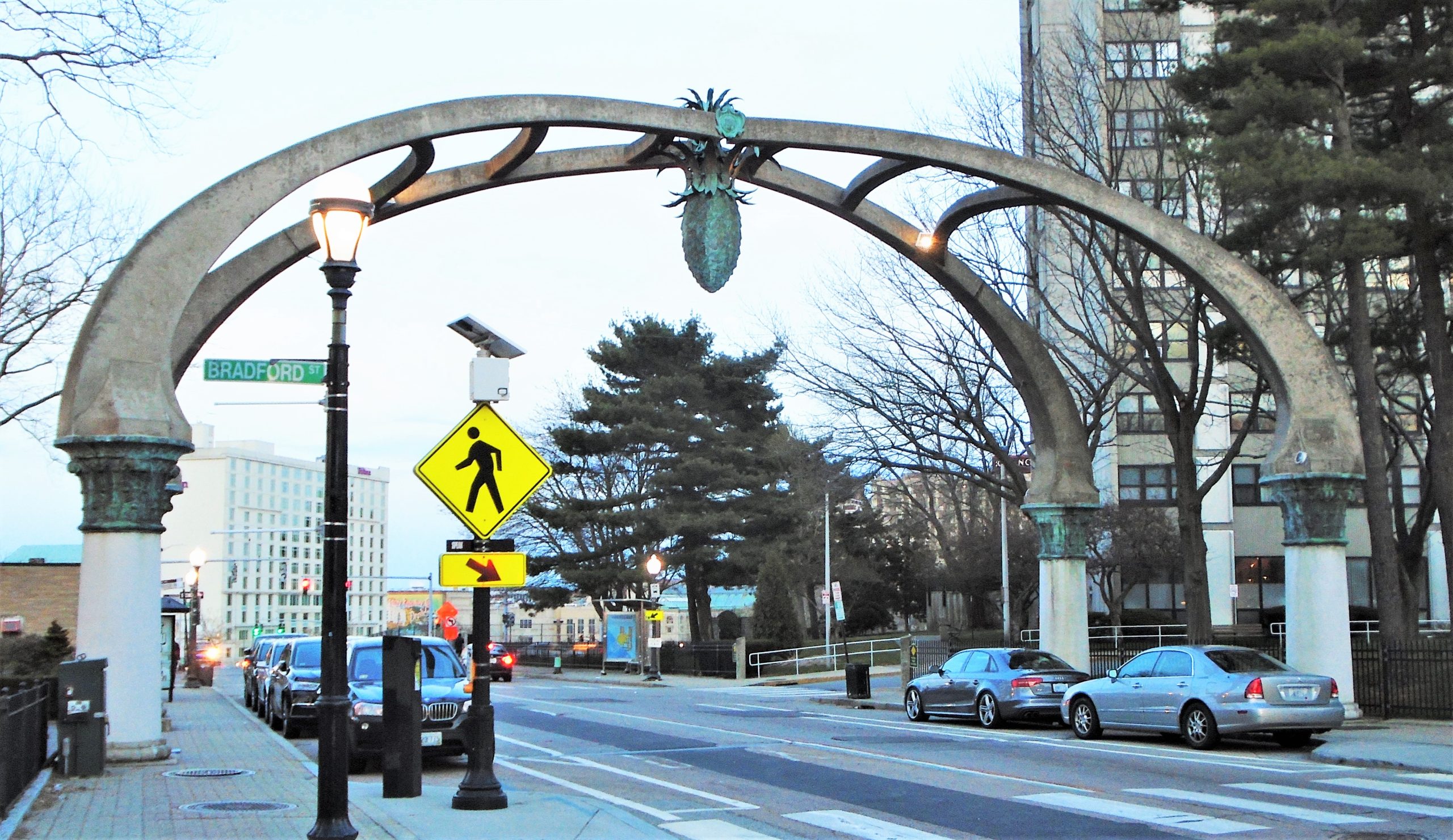
Atwells Avenue is the spine. It climbs gently west from the I-95 overpass, lined with three- and four-storey brick and frame blocks built between 1880 and 1920, most of them with shops on the ground floor and flats above. The eastern entrance is marked by an iron gateway arch with a bronze pine cone (La Pigna) hanging from its centre, installed in 1980 and now the neighbourhood’s emblem.
The median of Atwells Avenue is painted in the green, white, and red of the Italian tricolour instead of the usual yellow lines. You see it before you read the street signs.
How it became Italian
Before the Italians
Federal Hill was named for the Federalist celebrations held there in 1788, when Rhode Island ratified the United States Constitution. For most of the nineteenth century it was farmland and country estates owned by Providence’s mercantile class.
By the 1840s the lower streets were filling with Irish immigrants, many of them working in the city’s textile shops and iron foundries. After the Great Famine of 1845 to 1851 the Irish population grew sharply. For a generation, The Hill was an Irish neighbourhood. As late as 1895 the population was still roughly evenly divided between Irish and Italian families.
The Italians arrive
The first significant wave of Italians reached Federal Hill in the 1870s. They came chiefly from the impoverished agricultural south of the Italian peninsula, from Campania, Abruzzo, Calabria, Basilicata, Sicily, and Puglia, where the unification of Italy in 1861 had failed to lift the peasantry out of poverty.
What pulled them to Providence specifically was work. The city’s textile mills, machine shops, and silver and jewelry factories were hungry for labour. Italian men also filled the construction crews building Providence’s streetcar lines, sewers, and downtown blocks. Wages on The Hill could be five or ten times what a farm labourer earned in Avellino or Cosenza.
Chain migration did the rest. One man would come, find work, find a room, and write home. A brother followed. Then a cousin. Then a wife and children. Whole villages, in time, ended up on the same Providence street.
The peak: 1900 to 1925
By 1905 the Italian population of Federal Hill had reached roughly twenty thousand people, concentrated on a slope only about half a square mile in size. Atwells Avenue had become the commercial spine of Italian Rhode Island, lined with butchers, fish dealers, pasta makers, barbers, tailors, undertakers, and societies for every region of origin.
Holy Ghost Church on Atwells Avenue was the spiritual centre. The parish was founded in 1889 by the Scalabrinian missionaries, an order sent specifically by Bishop Giovanni Battista Scalabrini to serve Italian emigrants in the Americas. The church building, finished in 1910, was designed in the Italian Romanesque style, its facade modelled on the Basilica of Santa Maria Gloriosa dei Frari in Venice and its bell tower on the campanile of Saint Mark’s.
Daily life ran on dialect, parish, and trade. Men worked in the mills, on construction gangs, on the docks at India Point, or in the small jewelry shops that gave Providence the nickname “the jewelry capital of the world”. Women took in piecework, ran shops, raised children, and managed the household economy. Children attended the parish school or the public schools and learned English first in the schoolyard.
The neighbourhood’s frustrations occasionally boiled over. In 1914 a sharp rise in the wholesale price of pasta touched off what the Providence papers called the Macaroni Riots, with crowds on Atwells Avenue demanding that grocers roll their prices back.
The change
The federal Immigration Act of 1924 effectively closed the door on further Italian arrivals, slashing the annual quota from Italy by more than ninety per cent. The community on The Hill stopped being replenished from the old country. The next chapters were written by the second and third generations.
After the Second World War, returning veterans used GI Bill mortgages to buy single-family houses in Cranston, Johnston, and North Providence. The construction of Interstate 95 in the 1950s and 1960s sliced through the eastern edge of Federal Hill, demolishing housing and severing the neighbourhood from downtown. Many families left the tenements for the suburbs while keeping their parish, their bakery, and their Sunday loyalties on The Hill.
The landmarks
La Pigna arch
Atwells Avenue at Dean Street
The iron gateway arch over Atwells Avenue, with a heavy bronze pine cone (La Pigna) hanging from its centre, was installed in 1980 as part of a city redevelopment of the neighbourhood. Tourists routinely mistake the pine cone for a pineapple. In Italian tradition the pigna is a symbol of welcome, hospitality, and abundance, which is why you find it carved on the gateposts of old villas across Tuscany and Campania.
Holy Ghost Church
472 Atwells Avenue
Founded in 1889 by the Scalabrinian missionaries to serve Federal Hill’s growing Italian community, Holy Ghost is the mother parish of Italian Catholic life in Rhode Island. The current building was completed in 1910 in Italian Romanesque style, with a campanile modelled on Saint Mark’s in Venice. Father Flaminio Parenti, the “Shepherd of Federal Hill”, led the parish for forty-two years, from 1922 to 1964.
Scialo Bros. Bakery
257 Atwells Avenue
Luigi Scialo arrived from Pomigliano d’Arco, near Naples, in 1916 and opened a bakery with his brother. He worked the ovens for the next seven decades and died in 1993, aged 103. His daughters Carol and Lois, who grew up in the flat above the shop, ran the business until 2020. The bakery reopened in 2021 after a group of anonymous local investors bought it on the condition that the ovens stay and the name stay.
Caserta Pizzeria
121 Spruce Street
Just off Atwells Avenue, Caserta has been making thick, square Sicilian-style pizza since 1953, from a recipe the family traces back to the 1940s. It is the oldest pizzeria on The Hill and a hand-me-down of three Providence generations. The house specialty is the Wimpy Skippy, a spinach pie stuffed with mozzarella, pepperoni, and black olives.
Costantino’s Venda Ravioli
275 Atwells Avenue
An old-fashioned Italian grocery and ravioli shop that doubles as a sit-down ristorante, Venda is the closest thing Federal Hill has to a public market hall. The cases hold imported salumi, dozens of cheeses, fresh pasta cut on the premises, and house-made sauces. It opens onto DePasquale Plaza, the open-air dining square at the heart of the neighbourhood.
Tony’s Colonial Food
311 Atwells Avenue
Tony’s has anchored the upper end of Atwells Avenue since the 1950s. It is the grocer of choice for Italian-American families across Rhode Island and southern Massachusetts who drive in for imported olive oil, dried pasta, cured meats, baccala at Christmas, and confetti for weddings. The shelves run deep, the staff know their regulars, and the windows have not been redesigned for fashion.
DePasquale Plaza and Garibaldi Square
Off Atwells Avenue, between De Pasquale Avenue and Dean Street
DePasquale Plaza is the open-air dining square at the centre of Federal Hill, anchored by a fountain and ringed by restaurants. A short walk west, Garibaldi Square holds a monumental bust of Giuseppe Garibaldi, the soldier whose Mille campaign in 1860 helped force the unification of Italy. Together the two squares form the public living room of the neighbourhood.
Where they came from
Federal Hill was, overwhelmingly, a Southern Italian neighbourhood. The largest contingents came from the Mezzogiorno: from Campania around Naples and Salerno, from Abruzzo, from Calabria at the toe of the peninsula, from Basilicata, from Sicily, and from Puglia. Smaller groups came from central Italy and from Italian-speaking towns in present-day Switzerland.
What pushed them out was a hard story. After Italian unification in 1861 the south was effectively governed as an internal colony. Land remained concentrated in the hands of absentee owners, taxes rose, malaria and cholera epidemics swept the countryside, and the small peasant farms could no longer feed the families that worked them. Between roughly 1880 and 1924, more than four million Italians left for the United States. A disproportionate share of them landed at Ellis Island and made their way north to mill cities like Providence, where work was waiting and a cousin had already taken a room.
Federal Hill today
Federal Hill is no longer the dense Italian enclave of 1925. The 2020 census recorded about eight thousand residents, of whom roughly two thirds identify as white non-Hispanic and a little over a fifth as Hispanic or Latino. Many of the grandchildren and great-grandchildren of the original Italian families now live in Cranston, Johnston, North Providence, and Warwick, and drive back in for Sunday lunch.
What the neighbourhood kept is the street. Atwells Avenue is still lined with Italian restaurants, bakeries, salumerias, espresso bars, and clubs. Holy Ghost still says Mass. DePasquale Plaza still fills up on summer evenings. The Columbus Day parade still marches down the avenue beneath the La Pigna arch.
The neighbourhood’s character has also shifted in the past two decades as new arrivals, including Dominican, Colombian, and other Latin American families, have moved into the residential streets. The commercial strip remains Italian-coded; the wider neighbourhood is more layered than it once was.
The story of Federal Hill is not a story of decline. It is the story of a community that built itself out of a half square mile in a small New England city, fed its children, sent them to college and into the suburbs, and kept the parish, the bakery, and the arch lit for whoever wanted to come home.
Frequently asked questions
Why did Italians settle in Federal Hill, Providence?
Italian immigrants began arriving in Federal Hill from the 1870s, drawn by Providence’s textile mills, jewelry factories, and construction trades, which paid wages far above what they could earn at home. Chain migration concentrated them on and around Atwells Avenue, where earlier arrivals could vouch for newcomers, find them rooms, and pass them work.
Is Federal Hill still Italian today?
Federal Hill is no longer the dense Italian enclave it was in the 1920s. Many families moved to Cranston, Johnston, and North Providence in the postwar decades. The neighbourhood is now more mixed, with a significant Hispanic and Latino population, but Italian restaurants, bakeries, and cultural institutions still anchor the commercial strip on Atwells Avenue.
What are the most famous Italian landmarks in Federal Hill?
The La Pigna gateway arch at the eastern end of Atwells Avenue is the neighbourhood’s symbol. Other anchors include DePasquale Plaza, Garibaldi Square, Holy Ghost Church on Atwells Avenue, Scialo Bros. Bakery at 257 Atwells Avenue, Caserta Pizzeria at 121 Spruce Street, Costantino’s Venda Ravioli at 275 Atwells Avenue, and Tony’s Colonial Food at 311 Atwells Avenue.
Where in Italy did the Federal Hill Italians come from?
Most came from Southern Italy. The largest contingents were from Campania, Abruzzo, Calabria, Basilicata, Sicily, and Puglia. Many independent mutual-aid societies and church feast days in Federal Hill trace back directly to specific towns and provinces in those regions.
When did Italians first arrive in Federal Hill?
Southern Italian immigrants began arriving in Federal Hill in the 1870s, with the numbers rising sharply from the 1880s onward. By 1895 the neighbourhood was roughly evenly split between Irish and Italian residents, and by the 1920s Federal Hill was predominantly Italian.
What happened to the Italian community in Federal Hill?
Postwar prosperity, the building of Interstate 95 through the eastern edge of the neighbourhood in the 1950s and 1960s, and rising suburban homeownership pulled many Italian families out to Cranston, Johnston, and North Providence. The commercial strip on Atwells Avenue stayed Italian in character, even as the residential streets diversified.
Trace your own family’s Federal Hill story
If your great-grandparents stepped off a ship in Providence harbour, climbed the slope from the train station, and made a life somewhere between Atwells Avenue and Dean Street, that journey is part of who you are. Atlas of Home builds a personalised heritage atlas for your family, tracing names, homeland, migration story, family recipes, and the places that made you.