
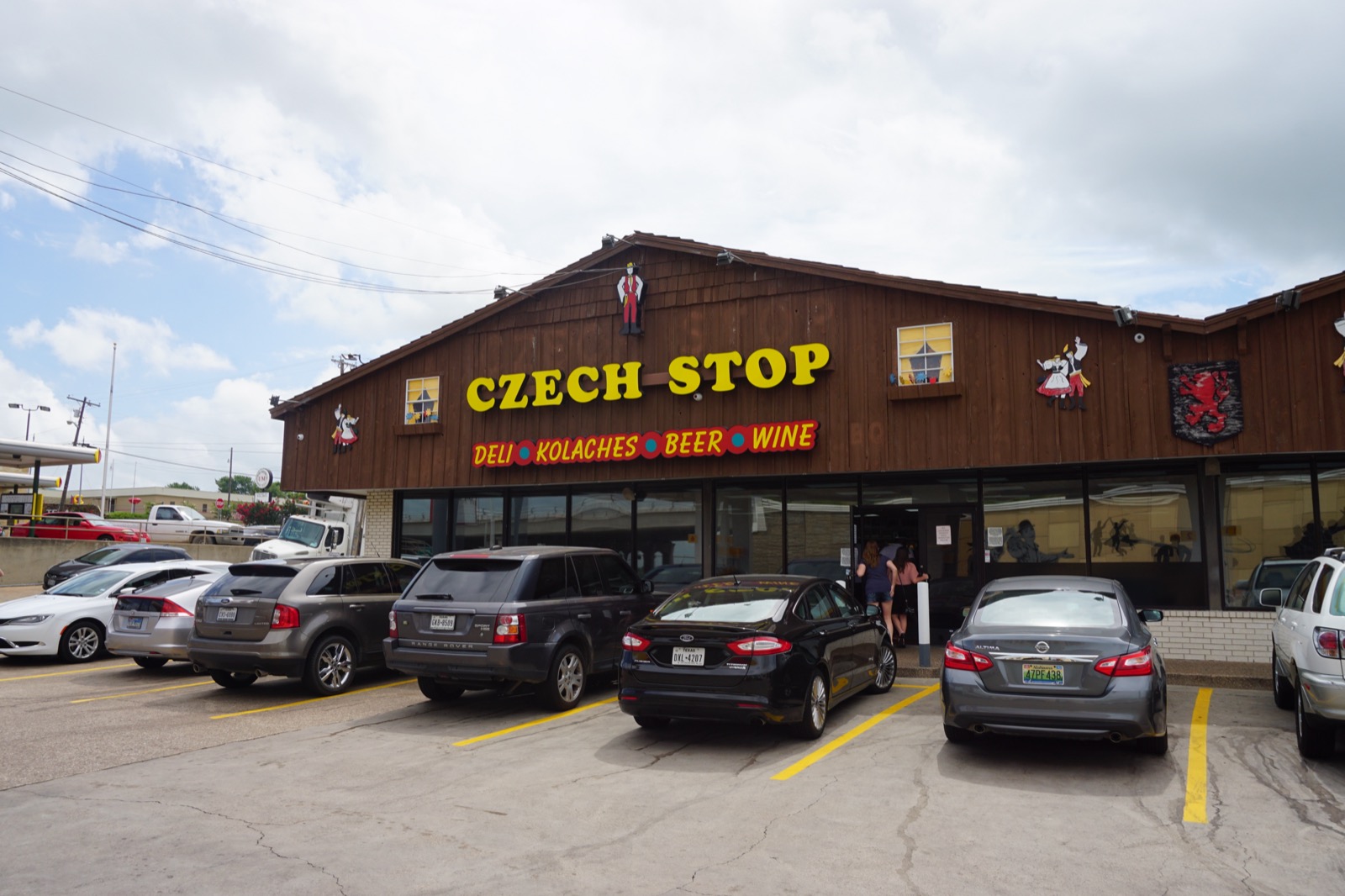
They call it the Czech Heritage Capital of Texas. At three in the morning, off Exit 353 on Interstate 35, the ovens at Czech Stop are still going. Pillowy bread with a thumbprint of poppy seed or apricot. A sausage tucked inside a soft round of dough.
Truckers rolling north to Dallas. Aggies rolling south to College Station. The smell of yeast and smoked pork hanging over a town of barely 2,800 people, twenty miles north of Waco, where most of the surnames on the mailboxes have not changed in a hundred and twenty years.
This is the story of how a small farming community in central Texas became the most Czech place in America. Not Cedar Rapids. Not Omaha. Here, on the Blackland Prairie, where Moravian farmers came for cheap land and stayed for everything else.
West, the Place
West sits in northeastern McLennan County, on the Blackland Prairie, about eighty miles south of Dallas and twenty miles north of Waco. Interstate 35 cuts straight through it, and so does the old Missouri, Kansas and Texas Railroad track that brought the town into being. Around 2,800 people live there now.
The streets are flat and quiet. Frame houses with deep porches. A grain elevator at the edge of town. A Catholic church spire visible from the highway. The downtown is a single short strip of brick storefronts on Oak Street and North Main, half of them rebuilt or repainted since 2013.
It is, on paper, an unremarkable Texas farming town. What makes it remarkable is who built it.
How West Became Czech
Before the Czechs
The land that would become West was first settled around 1852, when a man named Carey Boulds built a cabin at a spot called Bould Springs. The Walter Wyatt Bennett family moved into the cabin in 1856 and became the community’s first permanent residents. For nearly thirty years, the settlement was a scatter of farms on the Blackland Prairie, raising corn and cotton on rich black soil.
That changed in 1881, when the Missouri, Kansas and Texas Railroad pushed its line through a quarter section of land owned by Thomas Marcus West, a businessman who had moved to the area in 1859. The new townsite went up beside the tracks. The post office was renamed for him in 1882. He opened a general store the following year, then a hotel, then a bank. By 1892, the town was formally incorporated.
The Czechs Arrive
Czech migration to Texas had begun a generation earlier. In 1850, a Lutheran pastor named Josef Arnost Bergmann arrived at Cat Spring in Austin County and started writing letters home describing the land and the prices. Those letters, copied and passed around in villages across Moravia, became the spark.
By the 1870s, whole families were sailing for Galveston. Most came from eastern Moravia, from the foothills of the Beskydy mountains around Frenstat pod Radhostem, and from the wooded region called Moravian Wallachia. They were Catholics, almost to a person.
They came because Moravia was running out of room. Land was subdividing into strips too small to feed a family. Habsburg conscription took young men for years at a stretch. And a cousin had written from a place called Praha, or Frenstat, or Hostyn, all named after villages back home, saying a man could own his own farm before he was thirty.
By 1900, there were more than 9,000 Czech-born residents in Texas. By 1910, more than 15,000. The cluster of towns they built became known, in time, as the Czech Belt, running between Houston, Austin, and Dallas.
West was at its northern edge. The first Czech families arrived in the late 1870s and early 1880s, drawn by the same railroad that made the town. They came to work the land as tenant farmers, then to buy it, then to open the businesses that served the farms. Nemecek Brothers Meat Market opened in 1896, smoking ring bologna and Czech-style sausage for the next century.
West at Its Peak
By 1900, West had a bank, a cotton mill, a weekly newspaper, several gins, and a population of around 2,000. By the early twentieth century, it was unambiguously a Czech town, the way South Boston was unambiguously Irish and Greenpoint was unambiguously Polish.
Daily life ran on Czech terms. Catholic Mass at Sts. Cyril and Methodius parish, often in Czech. Polka and waltz dances on Saturday nights at the SPJST lodge, the Slavonic Benevolent Order of the State of Texas, a Czech-American fraternal society founded in La Grange in 1897. Sausage smoked the way it had been smoked in Frenstat. Kolache baked the way they had been baked in the Beskydy hills.
Cotton paid the bills for half a century. Corn and dairy filled the gaps. Czech families farmed in the morning, ran the gin or the meat market in the afternoon, and on Sundays put on stiff shirts and walked to the church their grandfathers had paid to build.
The Czech language stayed alive longer here than almost anywhere else in the United States. Through the 1930s and into the 1950s, you could still hear it in the feed store and on the church steps. The Texas Czech dialect, shaped by Moravian Wallachian and Lachian roots and salted with Texas English loanwords, became its own thing, preserved like a kind of linguistic amber.
The Change
The Second World War broke the seal. Czech-speaking boys from West shipped out to Europe and the Pacific, came home in English, married out, moved to Dallas and Houston for work. By the late 1940s, parish records and lodge minutes that had been kept in Czech began switching to English. The language entered what linguists now call a final stage of obsolescence.
The farms consolidated. Cotton gave way to other crops. The kids who stayed mostly worked in town, not on the land. The kids who did not stay mostly left.
And then in 1983, a young man named Bill Polk, who had studied at Texas Tech and wanted to be a chef, opened a convenience store at the I-35 exit and stocked it with kolache from a small local bakery called Kolache Kitchen. He called the store Czech Stop. Within a few years he had built his own bakery onto the side of it.
What Polk understood was that the interstate had given West something its founders never imagined. Three million cars a year passed within sight of the town’s grain elevator. If you gave even a fraction of them a reason to pull off, you had a business. He gave them kolache.
By the 2000s, Czech Stop was running its ovens twenty-four hours a day. The town’s identity, which had been quietly fading inside its own front parlours, was suddenly being broadcast back to itself by the people who stopped on the way to somewhere else. West had become, in a strange and welcome twist, the Czech capital of America.
Then on April 17, 2013, a fire broke out at the West Fertilizer Company storage facility on the east side of town. The ammonium nitrate inside detonated. Fifteen people were killed, ten of them firefighters. More than 160 were injured. Some 150 buildings were damaged or destroyed. The blast registered as a 2.1-magnitude earthquake and was felt eighty miles away.
The town that rebuilt itself afterwards was the same town and not the same town. Money came in from across Texas, from across the country, from the Czech Republic. New homes went up. A new high school opened. In 2019, West dedicated a memorial with a reflecting pool and a plaque for each of the fifteen lost. Czech Stop never closed for a day.
The Landmarks of Czech West
Czech Stop and Little Czech Bakery (104 South George Kacir Drive). Founded by Bill Polk in 1983 as a convenience store with one oven and three shelves. Today it employs more than 100 people and bakes around the clock. The bakery sells kolache filled with prune, poppy seed, apricot, cream cheese and cottage cheese, alongside klobasnek wrapped around smoked sausage. It is the most famous Texas kolache outlet, and for many travellers on I-35 the entire reason they have ever heard of West.
Slovacek’s West (5945 Wiggins Lane). A roadside complex of bakery, smokehouse, gift shop and beer garden opened in November 2013, seven months after the explosion. The Slovacek family bought the Snook-based sausage company in 1995 and brought their full line to West. When the historic Nemecek Brothers Meat Market closed for good after more than a century, Slovacek’s revived the Nemecek brand so the old wieners and ring bologna would not disappear.
Gerik’s Ole Czech Smokehouse and Bakery (215 North College Avenue). The third of the three big kolache and sausage operations in West, run by the Gerik family, who have been smoking meat in central Texas for generations. The klobasnek here use Slovacek sausage in a soft yeast wrap that locals defend with religious intensity.
Sts. Cyril and Methodius Catholic Church (downtown West). The Czech Catholic parish, named for the ninth-century missionaries who brought Christianity to the Slavic peoples. The church anchored the religious life of the Czech community from its founding and remains the spiritual centre of West.
The SPJST Lodge. A meeting hall of the Slovanska Podporujici Jednota Statu Texas, the Czech-American fraternal society founded in La Grange on July 1, 1897. SPJST grew into one of the largest Czech fraternal organisations in the country, with around 40,000 members across more than 100 Texas lodges today. The West lodge hosted dances, weddings, funerals, and the practical work of mutual aid that held Czech immigrant life together.
Westfest (West Fair and Rodeo Grounds, South Main Street). The town’s annual Labor Day weekend Czech festival, founded in 1976. It draws around 50,000 visitors a year for polka bands, kolache baking contests, Miss Westfest, a Taroky tournament, a Polka Mass, and the kind of folk dancing the founders learned from their grandparents. Westfest has raised over a million dollars for community projects.
West Fertilizer Memorial Park. Dedicated on the sixth anniversary of the 2013 explosion, the memorial sits on the east side of town with a reflecting pool and a plaque for each of the fifteen lives lost. A quiet counterweight to the celebration down at the festival grounds.
Where the West Texas Czechs Came From
Almost all of them came from Moravia, the eastern half of what is now the Czech Republic. Not Bohemia, not Prague. The villages were in the foothills of the Beskydy mountains in the far east of Moravia, places like Frenstat pod Radhostem, Roznov pod Radhostem, and Vsetin. The wider region is called Moravian Wallachia, or Valassko, a high, wooded country of sheep pastures and timber.
These were not the urban Czechs of Prague or Brno. They were small farmers, woodworkers and shepherds. Catholic by deep tradition. They left because their land would not divide further, because Habsburg conscription took their sons, and because letters from cousins in Texas described black soil that grew cotton without a fight. They named their new Texas towns after their old ones. Praha. Frenstat. Hostyn. A geography of homesickness, laid down across central Texas.
West Today
You can drive into West today and find three things at once. The interstate town, with Czech Stop and Slovacek’s running at full tilt, taking credit cards from people who have never met a Texas Czech in their lives. The everyday town, where the families with names like Kucera and Marek and Pavlas still live in the houses their grandparents built. And the rebuilt town, where the streets east of the railroad still feel newer than they should, because they are.
The Czech language is fading. The University of Texas at Austin has a Texas Czech Legacy Project recording the last fluent speakers before the dialect goes. Linguists give it another fifteen years at most. The polka bands are getting smaller, the dancers greyer, the Mass in Czech now a memorial rather than a habit.
And yet. Westfest still draws its 50,000 every September. The ovens still run all night. A new generation of bakers, some of them Czech by descent and some by adoption, keeps the recipes going. The kolache is now the official pastry of the Texas Legislature, designated in 1997, a small bureaucratic acknowledgement of something larger.
The story did not end with the language. It moved sideways into food, into the festival, into the names of the streets, into the way the town carries itself. If your great-grandfather got off a boat at Galveston in 1885 with a trunk and a sack of seed, this is one of the places he might have gone. And one of the places his name might still be on a mailbox.
Frequently Asked Questions
Why did Czechs settle in West, Texas?
Czech farmers from Moravia were drawn to West, Texas in the late 1870s and 1880s by the rich Blackland Prairie soil, cheap and available farmland, and the new Missouri, Kansas and Texas Railroad that ran through the town in 1881. Earlier Czech immigrants in central Texas wrote letters home praising the land, sparking a chain migration that made Czechs the majority population in West by the time it incorporated in 1892.
Is West still Czech today?
Yes, although the community is heavily assimilated. Around 75 percent of West, Texas residents can claim some Czech ancestry, and the town is officially recognised as the Czech Heritage Capital of Texas. The Czech language itself is nearly gone, but Czech surnames, the Catholic parish, the Westfest festival, and three thriving Czech bakeries keep the heritage publicly visible.
What are the most famous Czech landmarks in West, Texas?
The Czech Stop and Little Czech Bakery at I-35 Exit 353 is the most famous, baking kolache twenty-four hours a day since 1983. Other key landmarks include Slovacek’s West, Gerik’s Ole Czech Smokehouse and Bakery, Sts. Cyril and Methodius Catholic Church, the SPJST fraternal lodge, and the West Fair and Rodeo Grounds where Westfest is held every Labor Day weekend.
Where in the Czech lands did the West Texas Czechs come from?
The overwhelming majority came from Moravia, the eastern part of today’s Czech Republic, particularly from the foothills of the Beskydy mountains around Frenstat pod Radhostem, Roznov, and Vsetin, and from the wider region called Moravian Wallachia. They were Catholic, rural, and spoke Moravian dialects of Czech rather than the Bohemian Czech of Prague.
When did Czechs first arrive in West, Texas?
The first Czech families arrived in the West area in the late 1870s and early 1880s, around the same time the Missouri, Kansas and Texas Railroad pushed its line through Thomas Marcus West’s land in 1881. By the time the town was incorporated in 1892, Czech immigrants already formed the majority of the population.
If your family’s story passed through West, Texas, or any of the small farming towns the Moravian Czechs made home, Atlas of Home can trace that journey. From a village in the Beskydy foothills to the Blackland Prairie, to wherever you are now.