
Roots / Chicago
They came for the steel. From the smokestacks of South Works to the open hearths of Indiana Harbor, a generation of young men from Habsburg villages, Montenegrin hills, and the highlands of Hercegovina followed the same long thread west. They learned the word for shift, the word for furnace, the word for Sunday. And on that Sunday, they found one another in a borrowed room with an icon on a kitchen table, and they sang the liturgy in Church Slavonic as if they had never left the river bend at home.
By the time the first Serbian Orthodox liturgy was served on Chicago soil, on the Fourth of July in 1905, a community was already a generation deep. It has been compounding ever since.
Chicago, The Place
Serbian Chicago has never been a single neighborhood. It has always been a constellation: the old Southeast Side parishes near the mills, the Northwest Side cathedral on Redwood Drive, the south-suburban churches that followed families out toward Lansing and the state line, and across that line into Lake County, Indiana, where Schererville, Crown Point, Merrillville, and Munster now anchor as much of the community as anywhere within Cook County itself.
Stitching them together, half an hour up the Tri-State on a clear morning, is the monastery at Libertyville. A few hundred acres of Illinois prairie that for a hundred years has functioned, for a particular kind of Chicagoan, as a piece of Serbia.
How Chicago Became Serbian
Before the Serbs
The Calumet region was not built for them. It was built by them, alongside Poles, Slovaks, Croatians, Hungarians, Mexicans, and Black workers up from the South. In 1880, the south shore of Lake Michigan was wetland and forest. By 1906, it was Gary, Indiana, raised out of sand for U.S. Steel. The South Works mill in South Chicago had opened in 1882. The land east of the Skyway was a horizon of stacks.
Into that grid came the first Serbs. Most arrived not from the Kingdom of Serbia itself but from Serbian-speaking lands inside Austria-Hungary and the Ottoman Empire. The Boka Kotorska on the Montenegrin coast. The villages of Hercegovina. The Krajina in what is now Croatia. The Vojvodina plain north of Belgrade. They were subjects, not citizens, of empires that were not theirs.
The Serbs Arrive (1880s to 1920s)
The earliest arrivals are recorded in the 1880s and 1890s, single men chasing wages in the mills, on the railroads, in the packinghouses. By 1892, an itinerant Serbian archimandrite named Firmilijan had crossed from Belgrade to Chicago and was serving the liturgy in a private home with a room converted to a chapel. It was a chapel the size of a parlor for a city the size of an empire.
By the turn of the century, fraternal lodges and singing societies were doing the work that the state in Serbia had never done for these emigrants. They buried the dead, settled the disputes, taught the children Cyrillic on Saturday mornings. The cultural and educational society Obilić, founded by Serbian immigrants in the United States in 1878, was already a model for what came after.
The figure who finally pulled the threads together was Sebastian Dabovich. Born in San Francisco to immigrant parents, he was the first person born in the United States to be ordained an Orthodox priest, and the first native-born American tonsured as an Orthodox monk. On the Fourth of July, 1905, Archimandrite Dabovich consecrated the first Serbian Orthodox parish in Chicago and named it Holy Resurrection. A community had a roof of its own.
Two decades later, in 1923, Archimandrite Mardarije Uskokovic arrived from Montenegro by way of Russia and bought ten acres of farmland in Libertyville, Illinois. He intended a seminary. He built a monastery. Within three years the church was consecrated in the style of Russian Novgorod, and Saint Sava Monastery had become what it remains: the spiritual capital of Serbian America.
The Peak: Two Great Waves After the Wars
The pre-1914 mill workers were the first wave. The second was forced. After 1945, with the Yugoslav monarchy abolished and the Communist Partisans in power, tens of thousands of Serbian royalists, Chetnik veterans, and anti-communist refugees came out of Europe’s displaced-persons camps and into American port cities. A great share of them landed in Chicago.
They had reason. King Petar II of Yugoslavia, exiled by the Tito government, would die in 1970 and be interred at Saint Sava Monastery in Libertyville. More than ten thousand mourners came for the funeral. He remains the only European monarch buried on American soil.
The post-war community founded parish after parish. Saint Simeon Mirotocivi on the Southeast Side, organized in 1964 and built on Commercial Avenue the next year, became a working-class spiritual home for the mill families. Saint George in Joliet served the steel towns to the southwest. Saint Sava in Merrillville, Indiana, gathered the Northwest Indiana families. And along the North Branch of the Chicago River, on Redwood Drive in Edgebrook, a new Holy Resurrection cathedral rose in 1973, designed by the architect Radoslav Kovacevic.
The third wave was the wars of the 1990s. The Bosnian War from 1992 to 1995. The Croatian Operation Storm in August 1995, which sent roughly 150,000 to 200,000 Serbs out of the Krajina in a matter of days, one of the largest single refugee movements in postwar Europe. The NATO bombing of Serbia and Montenegro in 1999. Chicago became one of the major American destinations for those displaced families, alongside Saint Louis and Cleveland. They arrived already Orthodox, already practiced at being a diaspora, and they slotted into existing parishes within a generation.
The Change: A Community Compounds
What is unusual about Serbian Chicago, set against many American immigrant histories, is that the church has not weakened across the generations. It has thickened. The number of Serbian Orthodox parishes in greater Chicago today is larger than it was in 1950, and far larger than it was in 1925.
The slava, the Serbian Orthodox family feast for a household’s patron saint, is still observed in thousands of Chicago-area homes each winter. Vidovdan, the June 28 commemoration of the Battle of Kosovo in 1389, still draws crowds to the cathedral. Chicago mayors have, in recent years, issued formal proclamations marking the day. Serbian Orthodox Christmas falls on January 7, the Julian calendar date, and on that morning in Schererville and Edgebrook and South Chicago, families burn the badnjak, the oak branch, before they sit down to roast pork and sarma.
The Landmarks of Serbian Chicago
Saint Sava Serbian Orthodox Monastery, Libertyville, Illinois. Founded in 1923 by Saint Mardarije of Libertyville on land bought with diocesan funds, the monastery is the spiritual anchor of Serbian America. Its grounds hold the tomb of King Petar II, the Saint Sava School of Theology (the only Serbian Orthodox seminary in the Western Hemisphere), and the cemetery where generations of Chicago Serbs are buried under Cyrillic stones.
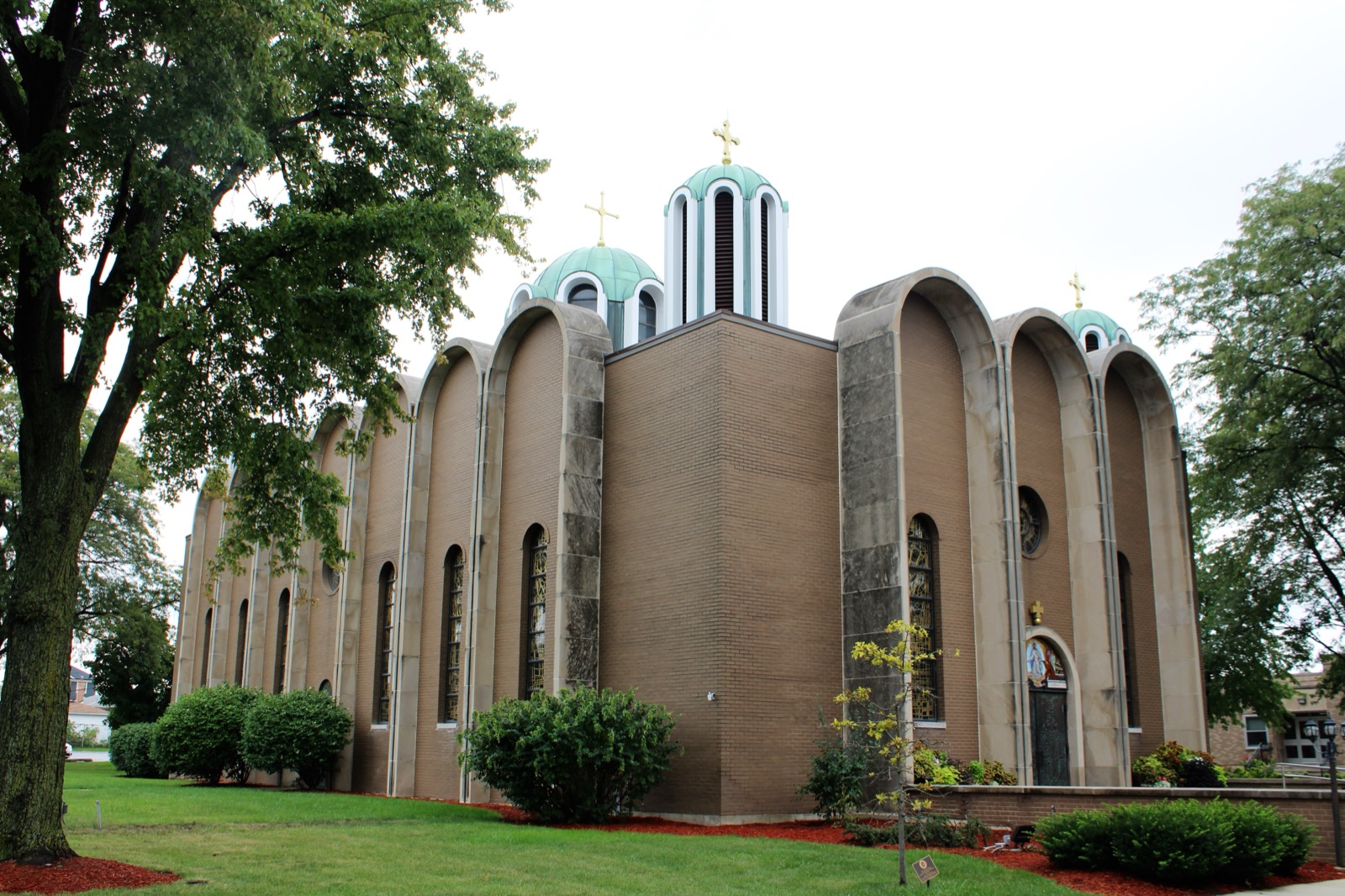
Holy Resurrection Serbian Orthodox Cathedral, 5701 North Redwood Drive, Chicago. Mother church of Serbian Chicago. The original parish was founded in 1905 by Sebastian Dabovich; the current cathedral, designed by Radoslav Kovacevic, was consecrated in 1973 on the city’s far Northwest Side. Two of its priests, Sebastian Dabovich and Mardarije Uskokovic, were canonized as saints in 2015.
Saint Simeon Mirotocivi Serbian Orthodox Church, 3737 East 114th Street, Chicago. Founded in 1964 by mill families on the Southeast Side and originally built on Commercial Avenue, Saint Simeon is the working-class soul of Serbian Chicago. The current East 114th Street church carries the parish into its seventh decade with the children of the founders still in the choir loft.
Saint George Serbian Orthodox Church, 300 Stryker Avenue, Joliet. The parish for the southwest suburbs and the old Joliet steel families. It belongs to the Diocese of New Gracanica and Midwestern America and has anchored Serbian life along the Des Plaines River corridor for generations.
Saint Sava Serbian Orthodox Church, Merrillville, Indiana. The largest Northwest Indiana parish, with a SerbFest each summer that is one of the better-loved Slavic festivals in the Calumet region. Three days of roast lamb, roast pig, sarma, ćevapi, kolo dancing, and a beer tent that runs late.
New Gracanica Monastery, Third Lake, Illinois. Consecrated in 1984 as an architectural replica of the fourteenth-century Gracanica Monastery in Kosovo, eighteen percent larger than the original. It serves as the seat of the Diocese of New Gracanica and Midwestern America and is, in its own quiet way, an act of architectural memory: a piece of Kosovo rebuilt in the Illinois fields.
Cafe Beograd, Irving Park, Chicago. One of the steady centers of Serbian eating in the city. Ćevapi off the grill with kajmak, pljeskavica the size of a dinner plate, and the football on the screen in the corner. Zora Kafana, also in the city, carries the same flag with live tamburica music on weekends.
Where the Chicago Serbs Came From
Serbian Chicago is not from one place. The earliest immigrants, those who arrived before 1914, came overwhelmingly from outside the Kingdom of Serbia itself: from the Boka Kotorska on the Adriatic coast, from Hercegovina, from the Krajina region of what is now Croatia, from Vojvodina, and from the Serbian-speaking villages of Lika and Dalmatia under Habsburg rule.
The Kingdom of Serbia proper, especially Šumadija around Belgrade, sent more emigrants after the First World War and through the interwar decades. The post-1945 wave, the royalist refugees and former Chetnik soldiers, came from across the whole of the new Yugoslavia. The 1990s wave was distinct again: Croatian Serbs expelled in Operation Storm in 1995, Bosnian Serbs from Republika Srpska, Serbs from Kosovo after 1999. The cathedral congregation now includes families whose grandparents arrived in 1909 sitting in the same pew as families who arrived in 1999.
Chicago Today
The hard numbers undersell what is here. The United States Census counts roughly 24,500 Illinois residents who identify as Serbian by primary ancestry, with about 6,800 in the city proper, but the figure is widely understood to capture a fraction of a community that often reports its ancestry as Yugoslav, Bosnian, Croatian, Montenegrin, or simply does not respond. The lived community, measured by parish rolls, festival attendance, and slava invitations, is several times that.
The center of gravity has shifted south and east across the state line. Northwest Indiana, especially Schererville, Crown Point, Munster, and Merrillville, holds a substantial share of Serbian-American family life today. The Northwest Side of Chicago still anchors the cathedral. The Southeast Side parishes are smaller than they were in the mill years but have not closed.
What is striking is how legible the community remains. Slava cards in Cyrillic still go up in Schererville kitchens each December and January. The Saint Sava Academy still teaches Serbian language in Edgebrook. SerbFest fills the cathedral parking lot on the second weekend of August. The fourth-generation grandchildren of the men who came for the South Works furnaces are still being baptized in the same font.
Most American immigrant stories are stories of dispersal. This one is a story of accumulation.
Frequently Asked Questions
Why did Serbs settle in Chicago?
Serbs came to Chicago for the steel mills. From the 1880s onward, young men from Habsburg-ruled Serbian lands, Montenegro, and the Kingdom of Serbia followed wages to South Works, the Indiana Harbor mills, and the railroads of the Calumet region. Religious freedom, chain migration, and the post-1945 Cold War refugee programs deepened the community across the twentieth century.
Are Serbs still in Chicago today?
Yes, and the community has grown rather than shrunk. Greater Chicago, including Northwest Indiana, holds one of the largest Serbian-American populations in the United States, anchored by multiple Serbian Orthodox parishes, the Saint Sava Monastery in Libertyville, and the cathedral on Redwood Drive. The center of gravity has shifted toward the south suburbs and Lake County, Indiana, but the institutions are intact.
What are the most famous Serbian landmarks in Chicago?
The Saint Sava Serbian Orthodox Monastery in Libertyville, founded in 1923 and the burial place of King Petar II of Yugoslavia, is the single most important Serbian-American site in the country. The Holy Resurrection Serbian Orthodox Cathedral on the Northwest Side, founded in 1905, is the mother church of Serbian Chicago. New Gracanica Monastery in Third Lake and Saint Simeon Mirotocivi on the Southeast Side round out the core.
Where in Serbia did the Chicago Serbs come from?
The early Chicago Serbs came mostly from outside the Kingdom of Serbia proper: the Boka Kotorska in Montenegro, Hercegovina, the Krajina and Lika in what is now Croatia, and the Vojvodina plain north of Belgrade. Later waves added Serbs from Šumadija around Belgrade, the Bosnian Serb territories, Kosovo, and Sandžak, especially after the wars of the 1990s.
When did Serbs first arrive in Chicago?
Single Serbian men were already in Chicago in the 1880s, working the mills, the railroads, and the packinghouses. By 1892, a visiting Serbian archimandrite was serving the liturgy in a private home. The first Serbian Orthodox parish, Holy Resurrection, was founded on the Fourth of July, 1905, by Sebastian Dabovich.
If your family came through the Calumet, or through any of the places the Serbs made home, Atlas of Home can trace that journey. From a village in the Boka or a town in the Krajina, to South Works, to Schererville, to wherever you are now.