
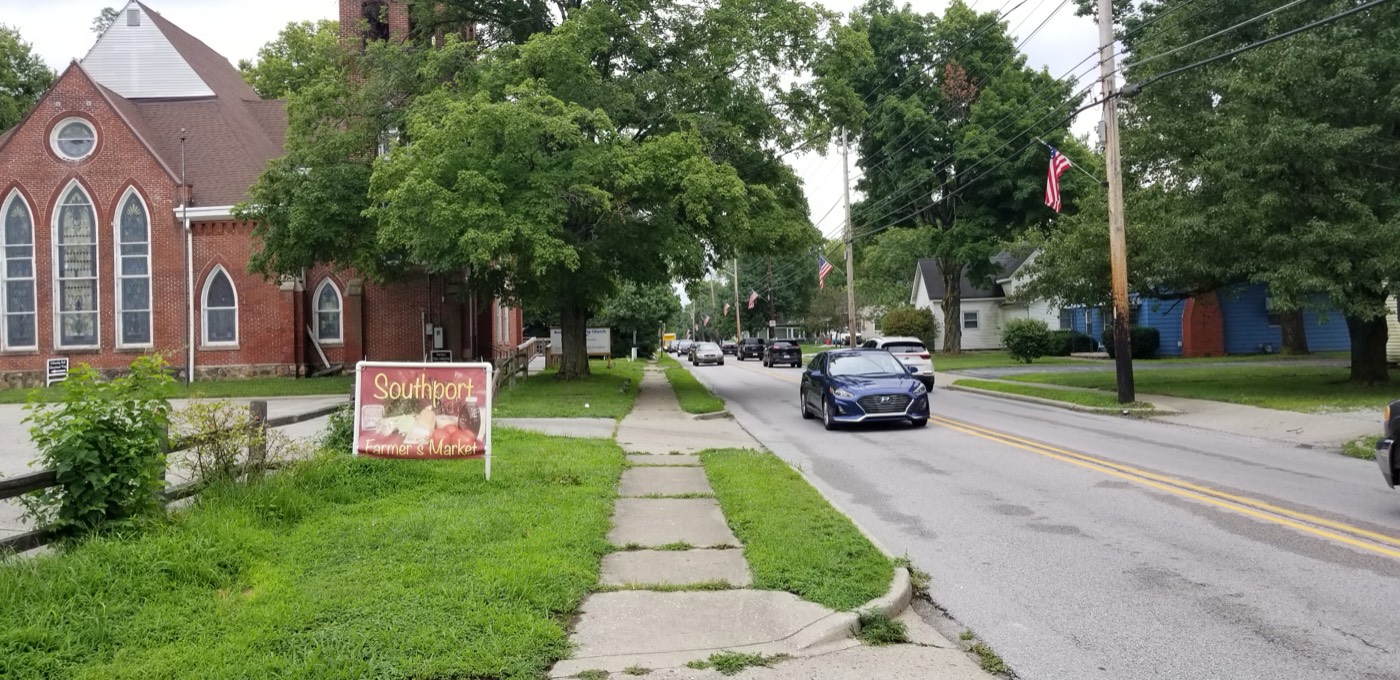
Drive south on Madison Avenue past the Southport city line and the shopfronts start to change. A grocery advertising goat curry and dried river fish. A church sign in a language with no obvious European root. A soccer pitch full of teenagers shouting in Hakha. The Chin in Indianapolis have built the largest concentration of their people anywhere outside Myanmar, and they have done it in the least advertised corner of a Midwestern county, in a township most Hoosiers drive through on the way to somewhere else.
The Place
Perry Township occupies the far south end of Marion County, a flat spread of post-war ranch houses, strip plazas and school playing fields bounded roughly by Interstate 465 and the Johnson County line. At its centre sits Southport, a small incorporated city of a few thousand people surrounded entirely by Indianapolis, with its own mayor and its own welcome sign on Southport Road.
For most of the twentieth century this was working-class white Indianapolis: factory families, Baptist congregations, Long’s Bakery doughnuts on a Saturday morning. Housing was cheap, the apartment stock was plentiful, and by the 1990s a good deal of it was ageing and half empty.
That combination of cheap flats, plentiful churches and entry-level jobs turned out to be exactly what a displaced Christian minority from the mountains of western Burma needed. The nickname arrived on its own. People here call it Chindianapolis.
How It Became Chin
The mountains they left
The Chin homeland is a range of forested ridges in western Myanmar, most of it above 1,000 metres, running along the Indian border. It is one of the poorest and least connected parts of the country. The people who live there are not a single group: Chin State contains dozens of distinct languages, with Tedim Chin, Hakha Chin and Falam Chin among the largest, and communities that identify variously as Laimi, Zomi, Asho, Khami and Daai.
American Baptist missionaries arrived in the Chin Hills in 1899, beginning with Arthur and Laura Carson, and the Chin Hills Baptist Association followed in 1907. The mission’s schools did the work its sermons could not, and conversion moved slowly, then all at once. Roughly a third of Chin were Christian in the mid-1960s. By 2010 the figure was around ninety per cent.
That is the fact that shaped everything afterwards. In a Buddhist-majority state run since 1962 by a military that treated Christianity as a foreign loyalty, being Chin became a political condition. Forced labour on military roads, confiscated land, restrictions on church building and pastoral training, arbitrary detention: a 2011 household survey found that more than nine in ten Chin families had been subjected to forced labour.
The long route out
Few Chin flew to Indiana. Most walked west into Mizoram in India, or south to Malaysia, and waited. Some waited years in Kuala Lumpur without legal status, working construction and cleaning, registering with the UN refugee agency and hoping a resettlement place came up.
The first arrivals in Indianapolis came in the early 1990s, resettled by Exodus Refugee Immigration, then a small agency handling a handful of Burma cases among many others. The numbers were tiny. A few families, scattered across the city.
What happened next is the ordinary mechanism of chain migration, and it happened fast. A Chin tribal leader named Than Hre settled in Perry Township in 2002. Others followed him, because he was there, because the rent was low, and because a family that has spent four years in limbo will choose the town where somebody already speaks Falam.
2005 to 2011: the wave
Large-scale American resettlement of Burmese refugees began in earnest in 2005, and Indianapolis received a share out of all proportion to its size. By 2008 roughly 1,350 had been placed. By 2011 the city was home to almost 7,000 Burmese refugees. Around three quarters of them were Chin.
The infrastructure they built came before the businesses. The Chin Community of Indiana was established by local Chin churches on 25 November 2001, before the wave had properly begun, to handle the unglamorous work of resettlement: airport pickups, benefit forms, landlord disputes, interpreting at hospitals. Churches multiplied along the same lines as back home, which is to say by dialect. Falam speakers founded one congregation, Hakha speakers another, Tedim speakers a third.
The schools caught it first
Perry Township Schools felt the change before the county did. More than 2,000 refugee children enrolled in the district in the years after 2001. Teachers who had never taught a non-English speaker were suddenly running sheltered content classes, scheduling art and keyboarding ahead of text-heavy subjects, and learning to distinguish a Hakha surname from a Tedim one.
The district became the most linguistically diverse in Indiana, with English learners at around 27 per cent of enrolment, the highest share in the state. At Southport High School close to a quarter of students were still learning English, and pupils had been born in more than thirty countries. The district’s response was unusual: rather than treat Chin languages as an obstacle, it began offering Chin language classes at high school level.
Shops, then institutions
Chin Brothers opened as a small market in 2007 and became the pivot point of the neighbourhood, later adding a restaurant and bakery. Others followed along Madison Avenue and Stop 11 Road: grocers stocking mustard leaf and fermented fish paste, phone shops that could unlock a handset and wire money home in one visit.
The Burmese American Community Institute followed in 2011, founded to push past resettlement into the next problem, which was that a generation of bright Chin teenagers had no clear route into American higher education. In February 2018 the city swore in its first Burmese police officer. The community had moved, in fifteen years, from arrivals to institutions.
The Landmarks
Chin Brothers Restaurant, 2318 E Stop 11 Rd, Indianapolis, IN 46227. The market opened in 2007 and the kitchen came later, and it now functions as the closest thing the south side has to a Burmese tea shop. Goat curry, fried rice, sticky rice cakes from the bakery counter, and a steady traffic of people who came in for one thing and stayed forty minutes talking.
Chin Community of Indiana, 2524 E Stop 11 Rd, Indianapolis, IN 46227. Founded by Chin churches on 25 November 2001 and still running the practical end of community life: employment help, ESL and citizenship classes, a seniors’ gathering programme, back-to-school immunisation clinics, and the summer soccer tournament that empties half the township’s living rooms every July.
Chin Evangelical Baptist Church, 5610 S Meridian St, Indianapolis, IN 46217. One of the anchor congregations of Chin Indianapolis and the usual home of the city’s Chin National Day celebration, an event that draws hundreds in full traditional dress and is generally reckoned the largest Chin gathering in the United States.
Indiana Chin Baptist Church, 8528 Madison Ave, Indianapolis, IN 46227. Madison Avenue is the community’s main artery, and this church sits on it. Chin congregations tend to organise by home dialect rather than by postcode, which is why a two-mile stretch of a suburban road can support several churches that are, on paper, the same denomination.
Falam Baptist Church, 3740 S Dearborn St, Indianapolis, IN 46237. Named for the Falam tract of Chin State, one of the three northern subdivisions the British administered separately and the town where Chin National Day was proclaimed. Most of its younger members have never seen the place.
Burmese American Community Institute, 4925 Shelby St, Suite 200, Indianapolis, IN 46227. Founded in 2011 under chief executive Elaisa Vahnie, BACI works on the long game: college access, workforce training, health navigation and youth programming for a community whose first decade here was necessarily spent on emergencies.
Southport High School, 971 E Banta Rd, Indianapolis, IN 46227. Opened in 1894 for the children of farmers, it now enrols around 2,400 students, close to a fifth of them Asian and most of those Chin. It offers Chin language instruction, which almost no other American high school does, and its graduation stage has become the most reliable annual measure of how the community is doing.
Where They Came From
Almost everyone here traces back to Chin State and the Chin-populated fringes of Sagaing Region, in the western hills. The three northern tracts, Tedim, Falam and Hakha, account for the largest share, which is why those three names recur on church signs and shopfronts across Perry Township.
The distinctions matter more than outsiders assume. Kelly Berkson, who directs the Chin Languages Research Project at Indiana University, has spent years pressing exactly this point: there is no single Chin language and no single Chin culture. There are dozens of languages, some mutually unintelligible, and dozens of traditions underneath the one label. Roughly fifty are spoken in Indianapolis.
Almost none arrived directly. The typical route ran through a camp or an unregistered flat in Malaysia, or through Mizoram in northeast India, with a wait of years in between. Many families were split across those two routes and reunited only in Indiana. After the 2021 coup another forty thousand or so Chin crossed into India, which means the pipeline that filled the south side has never really closed.
Indianapolis Today
Estimates of the Chin population in greater Indianapolis run from around nineteen thousand to more than thirty thousand, depending on who is counting and whether they include the second generation and the wider Burmese communities. Nobody disputes the headline: this is the largest Chin population in the United States and the largest concentration anywhere outside Myanmar.
The community is no longer new, and that brings different problems. Elders who never fully learned English depend on grandchildren to interpret at the doctor’s surgery. Those grandchildren are losing Hakha and Tedim faster than their parents expected, and the church that held everything together through resettlement now competes with American teenage life for the same Sunday afternoons.
Materially, though, the trajectory is upward. Chin families own the houses they once rented, run the shops along Madison Avenue, teach in the schools that once enrolled them as beginners, and patrol the streets in IMPD uniforms. Perry Township is not a refugee neighbourhood any more. It is a Chin one, which is a different and more permanent thing, and it belongs in the same Indiana story as the Swiss settlers who built Berne, the Slovak refinery families of Whiting, and the more recent Indian professionals reshaping Zionsville. It also rhymes with what happened two hours north, where Burmese refugees remade a corner of Fort Wayne.
The strongest evidence sits on the calendar. Every year on the weekend nearest 20 February, marking the 1948 assembly at Falam that gave the Chin their national day, hundreds of people fill a church hall on the south side of Indianapolis in embroidered cloth their grandmothers would recognise, and dance the dances of a homeland most of the children in the room have only seen in photographs.
Frequently Asked Questions
Why are there so many Chin in Indianapolis?
Cheap housing, plentiful entry-level jobs and an unusual density of churches made Perry Township workable for early arrivals in the 1990s and early 2000s. Chain migration did the rest, as resettled families steered relatives towards the one American city where somebody already spoke their dialect.
How many Chin live in Indianapolis?
Estimates for the Chin in Indianapolis range from roughly 19,000 to more than 30,000, depending on the counting method and whether US-born children are included. It is the largest Chin population in the United States and the largest anywhere outside Myanmar.
Where exactly is the Chin community in Indianapolis?
Overwhelmingly on the far south side, in Perry Township and the small city of Southport, clustered around Madison Avenue, South Meridian Street and Stop 11 Road. Karen and Karenni communities from Myanmar settled instead on the north side around Nora.
Are the Chin the same as the Burmese?
No. The Chin are one of Myanmar’s ethnic minorities, from the western hills, and are overwhelmingly Christian in a Buddhist-majority country. That difference is the main reason they were persecuted under military rule and the main reason so many ended up as refugees.
What language do the Chin in Indianapolis speak?
There is no single Chin language. Around fifty are spoken locally, with Hakha, Falam and Tedim the most common. Indiana University’s Chin Languages Research Project documents them, and Perry Township Schools offers Chin language classes at high school level.
What is Chin National Day?
It marks the general assembly held at Falam in Chin State on 20 February 1948, at which Chin leaders chose democratic self-administration. Indianapolis hosts what is widely considered the largest Chin National Day celebration in the United States, held on the weekend nearest that date.
If your family’s story passed through Indianapolis, or any of the places the Chin have made home in America, Atlas of Home can trace that journey. From the ridges above Falam and Hakha to a church hall off Madison Avenue, to wherever you are now.