
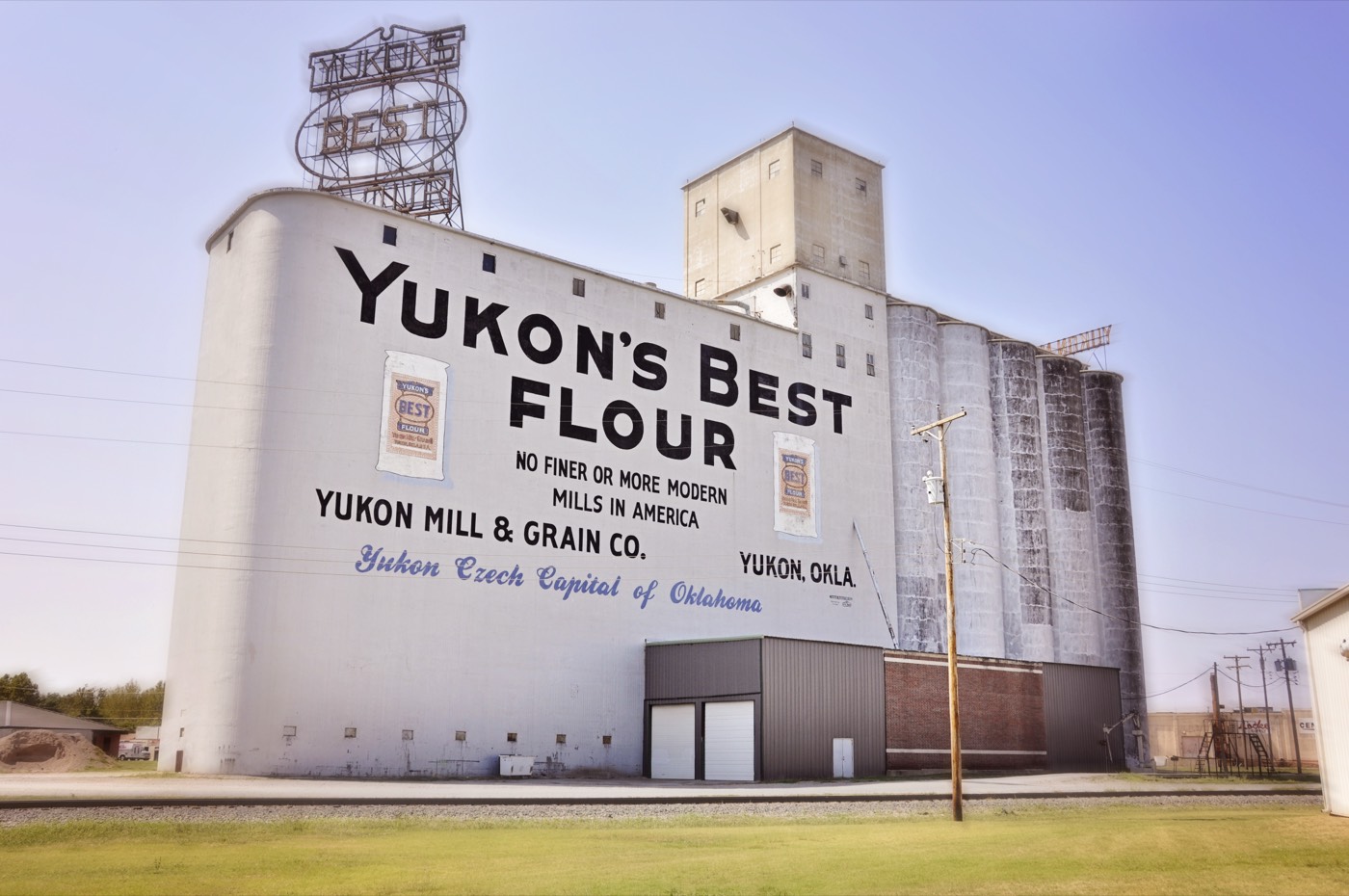
Drive west out of Oklahoma City on old Route 66 and the skyline that greets you is not a steeple but a grain elevator, its flank lettered four storeys high: YUKON’S BEST. The sign has guided travellers since the 1940s, and behind it lies a quieter story. The Czechs in Yukon, Oklahoma turned a wheat-milling railroad town into the self-proclaimed Czech Capital of Oklahoma, and on most Saturday nights the accordions are still playing.
The Place
Yukon sits in Canadian County, in the south-central part of Oklahoma, roughly fifteen miles west of downtown Oklahoma City. It was founded in 1891 by A. N. Spencer, who acquired the townsite from homesteaders who had staked claims when the Unassigned Lands opened to settlement in 1889.
The Choctaw, Oklahoma and Gulf Railway laid its tracks through the new town that same year, and the older settlement of Frisco, just to the east, emptied out almost overnight as businesses moved to follow the rails. Yukon grew from 830 people in 1907 to a suburban city of 23,642 by the 2020 census.
For most of the twentieth century the town ran on flour. Today it runs partly on commuters, who fill the subdivisions north and south of Interstate 40, and partly on memory. The water tower, the festival and the mill all point back to the same source.
How It Became Czech
The Caha party and the sooners
The first Czechs in this corner of Oklahoma did not arrive by the rules. According to the Oklahoma Historical Society, the earliest major Czech settlement in the territory was led by Anton Caha, born in Klanchov, Moravia, around the 1850s, who brought roughly twenty-five Czech Americans into the Unassigned Lands ahead of the legal opening.
Caha tried to stake a claim near the confluence of Mustang Creek and the North Canadian River before the gun. Like many of the so-called sooners, he was prosecuted, and he served a two-year sentence at the federal prison in Leavenworth, Kansas. He returned afterwards, took up his land lawfully, and lived out his life as a respected citizen.
The settlement that grew from that first push spread across the Canadian County townships of Yukon, Mustang and El Reno, west of Oklahoma City. It became the anchor of Czech life in the new territory.
The Bohemian wave, around 1898
The trickle became a stream near the end of the century. The Oklahoma Historical Society records that beginning in about 1898, Yukon began attracting a sizeable Bohemian population, the term then used for Czechs from the western lands of what is now the Czech Republic.
Most of these families were not coming straight from Europe. The 1910 census counted 5,633 people of Czech foreign white stock in Oklahoma, of whom 1,624 were foreign-born. Many had first settled in the older Czech colonies of Nebraska, Kansas, Iowa and Texas, and a good number had passed through Wisconsin or Chicago before moving on to cheaper land in the territory.
They were drawn by the same thing that drew everyone: wheat ground that could be homesteaded. The Czechs who reached Yukon were farmers first, and the flat brown county around the town suited them.
Lodges, gymnasts and a hall
What the Czechs built first, after their farms, were their fraternal lodges. The Sokol gymnastic society, a Czech institution that fused physical training with national pride, organised its first Oklahoma chapter in Yukon in 1898. The Western Bohemian Fraternal Association established its Yukon lodge in 1899.
Out of those two bodies came the most important Czech building in the state. Members of the Sokol Karel Havliček lodge and the ZCBJ lodge Jan Žižka No. 67 raised a meeting hall on Czech Hall Road, rebuilt in its present form in 1925 by builder George Morava using materials from the original structure. Since 1925 the hall has hosted a Czech dance almost every Saturday night.
The mill that fed the state
The other engine of Czech Yukon was the Yukon Mill and Grain Company. Around 1903 it passed into the hands of John F. Kroutil, Frank L. Kroutil and A. F. Dobry, three Czech millers whose families would shape the town for generations.
Under them the operation grew into the largest flour plant in Oklahoma and across the Southwest, milling as much as 2,000 barrels a day by the 1930s. Their Yukon’s Best brand put the town’s name on flour sacks and, eventually, on the giant sign beside Route 66. When people say Yukon is a Czech town, the mill is half of what they mean.
The festival, 1966
For decades the Czech identity lived quietly inside the lodges. It went public in 1966, when the WFLA lodge No. 67 and the Sokol lodge Karel Havliček sponsored a festival to mark Yukon’s 75th anniversary.
The one-off party was such a success that John Kouba, Ralph Stejskal and Hubert Smrcka pushed to make it annual, and Oklahoma Czechs, Inc. was formed to run it. The Oklahoma Czech Festival has been held on the first Saturday of October ever since, and it is the reason the state legislature came to call Yukon the Czech Capital of Oklahoma.
The Landmarks
Czech Hall, 205 N. Czech Hall Road. Rebuilt in 1925 by George Morava for the Sokol Karel Havliček and ZCBJ Jan Žižka lodges, the hall was added to the National Register of Historic Places on 25 November 1980. It has held a Czech polka and waltz dance nearly every Saturday night since 1925, open to anyone of any age or ancestry, and one wing houses a small museum of local Czech-American history.
Yukon’s Best Flour Mill, on Route 66 at Main Street. The grain elevator of the old Yukon Mill and Grain Company, run by the Kroutil and Dobry families, carries the 42-by-55-foot YUKON’S BEST sign first lit in the 1940s. The mill stopped grinding in the 1970s, but the town raised about 175,000 dollars to restore and relight the sign in 2013, swapping its bulbs for LEDs.
The mill mural, on the elevator silos. Oklahoma artist Carlos Barboza painted a mural across the side of the flour mill, completed in 2019. It gathers Yukon’s symbols in one frame: a Czech festival queen, the original Miller mascot, a longhorn on the Chisholm Trail, a Route 66 shield, and the town’s most famous son, country singer Garth Brooks, with his guitar.
The Czech mural, downtown on the Oklahoma Czechs, Inc. building. Painted in 1989 by Oklahoma City artist Bill Firquain, this older mural depicts the astronomical clock of Prague’s Old Town Hall, tying the prairie town directly to the Bohemian capital its founders left behind.
St. John Nepomuk Catholic Church, 600 S. Garth Brooks Boulevard. Named for the Bohemian saint and tracing its parish life to 1889, this church has long served Yukon’s Catholic Czech families. A Czech-language Mass is still offered here each year during the festival weekend.
Yukon’s Main Street and the festival parade. On the first Saturday of October the parade steps off at 10 a.m. down Main Street, with more than a hundred entries. The Oklahoma Czech-Slovak Royalty, a queen-elect with junior queens, princes and princesses, is presented to the crowd, crowned on Czech Day after a pageant the Sunday before.
Garth Brooks Boulevard. The commercial strip at Yukon’s main Interstate 40 exit was renamed for the singer in the 1990s. It is not a Czech landmark, but it is the road most visitors take to reach the mill, the hall and the festival, and it captures how the town now balances its two best-known names.
Where They Came From
The Yukon Czechs came overwhelmingly from the historic Czech lands, Bohemia and Moravia, the western and central regions of today’s Czech Republic. Anton Caha, who led the first party, was born in Moravia, and the population that followed from 1898 onward was described in the records of the day as Bohemian.
Few came directly from Europe to the prairie. The 1910 figures show that most Oklahoma Czechs had lived first in the established colonies of Nebraska, Kansas, Iowa and Texas, often after an earlier stop in Wisconsin or Chicago. Yukon was, for many families, the third or fourth American place they had called home.
That layered migration is the Oklahoma Czech story in miniature: a movement from the villages of central Europe to the industrial Midwest, and then a second migration to the open land of the southern plains. The same pattern shaped Czech communities elsewhere, from the Czechs in Wilber, Nebraska, the self-styled Czech capital of the United States, to the Czechs in Cedar Rapids, Iowa.
Yukon Today
Yukon in 2026 is a fast-growing Oklahoma City suburb, and most of its 23,000-plus residents have no Czech ancestry at all. The mill stopped milling half a century ago. The lodges are smaller than they were, and the Saturday dances draw curious newcomers as much as old families.
Yet the Czech thread has not snapped. The festival still fills Main Street every October, the hall still opens its doors on Saturday nights, and the restored sign still burns over Route 66. The town has chosen to keep its heritage visible, on the silos, on the boulevard signs and in the kolaches sold from festival booths.
It is a particular kind of survival. The community that built Yukon largely dispersed into the wider city, but it left its name on the place, and a small core of volunteers keeps the customs alive on purpose rather than by inertia. Compared with the dense urban Czech enclaves of the Czechs in Pilsen, Chicago or the Czechs in Cicero, Illinois, Yukon is something rarer: a Czech identity carried by a whole small town rather than a single neighbourhood, much as the Czechs in Astoria, Queens once anchored a corner of New York.
Frequently Asked Questions
Why is Yukon called the Czech Capital of Oklahoma?
Yukon attracted a large Bohemian, or Czech, population beginning around 1898, and Czech families built lodges, a dance hall, churches and the town’s flour mill. The Oklahoma Czech Festival, founded there in 1966, led to Yukon being recognised as the Czech Capital of Oklahoma.
When did the Czechs in Yukon, Oklahoma first settle the area?
The first major Czech party, led by Anton Caha of Moravia, entered the Unassigned Lands as sooners just before the 1889 opening. The larger Bohemian wave that gave the town its character arrived from about 1898 onward, mostly from older Czech colonies in Nebraska, Kansas, Iowa and Texas.
What is Czech Hall and can you visit?
Czech Hall, at 205 N. Czech Hall Road, is a fraternal dance hall rebuilt in 1925 and listed on the National Register of Historic Places in 1980. It is open to the public for a Czech polka and waltz dance almost every Saturday night, regardless of age or ancestry, and contains a small museum.
When is the Oklahoma Czech Festival held?
The festival takes place in Yukon on the first Saturday of October every year. It includes a Main Street parade of more than a hundred entries, Czech-Slovak royalty, traditional food such as kolaches, music and dancing, and is run by the non-profit Oklahoma Czechs, Inc.
What is the Yukon’s Best Flour sign?
It is a 42-by-55-foot illuminated sign on the grain elevator of the old Yukon Mill and Grain Company, beside Route 66. The mill was run by the Czech Kroutil and Dobry families, milled flour until the 1970s, and the sign, first lit in the 1940s, was restored and relit in 2013.
Are the Czechs in Yukon, Oklahoma still a distinct community today?
Most of Yukon’s residents today have no Czech ancestry, and the original community has largely merged into the wider Oklahoma City area. The heritage survives through the annual festival, the Saturday dances at Czech Hall, St. John Nepomuk parish and a core of volunteers who keep the customs alive.
If your family’s story passed through Yukon, or any of the places Czechs have made home in America, Atlas of Home can trace that journey. From a village in Bohemia or Moravia to a wheat town on the Oklahoma prairie, to wherever you are now.