
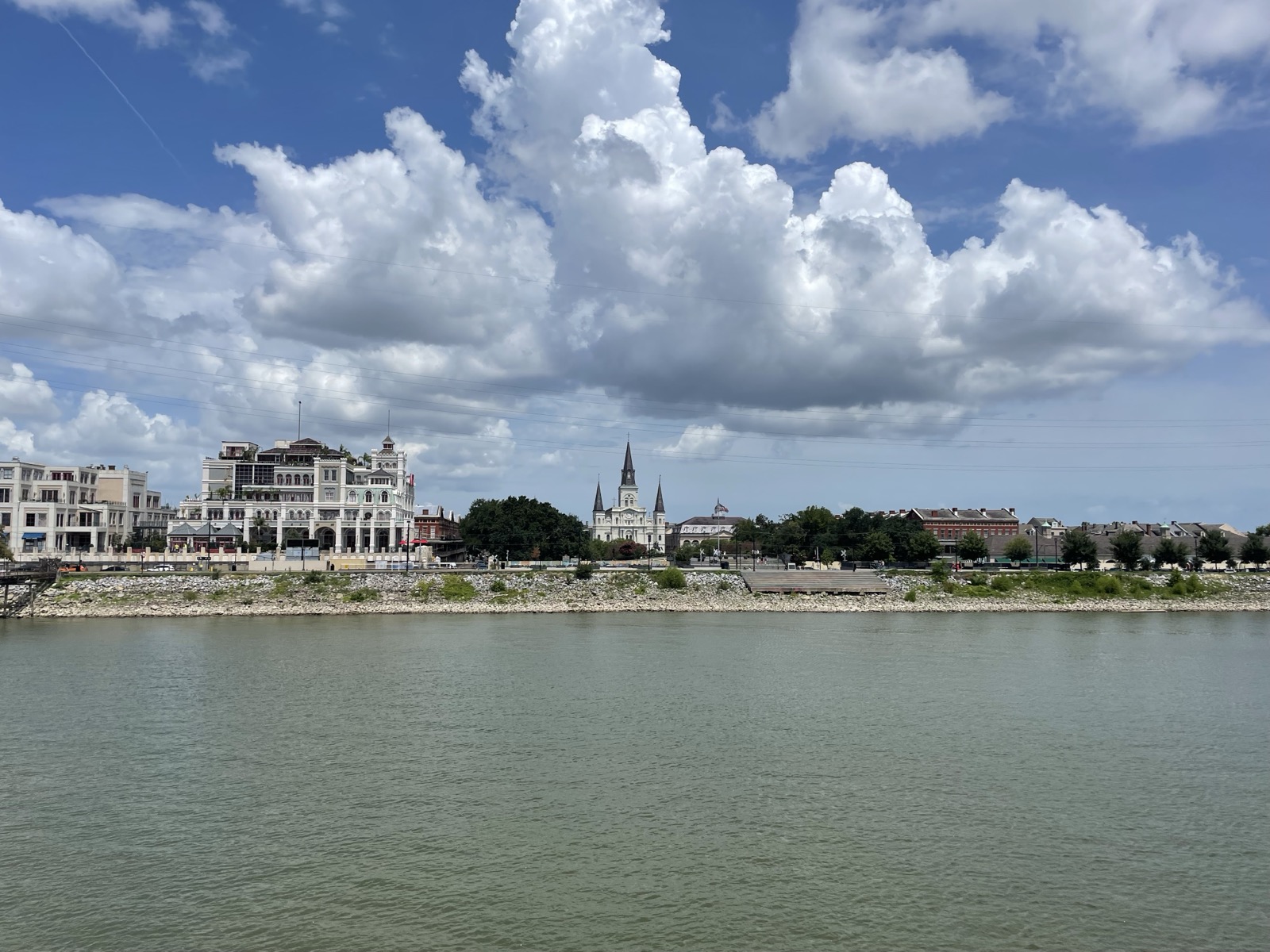
They called it the Vieux Carre. The Old Square. Six blocks by eleven, wedged into a crescent of the Mississippi where the river bends back on itself and the air sits warm and heavy all year.
In 1718 there was nothing here but canebrake and cypress and a ridge of high ground a French Canadian officer thought he could turn into a city. Three hundred years later you can still walk the grid he ordered drawn, past the cathedral named for the king of France and out to the market that has not closed since George Washington was alive.
The French Quarter, The Place
The French Quarter sits between Canal Street, Esplanade Avenue, Rampart Street, and the Mississippi River. It is the oldest neighbourhood in New Orleans and the original colonial city in full, eleven blocks long and six blocks deep, anchored at its centre by Jackson Square and St. Louis Cathedral.
Most visitors arrive by foot from Canal Street, drift through Royal and Bourbon and Chartres, and find their way to Decatur and the river. The buildings are low, two and three storeys, with stuccoed brick fronts in faded ochres and pinks, wrought-iron galleries over the banquettes, and shuttered French doors opening straight onto the street.
How New Orleans Became French
Before the French
Before the city, there was a portage. The Chitimacha and Choctaw had used the crescent for generations as a crossing point between the Mississippi and Bayou St. John, which fed out to Lake Pontchartrain. The high ground above the swamp was one of the few patches of solid earth in a delta of water and reed.
The French had been in the lower Mississippi since 1699, when Pierre Le Moyne d’Iberville and his younger brother Jean-Baptiste Le Moyne de Bienville sailed in from the Gulf on a mission from Louis XIV. They built forts at Biloxi and Mobile first. The crescent sat empty for another nineteen years, waiting for someone to gamble on it.
The French Arrive
That gamble came in 1718. Bienville, by then governor of the colony for John Law’s Company of the Indies, sent a party of soldiers, convict labourers, and enslaved Africans to clear the canebrake and stake out a town. He named it La Nouvelle-Orleans for the Duc d’Orleans, regent of France. For three years it was bark huts in a clearing.
The proper city came in 1721, when Bienville handed the planning to a young French engineer, Adrien de Pauger. Working from a scheme by his superior Pierre Le Blond de la Tour, Pauger laid out a tight grid of seventy squares fronting the river. He named the streets for the French royal house: Bourbon, Royal, Dauphine, Conti, Chartres, Orleans, Bienville.
The capital of French Louisiana moved here in 1723. Settlers came in waves: soldiers, traders, missionaries, the Ursuline nuns of Rouen who arrived in 1727 to run a hospital and a school for girls. The colony struggled. It was hot, malarial, and remote. France lost interest. In 1762, under the Treaty of Fontainebleau, Louis XV quietly handed the whole colony to his Bourbon cousin in Spain.
The Spanish ruled the Quarter for forty-one years. Then came the fires. On Good Friday, 21 March 1788, eight hundred and fifty-six of the eleven hundred buildings in New Orleans burned. Six years later, on 8 December 1794, another two hundred and twelve went up.
Both times the city rebuilt under Spanish fire codes: brick walls, stucco, tile roofs, courtyard plans, wrought-iron galleries replacing the wooden balconies of the French era. This is why the French Quarter looks Spanish today. The bones are French. The skin is Spanish.
The Quarter at Its Peak
Spain handed Louisiana back to Napoleon in 1800. Napoleon held it for twenty days of ceremony and sold it to Thomas Jefferson on 30 April 1803. The Louisiana Purchase was signed inside the Cabildo on Jackson Square. The tricolour came down, went up, and came down again. The Stars and Stripes went up in its place. American Louisiana began.
The Creole French of the Quarter, those born in the colony to French parents, did not give up easily. For most of the nineteenth century the Vieux Carre stayed defiantly Francophone. French-language newspapers ran across south Louisiana. The opera was sung in French. The lawyers argued in French. Trade ran with Bordeaux, Le Havre, and Nantes.
Then came the great wave from Saint-Domingue. The slave revolt that became the Haitian Revolution had begun in 1791. By 1809, ten thousand refugees from the former French colony had reached New Orleans by way of Cuba, after the Spanish governor in Havana expelled them. They came in three roughly equal parts: white French planters, free people of colour, and the enslaved. They doubled the city’s population in a year.
They reinforced everything French about the Quarter. Creole French speakers, Catholics, planters who built townhouses on Royal and Esplanade, free people of colour who set up trades along the back streets. They brought their kitchens, their music, their Carnival traditions. New Orleans tilted further into the Caribbean and further from the Anglo-American cities upriver.
More French kept coming. Royalists chased out by the Revolution. Revolutionaries disenchanted with Napoleon. Veterans of Waterloo. Refugees of 1830 and 1848. Merchants from Bordeaux sent over to handle the cotton trade.
Through the 1830s, 1840s, and 1850s the Creole French ran the Quarter while the Anglo-Americans built their mansions across Canal Street in the Garden District. There were two cities, Canal Street the river between them.
The Change
The Civil War broke the Quarter’s French century. Union forces took New Orleans in 1862 without a fight. Reconstruction reordered every social hierarchy the Creoles had built. The cotton trade weakened. The opera burned down. Wealthy Creoles moved out to Esplanade Ridge, and the Quarter slipped into a long decline as a tenement district for Sicilian immigrants.
The language went next. Louisiana entered the United States with two official languages in its 1845 constitution. The 1864 constitution dropped French. In 1921 the state mandated English-only public schooling, and children caught speaking French at school were beaten or fined. Within a generation the language went underground, then mostly silent.
Preservation saved the buildings. The Vieux Carre Commission was founded in 1925 to stop demolition, and in 1936 the Quarter became one of the first historic districts in the United States with full legal protection. The bohemians arrived. Then the bars. Then the cruise ships. By the time anyone counted, the Quarter had become a tourism economy, with under four thousand permanent residents in a footprint that draws millions a year.
The Landmarks of French New Orleans
St. Louis Cathedral, 615 Pere Antoine Alley. The spiritual heart of French Louisiana. Bienville set aside the land in 1718 and named the parish for the patron saint of France. The first wooden church opened in 1727 and burned in the 1788 fire. The current building was finished in 1794 and substantially rebuilt by the architect J.N.B. de Pouilly in 1850. It is the oldest continuously operating cathedral in the United States.
Jackson Square, between Decatur, St. Peter, Chartres, and St. Ann. Pauger laid this out in 1721 as the Place d’Armes, the parade ground of the French garrison. It was renamed for Andrew Jackson after the Battle of New Orleans in 1815. The cathedral faces it. The Cabildo and the Presbytere flank it. The wrought-iron Pontalba buildings, raised in 1850 by the Baroness Micaela Almonester de Pontalba, line the upriver and downriver sides.
The Cabildo, 701 Chartres Street. The Spanish government house, finished in 1799. Inside, on 20 December 1803, the Louisiana Purchase transfer took place. Spain handed the colony to France, France handed it to the United States, three flags came down and went up in twenty days. It is now part of the Louisiana State Museum.
The Old Ursuline Convent, 1100 Chartres Street. Finished in 1752 to replace a 1734 convent, this is the oldest surviving building in the entire Mississippi Valley. The Ursuline nuns who arrived from Normandy in 1727 ran a girls’ school, an orphanage, and a hospital here until 1824. Stucco-covered brick, severe and symmetrical, French neoclassical in its bones.
The French Market, 1008 North Peters Street. Founded as a Native American trading post long before the city, formalised by the Spanish government in 1791, the oldest continuously operating public market in the United States. It runs six blocks from Jackson Square to Esplanade Avenue. Cafe du Monde sits at the upriver end, in the same place it has sold beignets and chicory coffee since 1862.
Antoine’s, 713 St. Louis Street. Founded in 1840 by an eighteen-year-old French chef named Antoine Alciatore, this is the oldest family-run restaurant in the United States, now in its fifth generation. Oysters Rockefeller and Pommes de Terre Souffles were invented here. It has stayed open through the Civil War, two world wars, Prohibition, the Depression, and Hurricane Katrina.
Tujague’s, 429 Decatur Street. The second oldest. Founded in 1856 by Guillaume and Marie Abadie Tujague, who had sailed from Bordeaux four years earlier. Guillaume worked as a butcher in the French Market before opening the restaurant. The Butcher’s Breakfast served here became the tradition of brunch.
Lafitte’s Blacksmith Shop, 941 Bourbon Street. A French Colonial Louis XV townhouse built between 1772 and 1791, one of the few structures that survived both fires. Legend ties it to the pirate Jean Lafitte, though the history is contested. It became a bar in 1933 and has been one ever since, lit by candles, no electric lights inside.
Where the French Quarter French Came From
The colonial French came disproportionately from the Atlantic ports that ran the trade with the New World. Bordeaux, La Rochelle, Nantes, and Le Havre were the embarkation points. Merchant families sent younger sons over to manage the cotton, indigo, and sugar trade. Many never went back.
The nineteenth-century waves came from a wider hinterland: Parisians fleeing one revolution or another, Normans pulled by family already in Louisiana, Gascons working as wine merchants on Decatur Street, refugees from Alsace and Lorraine after 1871. The Tujagues came from southwestern France. The Alciatores came from Marseille.
The Saint-Domingue refugees came from Cap-Francais, Port-au-Prince, Les Cayes, and Jeremie, by way of Santiago de Cuba and Havana. They were not new arrivals from France. They were Creole French, born in the Caribbean, often two or three generations removed from the homeland. They carried a French that was already creolised, kitchens that had absorbed African and Caribbean cooking, and a Catholicism that lived alongside Vodou. They were the ones who made New Orleans New Orleans.
The French Quarter Today
The Quarter is mostly a place people visit, not a place where French people live. Just under four thousand residents share its grid with the cruise ships and the bachelorette parties and the brass bands. Very few are first-generation French. The descendants of the old Creole families mostly left for the leafy avenues along Esplanade and St. Charles a hundred years ago.
And yet the French is everywhere. It is in the street names Pauger gave the grid in 1721, still unchanged. It is in the cuisine: gumbo, etouffee, jambalaya, beignets, cafe au lait with chicory. It is in the Catholic liturgy at St. Louis Cathedral. It is in Mardi Gras, which arrived with the Le Moyne brothers in 1699 and never left.
The language is the thing that almost slipped away. Louisiana French and Louisiana Creole are both endangered, with maybe a hundred and fifty thousand speakers left in the state. CODOFIL, the state agency founded in 1968, runs immersion schools and brings in teachers from France and Quebec. You can hear French again in the Quarter, mostly from tourists, sometimes from a stubborn Creole family that never let it go.
The Quarter is not French the way it was French in 1850. It is French the way a city is French after three centuries of fires, sales, refugees, statehood, war, preservation, tourism, and storms. The bones are still there. So is the cathedral bell, which rings every quarter hour over Jackson Square, same as it did when this was a parade ground for the king of France.
Frequently Asked Questions
Why did the French settle in New Orleans?
The French settled New Orleans in 1718 because the crescent in the Mississippi gave them a defensible foothold on the trade route between the Gulf and the interior of North America. Bienville chose the high ground above the swamp on the advice of Indigenous traders who used it as a portage. The colony’s purpose was to anchor French Louisiana and block English expansion west.
Is the French Quarter still French today?
The French Quarter is no longer a French-speaking neighbourhood, but its French and Creole heritage saturates the streets, food, architecture, and Catholic life. Of the roughly four thousand current residents, very few are of recent French descent, and most spoken French in the Quarter today comes from visitors or restaurant staff. The deeper layer of French Creole culture, however, survives in everything from gumbo to Mardi Gras to the street names laid down in 1721.
What are the most famous French landmarks in the French Quarter?
St. Louis Cathedral on Jackson Square is the oldest continuously operating Catholic cathedral in the United States, flanked by the Cabildo and the Presbytere. The Old Ursuline Convent on Chartres Street, finished in 1752, is the oldest surviving French colonial building in the Mississippi Valley. Antoine’s on St. Louis Street is America’s oldest family-run restaurant, and the French Market on Decatur is the oldest public market in the country.
Where in France did the New Orleans French come from?
The colonial French of New Orleans came mostly from the Atlantic ports of Bordeaux, La Rochelle, Nantes, and Le Havre, with hinterlands stretching into Gascony, Normandy, and the Paris basin. Nineteenth-century arrivals added Marseille, Alsace, and Lorraine. The largest single wave, the ten thousand Saint-Domingue refugees who landed in 1809, were Creole French born in the Caribbean, mostly from Cap-Francais and Port-au-Prince in present-day Haiti.
When did the French first arrive in New Orleans?
The French founded New Orleans in 1718, three years before Adrien de Pauger drew up the street grid in 1721. The Ursuline nuns of Rouen arrived in 1727. French rule lasted until 1762, when Louis XV transferred the colony to Spain, and French migration continued in waves through the nineteenth century from the homeland and from Saint-Domingue.
If your family’s story passed through the French Quarter, or through any of the French ports that sent their sons and daughters to the Mississippi, Atlas of Home can trace that journey. From the docks of Bordeaux to the galleries of Royal Street, to wherever you are now.