
By 1776, you could walk forty miles inland from Wilmington and not hear a word of English. The talk along the Cape Fear River was Gaelic. The hymns in the wooden churches were Gaelic. The bargains struck at the docks at Cross Creek, where pine tar moved downriver toward the sea, were sealed in Gaelic. For roughly half a century, the largest concentration of Scottish Highlanders anywhere outside Scotland lived in the pinewoods of eastern North Carolina, and they brought their old country with them so completely that it almost became a second one.
This is how it happened, what tore it apart, and what survives.
The Cape Fear Region, The Place
The Cape Fear region of southeastern North Carolina is the watershed of a single river. It runs from the sandhills near Fayetteville down through Bladen and Pender counties to the Atlantic at Wilmington. The Scottish settlement spread across what are now Cumberland, Bladen, Robeson, Moore, Harnett, Hoke, Richmond, and Scotland counties.
The land is flat and sandy, full of longleaf pine. The river was the road. Everything moved by water, and the inland town of Cross Creek, at the head of navigation, became the gathering point.
How Cape Fear Became Scottish
Before the Highlanders
Before the Scots, the Cape Fear was already half-settled. The lower river had been claimed in the late 1720s by planters moving down from Virginia and across from Charles Town. Wilmington was chartered in 1739. Upriver, the land was sparsely held by traders, small farmers, and Tuscarora and Cape Fear Indian remnants pushed west by the wars of the early 1700s.
The colony’s royal governor in 1734 was a Scotsman named Gabriel Johnston, born in Annandale and educated at St Andrews. Johnston believed his countrymen would make North Carolina prosperous if he could get them across the Atlantic. He set about doing it.
The Highlanders Arrive
In July 1739, a ship called the Thistle sailed from Campbeltown at the tip of the Kintyre peninsula in Argyll. Aboard were roughly 350 men, women and children led by a group of clansmen, including a man known as Neill “Black Neil” McNeill. They had been recruited by promises of land, a ten-year tax exemption, and the open Atlantic between them and rising rents at home.
The Thistle reached the port of Brunswick in September. Its passengers worked their way up the Cape Fear by boat and on foot, finally settling in the country around Cross Creek and the Lower Little River. This was the Argyll Colony, the founding event of Highland North Carolina.
The trickle became a flow. Through the 1740s and into the 1750s, families from Argyll, Inverness-shire, and the islands followed in their wake, often in chains. One brother sent for another, a tacksman brought his tenants, a sailor talked up the pine country at a wedding in Skye. Place names multiplied on the Carolina maps: Argyll, Barbecue, McPherson, Cameron, McLean.
Then came 1746. On a moor near Inverness, Bonnie Prince Charlie’s Highland army was destroyed at the Battle of Culloden in under an hour. What followed was worse. The Hanoverian crown banned the kilt, the bagpipes, and the Gaelic schoolmasters, and broke the clan system that had held Highland life together for centuries. Then the landlords began clearing the glens for sheep.
For the next thirty years, the Cape Fear became a refuge for people who had run out of other options. The flow accelerated through the 1760s. From the Isle of Skye alone, an estimated twenty percent of the population left in a single decade. Many came to North Carolina.
The Cape Fear at Its Peak
By 1776, contemporary observers put the number of Highland Scots in the upper Cape Fear valley at around 15,000. Some estimates run higher. Whatever the exact figure, it was the densest Gaelic-speaking community ever established in the Americas.
Cross Creek, the inland trading town that would later be renamed Fayetteville, was its capital. A census of the village in 1776 found a population that spoke almost exclusively Gaelic. Travellers passing through in those years wrote in their letters that they felt they had landed in a foreign country.
The economy ran on naval stores. The longleaf pine of the sandhills was tapped for resin, boiled down to tar, pitch, and turpentine, packed into barrels and floated down the Cape Fear to Wilmington’s wharves. From there it went to Britain to keep the Royal Navy’s wooden hulls afloat. Highlanders also farmed corn and tobacco, raised hogs and cattle, and ran the river ferries.
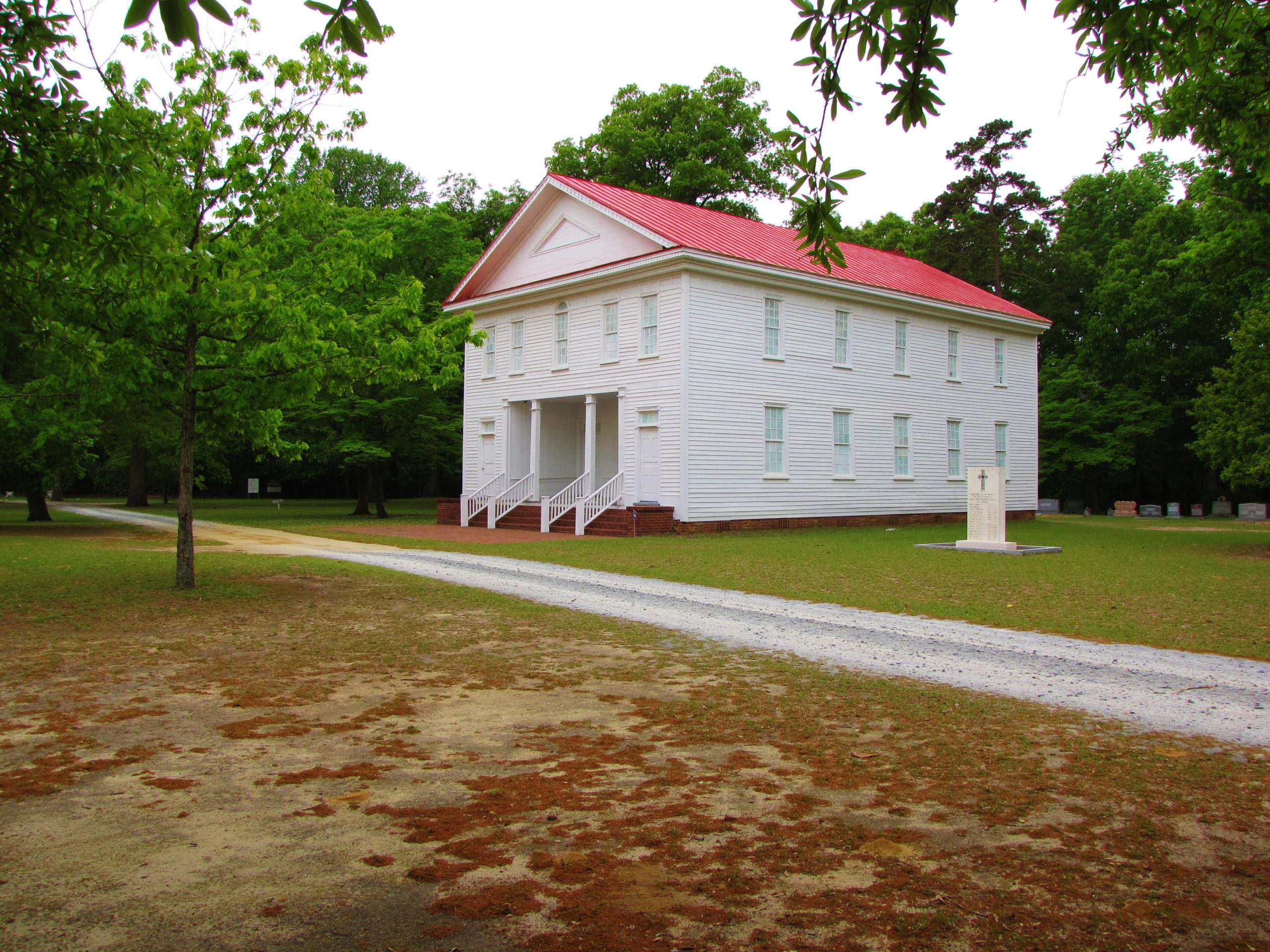
Three Presbyterian churches anchored the community. Bluff Church near present-day Wade, Barbecue Church in Harnett County, and Longstreet Church on what is now Fort Bragg were founded in the 1750s by the Reverend James Campbell, himself born in Kintyre. Services were preached in Gaelic and English on alternating Sundays. Children learned the Shorter Catechism in their mother tongue. A Gaelic press operated in Fayetteville into the early nineteenth century, printing hymnbooks and devotional works for a clientele that could read no other language.
The Change
The American Revolution broke the community. Most Highland Scots in North Carolina were Loyalists. They had taken an oath to King George as a condition of pardon after Culloden, and they were not interested in raising another rebellion against the same crown thirty years later.
In February 1776, around 1,600 Loyalists, the great majority of them Highlanders, mustered at Cross Creek under Brigadier General Donald MacDonald. They marched toward the coast to meet a British fleet. They never got there. At Moore’s Creek Bridge, eighteen miles north of Wilmington, a Patriot militia ambushed them on the morning of February 27. The bridge had been partly dismantled and the timbers greased.
The Highland charge across what remained of the bridge, swords drawn, was met with point-blank musket and artillery fire. Lieutenant Colonel Donald MacLeod was hit by twenty musket balls. The battle was over in three minutes. It is recorded as the last Highland charge in military history.
Living on the plantation where her husband had raised his Loyalist battalion was Flora MacDonald, the woman who in 1746 had smuggled Bonnie Prince Charlie off the Isle of Skye dressed as her maidservant. She and her husband Allan had emigrated to North Carolina in 1774 and settled at a place they called Killiegrey, near Cameron Hill in present-day Montgomery County. After Moore’s Creek, her husband and son were imprisoned. The Patriots seized her plantation. She lived through three hard years in occupied country before sailing back to Skye in 1779.
The aftermath of the war was brutal for the Cape Fear Scots. Many fled to Nova Scotia and Upper Canada. Those who stayed had their land seized or their reputations marked. The Gaelic press kept running, the Presbyterian services continued, but the community had been hollowed out.
Through the nineteenth century, Gaelic slowly retreated. The language was still preached in Cape Fear churches into the 1820s and 1830s. New arrivals from Scotland kept it alive into the 1850s. After the Civil War, the immigration stopped, the old generation died, and the children spoke English. Pockets persisted. There are documented Gaelic speakers in rural Cumberland and Harnett counties into the early twentieth century, making the Cape Fear the longest-surviving Gaelic-speaking diaspora community on the continent.
The Landmarks of Scottish Cape Fear
Old Bluff Presbyterian Church, 4150 Old Bluff Church Road, Wade. Organised in 1758 by the Reverend James Campbell of Kintyre, this is one of the three “mother churches” of Highland Cape Fear. Gaelic services continued here for almost a century. The current Greek Revival sanctuary was built in 1858, but the cemetery beside it holds settlers who crossed on the early ships.
Longstreet Presbyterian Church, Longstreet Road, Fort Bragg. Founded in 1756 in a hamlet then called Argyle, Longstreet is now inside the Fort Bragg military reservation about twelve miles west of Fayetteville. The federal government bought the building and grounds in 1921 and has preserved it ever since. The descendants of the original congregation gather there every year.
Moore’s Creek National Battlefield, Currie. Forty miles south of Fayetteville, the battlefield where the Highland charge died is now a National Park Service site. The reconstructed bridge crosses the same dark water. Plaques mark where MacLeod fell.
The Cross Creek Historic District, downtown Fayetteville. The old trading town’s grid still survives around Market Square and the streams that gave it its name. The 1832 Market House stands where Highland tacksmen once weighed barrels of pine tar. Fayetteville’s annual Tartan Day observance in early April runs through this district.
Flora MacDonald Historic Highway Marker, NC Highway 24/27 near Mt Gilead. A roadside marker in Montgomery County stands near the site of Killiegrey, the plantation Flora and Allan MacDonald briefly owned. The house is gone. A annual gathering is held in her memory at the Flora MacDonald Highland Games every spring at Red Springs.
The Scottish Heritage Center, St Andrews University, Laurinburg. Founded in 1989 on the campus of what was originally Flora MacDonald College, the Heritage Center holds one of the largest collections of Scottish-American genealogical and cultural material in the country. The university itself closed in May 2025, but the archive endures and its staff continue to host researchers.
Loch Norman Highland Games, 4431 Neck Road, Huntersville. Held every April at Historic Rural Hill since 1994, Loch Norman is one of the largest Highland Games in the American South. Just outside the Cape Fear watershed, an hour west, it pulls clans and pipers from across the old Scottish settlement. The 2026 games run 18-19 April.
Where the Cape Fear Scottish Came From
The first wave was overwhelmingly from Argyll. The Thistle of 1739 sailed from Campbeltown, and the families on board came from the surrounding peninsulas of Kintyre, Knapdale, and the islands of Islay and Jura. Through the 1740s and 1750s, the Argyll connection held: most Cape Fear settlers came either from the shire itself or from neighbouring Inverness-shire to the north.
The second wave, after 1766, looked further west. The Isle of Skye sent thousands. The Outer Hebridean islands of North Uist, South Uist, Harris, and Lewis sent hundreds. Lochaber, the mainland Highlands south of Loch Ness, contributed clansmen displaced by the early estate reorganisations. A smaller stream of Lowland Scots arrived through Wilmington’s mercantile trade, but the Cape Fear settlement was emphatically Highland in language, religion, and clan name.
The MacDonalds, MacLeods, Campbells, McNeills, McLeans, McPhersons, Camerons, Sinclairs and Stewarts who put their marks on Carolina deeds were not abstractions. They came from named glens and named islands. Their descendants in the Cape Fear today can still trace a line back to a particular farm in Skye or a particular sea loch in Argyll.
Cape Fear Today
The Gaelic is gone. The last fluent native speakers in rural North Carolina died in the 1930s and 1940s. The language now exists in the Cape Fear only as fragments: hymn titles, place names, a few words held in family memory.
But the rest of the inheritance is loud. Cumberland County still has more Presbyterian churches per square mile than almost anywhere in the South. The Cape Fear Valley Scottish Clans organisation runs Robert Burns suppers and Tartan Day events out of Fayetteville. The Flora MacDonald Highland Games at Red Springs draw thousands every October. Scotland County hosts its own games each autumn. The pipe bands of Fayetteville and Wilmington play at funerals and parades from Carolina Beach to the sandhills.
Walk through the cemetery at Old Bluff on a quiet weekday and you will read the same dozen surnames over and over: McAllister, McNeill, MacKenzie, Campbell, Cameron. Some of the stones are weathered to illegibility. The names underneath are not.
The Cape Fear is not Scottish the way it was in 1776. But it has never stopped knowing what it was. The descendants of the men who crossed on the Thistle, who fled after Culloden, who walked the Yadkin Road in from the coast, are still here. The kilts come out every spring. The pipes play. The story keeps moving.
Frequently Asked Questions
Why did Scottish Highlanders settle in the Cape Fear region?
Scottish Highlanders came to the Cape Fear region of North Carolina for a mix of economic and political reasons. Royal governor Gabriel Johnston, himself a Scot, recruited them with land grants and a ten-year tax exemption beginning in 1739. The defeat at Culloden in 1746 and the Highland Clearances that followed turned the trickle into a flood, sending thousands of dispossessed clans-people to the pine country along the Cape Fear River.
Are the Scottish still in Cape Fear today?
The descendants of the Highland settlers are still all over the Cape Fear region, especially in Cumberland, Robeson, Scotland, and Harnett counties. The Gaelic language died out in the early twentieth century, but Scottish surnames, Presbyterian churches, pipe bands, Highland Games, and clan societies continue to anchor a visibly Scottish heritage culture. The community has assimilated, but it has not forgotten.
What are the most famous Scottish landmarks in Cape Fear?
The major landmarks are Old Bluff Presbyterian Church near Wade, Longstreet Presbyterian Church on Fort Bragg, the Cross Creek historic district in Fayetteville, the Moore’s Creek National Battlefield near Currie, the Scottish Heritage Center at St Andrews University in Laurinburg, and the annual Highland Games held at Red Springs, Laurinburg, and Huntersville. Each of these traces directly to the colonial Highland settlement.
Where in Scotland did the Cape Fear Scottish come from?
The first and largest wave came from Argyllshire on the west coast, especially the Kintyre peninsula, Knapdale, and the islands of Islay and Jura. After 1766, large numbers arrived from the Isle of Skye, the Outer Hebrides islands of North Uist, South Uist, Harris, and Lewis, and the mainland district of Lochaber. The Cape Fear Scottish settlement was overwhelmingly Highland and Gaelic-speaking.
When did the Scottish first arrive in Cape Fear?
The first organised Highland Scottish settlement was the Argyll Colony of 1739, when a ship called the Thistle sailed from Campbeltown in Scotland and landed roughly 350 settlers at the port of Brunswick. They moved up the Cape Fear River and founded the colonial settlement around Cross Creek. Migration continued in waves through the 1770s, peaking just before the American Revolution.
If your family’s story passed through the Cape Fear pinewoods, through Cross Creek or Bluff Church or the sandhills, or through any of the Highland glens and islands that sent their people across the Atlantic, Atlas of Home can trace that journey. From Skye, Argyll, and Uist to Carolina, and onward to wherever you are now.