
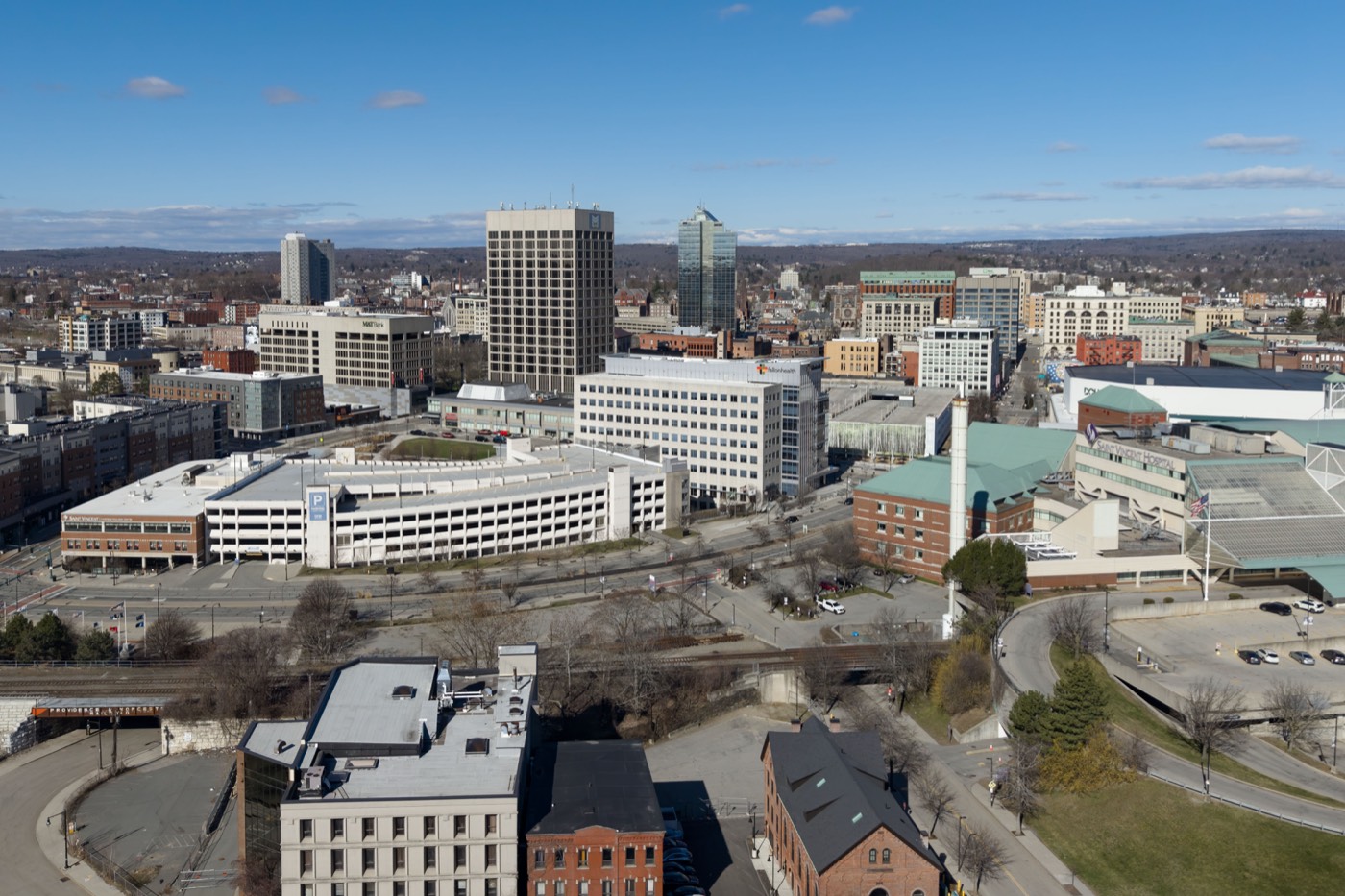
On a hill above Lake Quinsigamond, where the wind once carried the grind of wire mills and the smell of fresh rye bread, you could have stood in 1910 and heard more Swedish than English. The story of the Swedes in Worcester, Massachusetts is the story of a New England factory city that, for a few remarkable decades, ran on Swedish hands. By 1900 Worcester held the largest Swedish population of any city in the eastern United States, and the men and women who built it left their churches, their cemeteries, and their midsummer pole behind.
The Place
Worcester sits at the centre of Massachusetts, roughly forty miles west of Boston, in a bowl of seven hills. It is the second largest city in New England, and the 2020 census counted 206,518 residents, the highest in its history, finally surpassing the industrial peak it had reached in 1950.
For the better part of a century it was a manufacturing town, a place of wire works and abrasives and machine shops rather than mansions. The wealth here was made on the factory floor, and the immigrants who arrived found not gentility but work, plenty of it, and the chance to own a three-decker of their own. The same was true across industrial Massachusetts, in mill cities like that of the Portuguese in Taunton and the tanning town of the Greeks in Peabody.
Lake Quinsigamond runs along the eastern edge of the city, a long ribbon of water that newly arrived Swedes said reminded them of home.
How It Became Swedish
The first arrival, 1866
The Swedish presence in Worcester has a single, well documented beginning. Carl Hanson, born in 1849 in Uddevalla in the western province of Bohuslan, arrived in 1866 and is recorded as the first Swede to settle in the city. He was a musician by trade, a piano tuner and composer who opened a music store, and he is remembered locally as the father of Worcester’s public evening schools.
For a few years he was almost alone. In 1868 there was still only one reported Swede in the City of Worcester. The first child born to Swedish parents in the city, Jennie Pulson, did not arrive until April 1872.
The wire works pulls a colony
What turned a trickle into a tide was iron. Washburn and Moen, the city’s largest employer, ran a vast wire works, and its South Works in Quinsigamond Village needed strong backs and men who understood metal. Swedes from the iron districts, from Värmland and from Sandviken, answered.
By the time the first Swedish shopkeeper opened on Main Street, the colony had already passed two hundred people, most of them working the wire. Philip Moen, one of the firm’s principals, had brought back knowledge of the Swedish iron industry, and the connection ran both ways: Worcester wanted Swedish skill, and Sweden had skill to spare.
By the late 1880s the number of Swedes in Worcester had swelled to around five thousand. Over the next three decades it spiked toward forty thousand. By 1930 roughly one in five people in the city was Swedish, some thirty-eight thousand souls in a single industrial town. Worcester was not alone: Swedish industrial colonies took root across the country, from the furniture workers among the Swedes in Jamestown, New York to the prairie utopia of the Swedes of Bishop Hill, Illinois.
Jeppson and the abrasives empire
The second great Swedish industry in Worcester was grinding wheels. John Jeppson, an immigrant from Höganäs in Skåne, brought a knowledge of ceramics from the Swedish potteries and perfected the manufacture of vitrified abrasive wheels. His experiments became the foundation of the Norton Company, which grew into the largest abrasives manufacturer in the world.
Norton became, in effect, a Swedish firm. Around 1915 some seventy-five per cent of the factory’s workers were Swedish, and of the men who had come from Sweden before 1900, seventy-eight reached or passed twenty-five years of service with the company. Jeppson’s son George, educated at the Royal School of Mines in Stockholm, would later run the firm.
The company built worker housing on Indian Hill Road at roughly fifteen hundred dollars a unit, and the surrounding Greendale neighbourhood filled with Norton’s Swedish hands. Between the wire works and the abrasives plant, two of Worcester’s defining industries were carried on Swedish shoulders.
Churches, choirs and credit
As the colony grew it built the institutions of a homeland in miniature. The Lutheran church, the established church of Sweden, came first: the first Swedish Lutheran congregation was organised in 1881. Methodist, Baptist, Congregationalist and Seventh Day Adventist Swedish churches followed, until at one point thirteen Swedish churches served the city.
Emanuel Lutheran Church was founded in Quinsigamond Village in 1896 by a small group of immigrants; thirty six people attended the organisational meeting, and the cornerstone of its building was laid in 1898. Music ran through everything: the Scandinavian National Singing Society dated to 1873, and the Thule Singing Society, the Worcester Male Chorus and others followed.
The community looked after its own money and its own sick. The Swedish Charitable Society organised in 1900, the Skandia Credit Union opened in 1915, and Fairlawn Hospital opened in 1921 to serve the Swedish population. Two Swedish language newspapers, Nordostern and the Worcester Veckoblad, carried the news of home.
Where the Swedes lived
The Swedes did not settle in one place but in several. Quinsigamond Village, by the wire works and the lake, was the largest and most enduring. Belmont Hill and Vernon Hill held others, Greendale gathered the Norton families, and the old Trowbridge district, now Hadwen Park, took in more.
They favoured the three-decker, the wooden triple flat that defined working Worcester, because three families could share the cost and the upkeep. The Old Swedish Cemetery on Webster Road, with land first purchased in 1885, and the later New Swedish Cemetery gave the community a permanent place in the city’s soil.
The Landmarks
Emanuel Lutheran Church, 200 Greenwood Street. Founded in 1896 by a handful of Swedish immigrants who first met on Ekman Street, Emanuel has served Quinsigamond Village for well over a century. The cornerstone of its building was laid in 1898, and the congregation, now part of the Evangelical Lutheran Church in America, still gathers on the same ground.
Trinity Evangelical Lutheran Church, 73 Lancaster Street. Formed on the first day of 1948 from the merger of three older congregations, Trinity was built in deliberate Scandinavian style at the direction of George Jeppson and designed by the architect Jens Fredrick Larson. It is the grandest monument the Swedes raised to their own faith in the city.
Zion Lutheran Church, 41 Whitman Avenue. Built in 1948 in Greendale, where so many of Norton’s Swedish workers lived, Zion was designed by the Swedish American architect Martin Hedmark. Its presence in that neighbourhood is a direct map of where the abrasives men made their homes.
The Norton Company, Greendale. Founded on John Jeppson’s mastery of the grinding wheel, Norton grew from a Swedish immigrant’s ceramic experiments into the largest abrasives maker in the world. For decades it was the city’s signature industry, and for much of that time it was overwhelmingly staffed by Swedes.
The Old Swedish Cemetery, 154 Webster Road. The community bought nine acres here in 1885 and added eighteen more in 1920. Walk its rows and the Swedish surnames run on for acres, a quiet census of the colony that the city directories cannot match.
Scandinavian Athletic Club, SAC Park, 438 Lake Street, Shrewsbury. Founded by soccer minded Swedish immigrants who gathered in Worcester in 1923, the club was chartered in 1924 and bought a cottage and seven acres in neighbouring Shrewsbury in 1928. It remains the living heart of the area’s Scandinavian life, and it hosts the midsummer festival each June.
Lake Quinsigamond. The long lake on the city’s eastern edge was the recreational centre of Swedish Worcester, its shore dotted with clubs such as Svea Gille, founded in 1888. Immigrants said the water reminded them of Sweden, and on summer evenings the lakeside was as much a Swedish parish as any church.
Where They Came From
The Worcester Swedes were not drawn from one corner of the country but the pattern is clear, and it follows the iron. Many came from Värmland and from Sandviken, both heartlands of Swedish metalworking, which is precisely why Washburn and Moen’s wire works could absorb them so readily. They already knew the trade.
John Jeppson, the father of the abrasives industry, came from Höganäs in the southern province of Skåne, a town built on coal, clay and ceramics. Carl Hanson, the first of them all, came from Uddevalla on the western coast in Bohuslan. Behind these names lies the wider Swedish emigration of the late nineteenth century, when poor harvests and scarce land pushed hundreds of thousands across the Atlantic in search of work.
Worcester offered exactly what they needed: not farmland, which was poor in central Massachusetts, but factory wages and the company of others who spoke the language. That sets it apart from the agricultural Swedish settlements of the Midwest, such as the college town built by the Swedes in Lindsborg, Kansas, or the urban enclave of the Swedes in Andersonville, Chicago. Chain migration did the rest, as one settled brother sent for the next.
Worcester Today
The Swedish Worcester of forty thousand is gone. The wire works closed, Norton was absorbed into a French multinational, and the last Swedish language church service in the city was held, by most accounts, in the 1950s. The grandchildren of the immigrants moved to the suburbs, married out, and stopped speaking the old tongue.
Yet the bones of Swedish Worcester are still visible to anyone who looks. The Lutheran churches stand. The two Swedish cemeteries fill their acres. Quinsigamond Village remains a recognisable neighbourhood, and the institutions the colony built, from the federation’s midsummer festival to the credit union that became a bank, have outlived the people who founded them.
Each June the Scandinavian Athletic Club raises a midsummer pole at SAC Park, with dancing and music, in a festival presented by the Swedish National Federation of Worcester. In 2026 it is reckoned the 123rd such gathering, which carries its origins back to the very years when the colony was at its height. It is a small, persistent flame, and it still burns.
Frequently Asked Questions
When did Swedes first settle in Worcester, Massachusetts?
The first recorded Swede in Worcester was Carl Hanson, a piano tuner and composer from Uddevalla, who arrived in 1866. As late as 1868 there was still only one reported Swede in the city, but the population grew rapidly once the wire works began drawing immigrant labour.
How many Swedes lived in Worcester at the peak?
By 1930 roughly one in five Worcester residents was Swedish, around thirty-eight thousand people. By 1900 Worcester already held the largest Swedish population of any city in the eastern United States, a position it held for decades.
Why did so many Swedes come to Worcester?
Work drew them. Washburn and Moen’s wire works and John Jeppson’s Norton Company needed skilled metal and ceramic workers, and many of the Swedes in Worcester came from the iron districts of Värmland and Sandviken, where they had learned the trade. Around 1915 some seventy-five per cent of Norton’s workforce was Swedish.
Which neighbourhoods were the Swedish parts of Worcester?
The main Swedish areas were Quinsigamond Village by the wire works, along with Belmont Hill, Vernon Hill, Greendale near the Norton Company, and the old Trowbridge district now called Hadwen Park. Quinsigamond Village remains the most recognisable of these today.
Is there still a Swedish community in Worcester today?
The large Swedish-speaking population has dispersed, and the last Swedish language church service in Worcester was held around the 1950s. However, the Lutheran churches, the Swedish cemeteries, and the annual Scandinavian Midsummer Festival presented by the Swedish National Federation keep the heritage alive.
Where can you experience Swedish heritage near Worcester now?
The Scandinavian Athletic Club at SAC Park, 438 Lake Street in neighbouring Shrewsbury, hosts the Scandinavian Midsummer Festival each June with a pole raising, dancing and music. Emanuel Lutheran Church in Quinsigamond Village and the historic Swedish cemeteries are also enduring reminders of the community.
If your family’s story passed through Worcester, or any of the places Swedes have made home in America, Atlas of Home can trace that journey. From the iron districts of Värmland and the potteries of Höganäs to a three-decker above Lake Quinsigamond, to wherever you are now.