
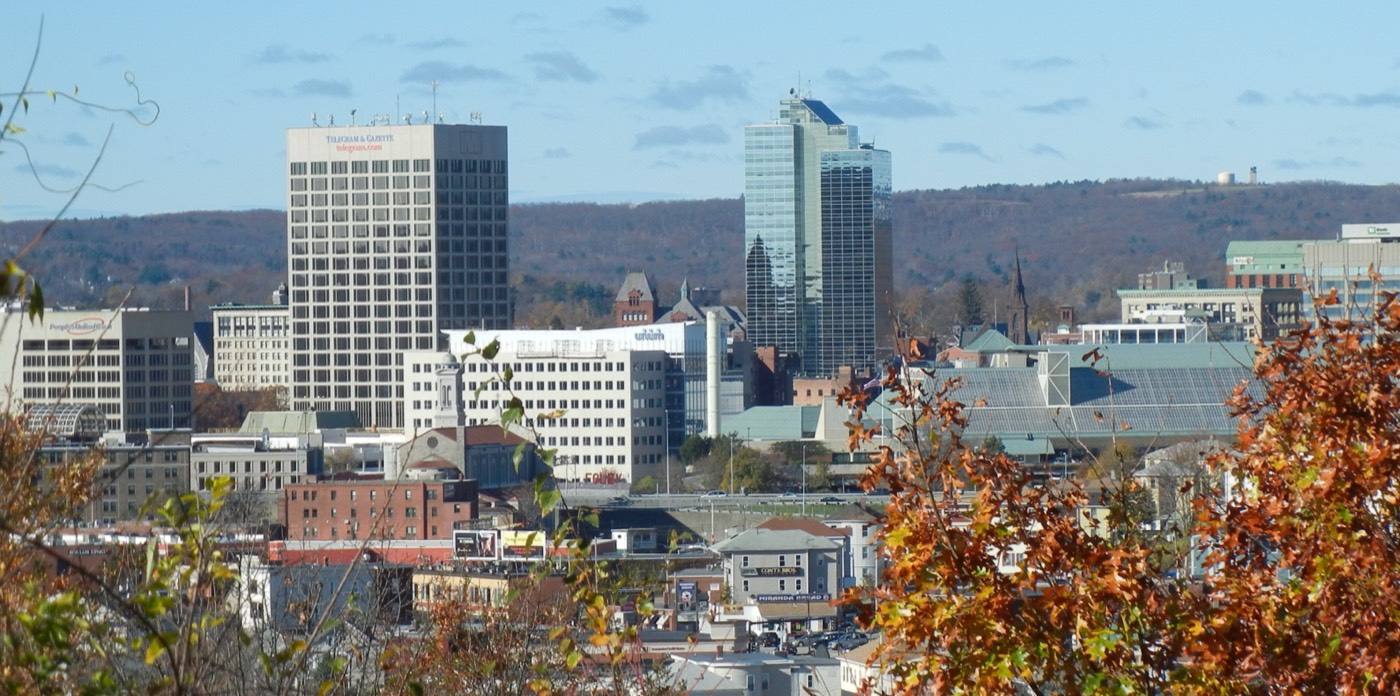
The story of the Irish in Worcester, Massachusetts begins in the mud. In the 1820s, gangs of young Irishmen dug a canal through the heart of central Massachusetts, and when the work ran out they did not go home. They stayed, sent for their families, raised churches in a Protestant city, and turned a hill town into one of the most stubbornly Irish places in New England.
The Place
Worcester sits in the middle of Massachusetts, forty miles west of Boston, ringed by seven hills and built on the steep slopes between them. It is the second-largest city in New England, an old factory town that made everything from wire to envelopes to abrasives.
For most of the nineteenth century it grew on immigrant labour, and the Irish were the first great wave of it. They arrived before the trains, before the wire mills, before Worcester was even a city, and they have been part of its character ever since.
How It Became Irish
The canal men, 1820s
The Blackstone Canal was dug between 1824 and 1828 to connect Worcester to Providence and the sea. It was brutal work, all of it by hand, and the men who did it were largely Irish labourers in their twenties, paid little and respected less.
The most famous of them was Tobias Boland, an Irish immigrant who oversaw construction and stayed on to help build the railroads that soon followed. Many of these pioneer Irish settled near what is now Kelley Square and the Canal District, in makeshift housing close to the water they had carved.
This first community was small and skilled, and it carried no priest of its own. Worcester’s churches were all Protestant. In 1826, Catholics had begun to settle in the area, but they had nowhere to worship.
A priest and a parish, 1834
A layman named Robert Laverty petitioned Bishop Benedict Fenwick of Boston to send a priest to Worcester. Father James Fitton, a Boston native, began visiting monthly in 1834, and from that small mission grew St. John’s parish, the oldest Catholic parish in New England outside Boston itself.
Fitton did more than say Mass. In 1840 he established a small seminary, Mount Saint James, on Pakachoag Hill south of the city, on roughly sixty acres of land. He handed it to Bishop Fenwick, who in 1843 founded the College of the Holy Cross there, the oldest Catholic college in New England.
The college was built to serve the Irish Catholic community pouring into the region, and Tobias Boland was among those who helped fund the land. The canal builder had become a founder of institutions.
The Famine flood, 1845 to 1852
The Great Famine turned a trickle into a flood. Tens of thousands of Irish landed in Boston in those years, and many made their way inland to the unincorporated lands of central Massachusetts, Worcester among them.
The new arrivals were poorer and more numerous than the pioneer Irish, and the two groups did not always get along. The earlier settlers had built careful, subservient ties to Worcester’s Yankee elite, and the Famine Irish resented both the deference and the men who paid for it.
Still, they filled the city. They worked the new wire mills and machine shops, lived in the three-deckers that came to define Worcester’s working districts, and worshipped at St. John’s and the daughter parishes that spread out from it across the east side.
The three-decker, that tall wooden tenement with one flat stacked on another and a porch at every level, became the signature Worcester home, and the Irish were among the first to fill them. A family could rent the second floor, take in a cousin upstairs, and walk to the mill in ten minutes.
The parish, not the neighbourhood, was the real unit of life. A man would describe where he lived by which church he belonged to, and the rhythm of baptisms, weddings, wakes, and feast days held the community together more tightly than any street map could.
The hills become Irish, 1880 to 1920
By the late nineteenth century the Irish had claimed whole neighbourhoods. Vernon Hill, on the city’s east side, and the low ground of Green Island near the old canal became strongholds, full of parish churches, corner taprooms, and the dense rows of triple-deckers that housed families three storeys at a time.
These were not wealthy districts. They were tight, Catholic, and proudly Irish, organised around the parish calendar and the politics that flowed from it. The Irish moved steadily into the police force, the fire department, City Hall, and the Church, the classic ladder of Irish-American advancement.
By the turn of the century the question in Worcester was no longer whether the Irish belonged. It was how much of the city they would run.
The Landmarks
St. John’s Catholic Church, 44 Temple Street. The mother church of Irish Worcester. The parish dates to 1834 and the present building was raised in 1845 and dedicated the following year. It is listed on the National Register of Historic Places and remains the oldest Catholic parish in New England outside Boston.
College of the Holy Cross, 1 College Street. Founded in 1843 by Bishop Benedict Fenwick on land that Father Fitton had assembled on Pakachoag Hill. It was built for the Irish Catholic sons of New England at a time when their faith barred them from older colleges, and it is still the oldest Catholic college in the region.
The Canal District and Kelley Square. The low ground where the Blackstone Canal once ran and where the canal-digging Irish first settled. The waterway is buried now, but the district keeps the name, and Kelley Square remains the gritty crossroads at the heart of the old Irish quarter.
Erin Gift Store, Worcester Public Market, 152 Green Street. A small Irish import shop run by Jennifer Courville, who was born and raised in Ireland. It sells handknit Aran goods and other imports from home, tucked inside the market in the old Canal District, a few minutes from where the canal men once lived.
O’Connor’s Restaurant and Bar, 1160 West Boylston Street. For decades the city’s best-loved Irish pub, opened in 1989 by Brendan and Claire O’Connor, graduates of the Shannon College of Hotel Management in County Clare. Its warren of snugs and rooms drew generations of Worcester families before it closed in 2026, mourned across the city.
Vernon Hill, east side. One of the historic Irish strongholds, a steep neighbourhood of triple-deckers and parish churches that filled with Irish families between roughly 1880 and 1920. It remains a touchstone for understanding how the Irish settled and held the east side of the city.
The Worcester County St. Patrick’s Parade, Park Avenue. Held since 1983 and reaching its forty-fourth year in 2026, the parade marches two miles up Park Avenue from Webster Square to Highland Street each March. Organised with the Ancient Order of Hibernians, who also run an Irish Festival, it is the largest public expression of the city’s Irish identity.
Where They Came From
The Worcester Irish were overwhelmingly from the south and west of Ireland, the regions that emptied hardest in the nineteenth century. Counties Cork, Kerry, Clare, and Tipperary recur again and again in the records of Irish emigration to New England, and they fed Worcester as surely as they fed Boston.
Migration ran in chains. One brother or cousin who found work in a Worcester mill would write home, send passage money, and pull the next relative across, so that whole townlands in Cork or Kerry came to be over-represented in particular Worcester streets.
The pull was steady work. From the 1820s onward, post-Napoleonic hardship in southern Ireland drove unskilled labourers toward the infrastructure projects of the New World, and Worcester had a canal, then railroads, then a forest of factories that needed hands.
For a young man or woman leaving a failing farm in Munster, Worcester offered something Ireland could not: a wage that arrived every week, a Catholic church that would marry and bury you, and a growing colony of people who spoke of the same parishes back home. That combination, more than any single landmark, is what built Irish Worcester.
Worcester Today
The 2020 figures count roughly 27,000 Worcester residents with Irish ancestry, about 6.9 per cent of the city, the second-largest Irish population in Massachusetts after Boston and ahead of Quincy. The percentage is lower than the state average, but the number is large and the roots run deep.
The Irish are no longer the newest arrivals. Worcester is now one of the most diverse cities in New England, home to growing Ghanaian, Albanian, and Latino communities, and the old triple-deckers of Vernon Hill and Green Island shelter many origins now. The Irish story is one layer among several.
But it is the foundational layer, and the city does not let it go. The parade still fills Park Avenue every March, St. John’s still stands on Temple Street, Holy Cross still crowns its hill, and the loss of an old pub like O’Connor’s is still treated as civic news. In Worcester, being Irish is less an identity to perform than a fact of how the place was made.
For families tracing their own line through the city, the pattern echoes elsewhere in the state. You can see it in the Irish of Quincy, in Braintree, and in Hyde Park, and farther afield in Bay Ridge, New York and the Chicago enclave of Sauganash. Worcester’s other heritages have their own chapters too, from the Greeks of Peabody to the Portuguese of Taunton.
Frequently Asked Questions
Why did the Irish first come to Worcester?
The first Irish in Worcester came in the 1820s to dig the Blackstone Canal, built between 1824 and 1828. When that work ended they stayed on to build the railroads, and the community grew from there into one of the largest Irish populations in Massachusetts.
How many Irish people live in Worcester today?
Around 27,000 Worcester residents report Irish ancestry, roughly 6.9 per cent of the city. That makes the Irish in Worcester the second-largest such community in Massachusetts after Boston, ahead of cities like Quincy.
What is the oldest Irish Catholic landmark in Worcester?
St. John’s Catholic Church at 44 Temple Street, whose parish dates to 1834 and whose present building was raised in 1845. It is the oldest Catholic parish in New England outside Boston and grew directly out of the early Irish settlement.
Where in Ireland did Worcester’s Irish come from?
Mostly from the south and west, with counties Cork, Kerry, Clare, and Tipperary heavily represented. Chain migration meant relatives followed one another from the same townlands into the same Worcester streets and mills.
Which Worcester neighbourhoods were the Irish heart of the city?
Vernon Hill on the east side and Green Island near the old canal were the great Irish strongholds, filled with parish churches and triple-deckers between about 1880 and 1920. The Canal District around Kelley Square was where the earliest canal builders settled.
Does Worcester still celebrate its Irish heritage?
Yes. The Worcester County St. Patrick’s Parade has marched up Park Avenue every year since 1983, reaching its forty-fourth year in 2026, and the Ancient Order of Hibernians runs an Irish Festival. The Irish in Worcester remain a defining part of the city’s public life.
If your family’s story passed through Worcester, or any of the places the Irish have made home in America, Atlas of Home can trace that journey. From a townland in Cork or Kerry to a triple-decker on Vernon Hill, to wherever you are now.