
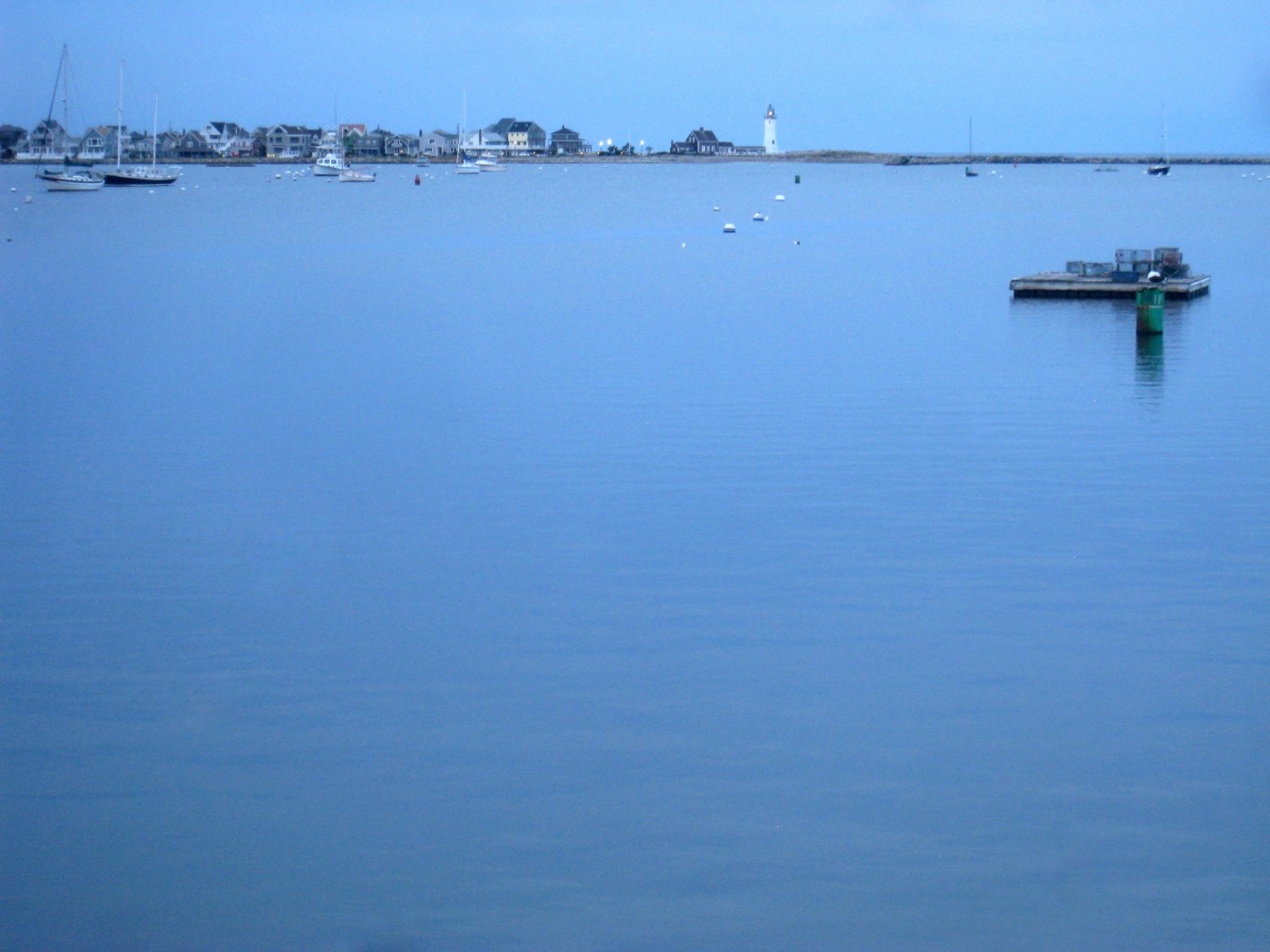
On the third Sunday of every March, a procession of pipe bands, fire trucks and green-clad schoolchildren winds 2.3 miles from the town common down to the harbour, where the Atlantic slaps against a granite breakwater and a white lighthouse keeps its old watch. This is Scituate, Massachusetts, and the Irish in Scituate are not a curiosity here. They are the town. The 2010 census recorded that almost half of Scituate’s roughly 18,000 residents claimed Irish ancestry, the highest concentration of any community in America.
The Place
Scituate sits on the South Shore of Massachusetts, midway between Boston and Plymouth, a coastal town of about 19,000 people built around a working harbour and a string of Atlantic beaches. It is affluent and quiet, with a 2024 median household income of roughly 137,000 dollars, well above the state and county figures.
The town is shaped by water. Five beaches face the open ocean, a tidal river curls behind them, and Front Street runs along the harbour lined with galleries, ice cream shops and pubs. The Old Scituate Lighthouse, finished in 1811, stands at the harbour mouth, and the medieval-looking Lawson Tower rises behind the town like something lifted from the Rhine.
It is the kind of New England seaside town that fills up in summer and empties in winter. What makes it different from its neighbours is the seaweed that once grew on its rocks, and the people from the west of Ireland who came to harvest it. Massachusetts has many towns defined by a single heritage, from the Armenians of Belmont to the Chinese of Wellesley, but few are defined by it as completely as Scituate.
How It Became Irish
The Irish story in Scituate does not begin with the famine ships docking in Boston, though those ships are part of it. It begins underwater, with a red algae the Irish already knew by heart.
A fisherman recognises the moss, around 1847
Around 1847, an Irish immigrant and fisherman named Daniel Ward was working the waters off Boston when he recognised something familiar clinging to the rocks at low tide. It was carrageen, the seaweed the Irish call carraigín and the rest of the world came to call Irish moss.
Ward knew this plant. In the coastal west of Ireland, communities had hand-harvested it for generations, eating it, using it as medicine, feeding it to livestock. He understood that what grew thickly on Scituate’s rocks had value, and he settled on the town’s beaches to build an industry around it.
Ward’s own fortune did not come from moss alone. In 1854 he won salvage rights to the wreck of the Forest Queen, which carried silver bars. He built a large house on a cliff and offered it for the first Catholic Mass said in the town, a detail that says a great deal about who was arriving.
The famine generation finds a trade waiting
The timing was unkind and then, for Scituate, oddly merciful. The Great Famine of 1845 to 1849 drove enormous numbers of Irish out of the country, and many of those fleeing landed in Boston with nothing. Word spread that on the South Shore there was a town where a familiar skill could put food on the table.
Mossing did not require capital, English fluency or a landlord’s permission. It required knowing the tides, owning a rake and a dory, and being willing to work cold water. Families from Ireland’s western coast had exactly this knowledge, and they came.
By 1870 there were close to 100 Irish families in Scituate. Ward had taken on a partner, Miles O’Brien, and the trade had become the spine of the local economy. The dried moss was shipped out to be used as a thickener and stabiliser in beer, wine, ice cream, paint, cosmetics and calico dye.
It was a different settlement from the dense urban parishes the Irish built elsewhere. Where the Irish of Pennsport in Philadelphia and the Irish of the Irish Channel in New Orleans packed around riverfronts, Scituate’s first families spread along open beaches and worked the tide.
How the work was done
The labour was punishing. Mossers rowed out in 16-foot dories and used rakes up to 12 feet long to haul the slippery weed off the sea floor around low tide. A good day might yield close to 1,000 pounds.
Then came the drying. The moss was spread across the beaches for several days, raked and turned, bleached pale by the sun. Rain at the wrong moment was a disaster: too much water and the moss began to bleed, turning to mush and losing its worth. It was a family operation, children included.
One of the most remembered figures is Mim Flynn, the Irish Mossing Queen, said to have rowed her own dory at the age of nine in 1934. Hawk Hickman, who mossed for more than 30 years, later wrote two books about the trade so it would not be forgotten.
The summer Irish and the Riviera
A second wave changed the town’s character again. By the early 1900s, Boston’s Irish were climbing out of poverty into the professional and political middle class, and they wanted somewhere to spend the summer. They found the South Shore.
Irish families from Boston bought or rented cottages along the Scituate and Marshfield shore, and the seasonal population swelled. The stretch of coast acquired a nickname that stuck: the Irish Riviera, in common use by the 1930s, half affectionate, half proud.
The connection ran deep into Boston’s Irish establishment. The South Shore drew the families and figures of the city’s Irish American world, the same world that produced figures like James Michael Curley and, in time, the Kennedys, who summered not far up the coast. Scituate was where ordinary Irish Boston went to feel the sea air. These were the families of Irish South Boston, Dorchester and Charlestown, trading the city’s triple-deckers for a summer cottage by the water.
From summer colony to home
After the Second World War the seasonal town became a year-round one. Returning servicemen from the Irish strongholds of South Boston, Dorchester and Hyde Park moved out to the South Shore suburbs, many of them already knowing Scituate from boyhood summers.
The mossing faded slowly. It supported workers into the 1960s under the local buyer Lucien Rousseau, and limped on until around 1997, finished off by cheap overseas labour and failing driers after Rousseau’s death. By then the moss was no longer the point. The Irish were rooted, and they stayed.
The Landmarks
Old Scituate Lighthouse, Lighthouse Road. Finished on 19 September 1811, it was among the earliest lighthouses in the country. During the War of 1812 the keeper’s daughters, Rebecca and Abigail Bates, became local legend as the American Army of Two, frightening off a British landing party by playing a fife and drum behind the trees. The lighthouse remains the town’s emblem and the endpoint of the St Patrick’s Day parade.
Lawson Tower, First Parish Road. A 153-foot stone tower built in 1902 by the financier Thomas W. Lawson, who encased an ugly water tank inside a structure modelled on a 15th-century German watch tower so that it would not spoil his wife’s view. The town bought it in 1923. Its bells are still rung on special occasions, including the Irish festivities.
Front Street, Scituate Harbor. The harbour’s main street, lined with galleries, gift shops and eateries, is the social spine of the town. It is where the parade ends and where, the rest of the year, the town’s Irish character shows up in pub windows rather than bunting.
Hibernian Tavern, Front Street. A contemporary Irish pub on the harbour whose menu runs from traditional boxty to wild mushroom and truffle ravioli. In good weather its front windows open and tables spill onto the sidewalk, a small daily statement of the town’s heritage.
Peggotty Beach. One of Scituate’s five Atlantic beaches and the site of the annual St Pat’s Plunge, when locals run into the freezing March ocean to raise money for charity. The beaches that once dried the Irish moss now host the celebrations of the people who harvested it.
The St Patrick’s Day Parade route, Town Common to Scituate Harbor. Begun in 1994 by Jim and Janet Campbell and a handful of neighbours as a small loop around the block in the Minot section, it now stretches 2.3 miles and costs around 60,000 dollars to stage. Held on the third Sunday in March, it is the largest public expression of the town’s identity.
Where They Came From
The Irish who built Scituate’s mossing trade came overwhelmingly from the western coast of Ireland, where seaweed harvesting was an old and ordinary part of life. Connemara, the wider County Galway coast and the Aran Islands held the greatest diversity of seaweed in the country, and the communities there had hand-gathered carrageen at low tide for generations.
This is why the trade transferred so cleanly. A family from the Galway coast did not need to learn how to read a tide line or rake a slippery rock. They arrived in Scituate already expert, carrying a skill that most American arrivals did not possess.
The famine emigration that filled the first cottages came from across Ireland, but the post-1880 emigration from the west was especially heavy. Around 15 percent of Connemara’s population is recorded as leaving between 1880 and 1884 alone, much of it under assisted emigration schemes. Some of that stream found its way to a Massachusetts town where the rocks grew like home.
Scituate Today
Scituate today is a comfortable commuter town and summer resort, more notable for its real estate and its harbour than for any working trade. The mossing is gone. The families are not.
The Irish identity here is no longer about labour. Almost nobody makes a living from the sea the way the first arrivals did. What endures is ancestry, memory and ritual: the parade, the plunge, the Hibernian’s pints, the bells of Lawson Tower, and the census fact that this remains, by share of population, the most Irish town in America.
It is a different kind of Irish American place from the working-class enclaves of the Mission District in San Francisco or the older Irish of Savannah, Georgia. Scituate is the prosperous, settled end of the Irish American story.
That can read as nostalgia, and partly it is. But it is also lived. Generations of the same families have stayed put on the same shore, and the town’s parishes, pubs and March festivities are the ordinary furniture of local life, not performances staged for visitors. The moss that first drew Daniel Ward and the famine families is mostly forgotten now, but the people it brought are still, unmistakably, at home.
Frequently Asked Questions
Is Scituate really the most Irish town in America?
By one clear measure, yes. The 2010 US census found that almost half of Scituate’s roughly 18,000 residents claimed Irish ancestry, the highest concentration of any place in the country. The Irish in Scituate are not a minority community here; they are close to the majority.
Why did Irish immigrants settle in Scituate?
They came for Irish moss. Around 1847 an Irish fisherman named Daniel Ward recognised the carrageen seaweed on Scituate’s rocks, a plant his countrymen had harvested in Ireland for centuries. Famine refugees with that same skill followed, and by 1870 there were close to 100 Irish families in town.
What was Irish mossing?
Irish mossing was the harvesting of carrageen seaweed, raked from the sea floor at low tide using 12-foot rakes from small dories, then dried on the beaches. The dried moss was sold as a thickener for beer, ice cream, cosmetics and dye, and the trade supported Scituate families until around 1997.
Where did the Scituate Irish originally come from?
Most came from the western coast of Ireland, especially Connemara, the County Galway coast and the Aran Islands, where seaweed harvesting was a long-established way of life. That existing skill is why so many western Irish families settled in this particular Massachusetts town rather than elsewhere.
Why is the South Shore called the Irish Riviera?
By the early 1900s, Boston’s increasingly prosperous Irish families began summering along the Scituate and Marshfield coast, and the seasonal population doubled. The nickname Irish Riviera was in common use by the 1930s and still describes the stretch of South Shore coast centred on Scituate.
What happens at the Scituate St Patrick’s Day Parade?
Held on the third Sunday in March, the parade runs 2.3 miles from the Town Common to Scituate Harbor and draws large crowds. It began in 1994 as a small neighbourhood loop and now anchors a weekend of events including the Mad Hatter’s Ball and the St Pat’s Plunge into the Atlantic at Peggotty Beach.
If your family’s story passed through Scituate, or any of the places the Irish have made home in America, Atlas of Home can trace that journey. From the seaweed beaches of Connemara and the Galway coast to the dories and drying flats of the Irish Riviera, to wherever you are now.