
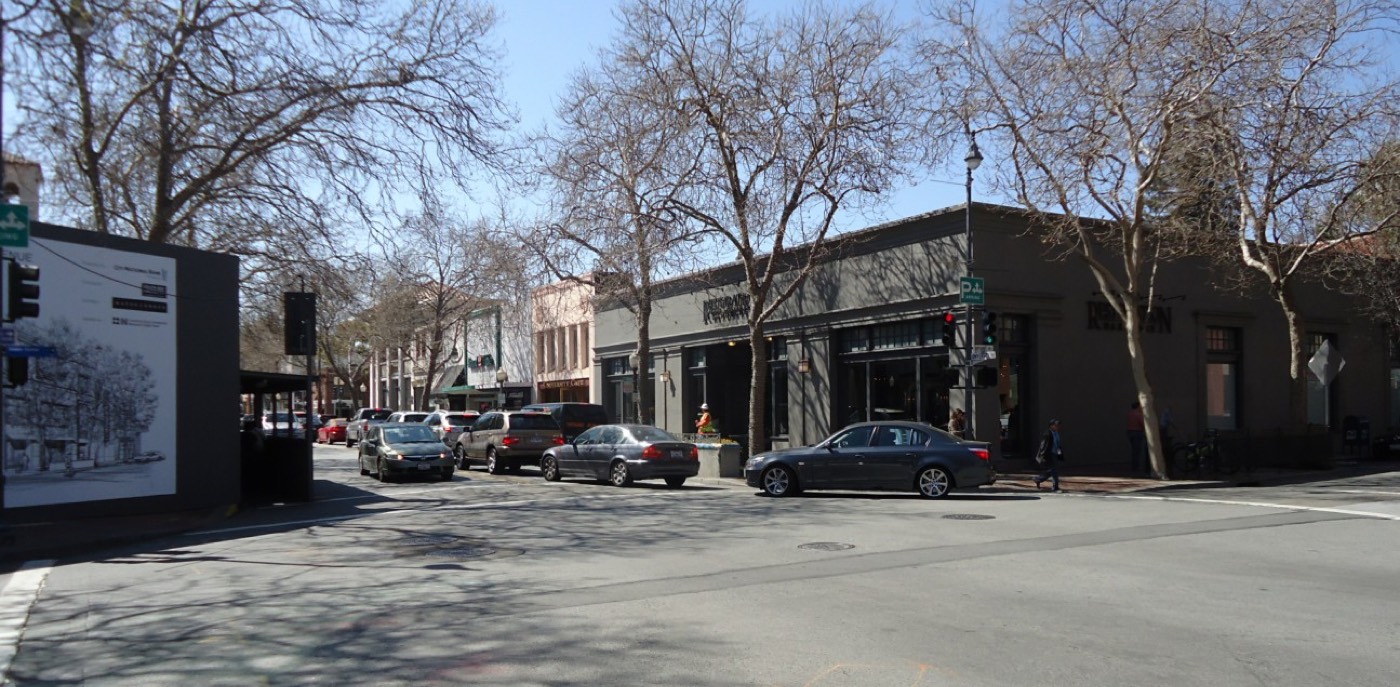
On a Friday afternoon on University Avenue, the smell of warm pita drifts out of a doorway and someone answers a phone in rapid Hebrew. This is the heart of the Israelis in Palo Alto, California, a community that arrived not in steerage but in business class, carrying laptops and patents instead of trunks, and that has quietly woven itself into the wealthiest stretch of Silicon Valley.
The Place
Palo Alto sits at the northern edge of Santa Clara County, wrapped around the campus of Stanford University. It is one of the most expensive towns in America, with a median household income above $230,000 and a median home value north of $3 million.
The town has long been the launchpad of the technology industry. Bill Hewlett and David Packard founded Hewlett-Packard in a Palo Alto garage on Addison Avenue in 1939, a building now marked as the birthplace of Silicon Valley.
Stanford itself supplied the spark. In the 1930s the university’s dean of engineering, Frederick Terman, often called the father of Silicon Valley, began urging graduates to build their companies nearby rather than leave California. That deliberate stitching together of campus and industry created the ecosystem of venture capital, talent and proximity that still defines the town.
That density of capital, engineering talent and ambition is exactly what would later draw thousands of Israelis west. For a country that had branded itself the start-up nation, Palo Alto was less a foreign city than a second home office.
How It Became Israeli
The Israeli presence in Palo Alto is younger than most diaspora stories. It did not grow from refugees or labourers but from engineers, many of them in their late twenties and thirties, who came chasing the same thing everyone else in this town chases: the next company.
The first wave: military intelligence and the start-up nation
By the late 1990s, Israeli emigrants were among the leading immigrant nationalities in Silicon Valley. A striking number had passed through the same institutions back home, above all the elite military intelligence Unit 8200, which functioned as an informal engineering school for a generation of founders.
Companies that would become household names in the Valley trace their roots to that unit. Check Point, CyberArk, Palo Alto Networks and the navigation app Waze all had founders who served in Israeli military intelligence before building businesses that crossed the ocean.
The expressway west
Through the 2000s and 2010s, a steady channel opened between Tel Aviv and the Peninsula. An Israeli engineer might raise seed money in Herzliya, then relocate the team to be near American customers and venture capital, with Palo Alto the natural landing point.
Accelerators built specifically for this traffic took root here. UpWest Labs, based in Palo Alto, was created to give Israeli founders a soft landing in the United States, a desk, a network and a runway into the American market.
Waze, developed in Israel, moved to Palo Alto soon after its founding and was acquired by Google in 2013 for close to a billion dollars. Houzz, the home-design platform founded by the Israeli couple Adi Tatarko and Alon Cohen in 2009, made its home in Palo Alto too.
Counting an uncounted community
Israelis are notoriously hard to count, partly because many hold dual citizenship and partly because they move back and forth. Estimates for the wider Silicon Valley region range enormously, from roughly 50,000 to as many as 200,000, against an American Israeli population estimated in the hundreds of thousands.
What is not in doubt is the gravitational pull of California. By the early 2020s the state had become home to more Israeli-founded technology unicorns than any other in the country, a tally that kept climbing into the dozens, and Palo Alto held a disproportionate share of them.
Building a place to be Israeli
Money and start-ups explain why Israelis came. The reason families stayed, raised children and put down roots is something quieter: the slow construction of institutions where you could be Israeli without translation.
The Oshman Family Jewish Community Center, on Fabian Way, became the anchor. It made a deliberate effort to welcome Israelis specifically, hosting barbecues for Yom Ha’atzmaut, Israel’s Independence Day, and tree plantings for Tu Bishvat.
Inside it grew the Israeli Cultural Connection, a hub of arts, music and family programming that draws thousands of people a year, and a place where the question of how to be an Israeli Jew living outside Israel could be worked out in good company.
For founders, the social glue extended into professional life. Networks like the Israeli Executives and Founders Forum, co-founded by Israelis who had moved to Northern California in the early 2000s, brought together expatriate techies for the kind of informal mentorship and deal-making that the army units had taught them to value. The line between a Shabbat dinner and a board introduction often blurred.
The Landmarks
Oshman Family JCC, 3921 Fabian Way. The community’s living room. Its Israeli Cultural Connection runs concerts, seminars and family events year round, and it is where local Israelis gather to mark the holidays of a country thousands of miles away.
Oren’s Hummus, 261 University Avenue. Founded by serial tech entrepreneur Oren Dobronsky, this downtown restaurant serves Israeli-style hummus, skewers and freshly made pita, with chickpeas, tahini, spices and coffee imported directly from Israel. It has become a default meeting point for the Israeli diaspora on the Peninsula.
Beged Kefet Hebrew Language School, Oshman Family JCC. Established in a private home in 2008 and operating from the JCC since 2009, Beged Kefet teaches modern spoken Hebrew and Israeli culture to more than 200 students from kindergarten through high school. It is accredited by the Western Association of Schools and Colleges.
UpWest Labs, Palo Alto. An accelerator built specifically for Israeli founders crossing into the American market, offering early-stage teams a base, mentorship and introductions to Valley investors. For many Israeli companies, it has been the first American address.
The HP Garage, 367 Addison Avenue. Not Israeli, but essential to the story. This is the garage where Hewlett-Packard began in 1939, the building Californians call the birthplace of Silicon Valley, and the symbolic centre of the engineering culture that drew Israelis here in the first place.
Crossroads Specialty Foods, 720 San Antonio Road. A world market on the Palo Alto edge that stocks imported foods from around the globe, including Israeli and Middle Eastern staples, the sort of place where an expatriate can find the brands of home on the shelf.
Falafel Stop, Sunnyvale. A short drive south, this no-frills counter is a longstanding fixture where Israelis across the Peninsula go for a falafel fix, proof that the community’s map runs well beyond the town line.
Where They Came From
Unlike most diaspora communities, the Israelis of Palo Alto did not come from a single town or region. They came from across Israel, but they shared something more specific than geography: a common set of institutions.
Tel Aviv and its tech corridor, the universities of Haifa and Be’er Sheva, and above all the army’s technology units supplied a steady stream of engineers fluent in both code and risk. Service in units like 8200 created a network that travelled with them across the Atlantic. The same instinct to gather around shared institutions shows up in older Israeli enclaves on the other coast, among the Israelis of Tenafly, New Jersey and the Israeli community of Pico-Robertson in Los Angeles.
The migration was also circular. Many kept apartments and family in Israel, flew back for holidays and reserve duty, and raised children who grew up genuinely bilingual. That refusal to fully let go of home is part of why a Hebrew school in Palo Alto could fill 200 desks. Parents who themselves spoke Hebrew at the dinner table wanted their American-born children to read it, argue in it and one day choose Israel for themselves rather than inherit it by default.
Palo Alto Today
Today the Israeli presence in Palo Alto is less a neighbourhood than a layer running through the town. You hear it in the cafes off University Avenue, in the parents’ chatter at the JCC preschool, in the Hebrew slipping into start-up Slack channels.
It is also a community shaped by the same pressures as everyone around it. Palo Alto’s astonishing housing costs push younger arrivals toward Mountain View, Sunnyvale and San Jose, so that the Israeli map of the Peninsula has spread far wider than the town that first anchored it. They join a broader tapestry of immigrant communities across the South Bay, from the Chinese of San Jose to the Koreans of Anaheim Hills further south.
What endures is the sense of a community that built its own institutions quickly and well. The barbecues for Yom Ha’atzmaut still happen, the falafel counters still draw a crowd, and the children at Beged Kefet still sing in Hebrew, holding open a door back to a country their parents never quite closed behind them.
Frequently Asked Questions
How many Israelis live in Palo Alto and Silicon Valley?
There is no precise official count, because many Israelis hold dual citizenship and move between countries. Estimates for the wider Silicon Valley region range from roughly 50,000 to as many as 200,000. The Israelis in Palo Alto specifically are a smaller but highly visible slice concentrated around the tech industry.
Why did Israelis settle in Palo Alto?
Palo Alto sits at the centre of Silicon Valley, home to Stanford University and the venture capital and engineering talent that Israeli founders needed to grow their companies. Many came to be near American customers and investors, often relocating start-ups first founded in Israel.
Where is the centre of the Israeli community in Palo Alto?
The Oshman Family JCC on Fabian Way is the community’s main gathering point, through its Israeli Cultural Connection programming and the Beged Kefet Hebrew Language School. Downtown spots like Oren’s Hummus on University Avenue also serve as informal meeting places for the Israelis in Palo Alto.
Is there Israeli food in Palo Alto?
Yes. Oren’s Hummus at 261 University Avenue serves Israeli-style hummus, skewers and pita with ingredients imported from Israel. Markets such as Crossroads Specialty Foods stock Israeli pantry staples, and falafel counters like Falafel Stop in nearby Sunnyvale draw Israelis from across the Peninsula.
What Israeli-founded companies are based in or near Palo Alto?
Houzz, founded by Adi Tatarko and Alon Cohen, is based in Palo Alto, and Waze relocated to the town before Google acquired it in 2013. California is home to more Israeli-founded technology unicorns than any other US state, with Palo Alto holding a notable share.
Can children learn Hebrew in Palo Alto?
Yes. The Beged Kefet Hebrew Language School at the Oshman Family JCC teaches modern spoken Hebrew and Israeli culture to more than 200 students from kindergarten through high school, and is accredited by the Western Association of Schools and Colleges.
If your family’s story passed through Palo Alto, or any of the places Israelis have made home in America, Atlas of Home can trace that journey. From a base in Tel Aviv or a desk in Unit 8200, to a Friday barbecue at the JCC on Fabian Way, to wherever you are now.