
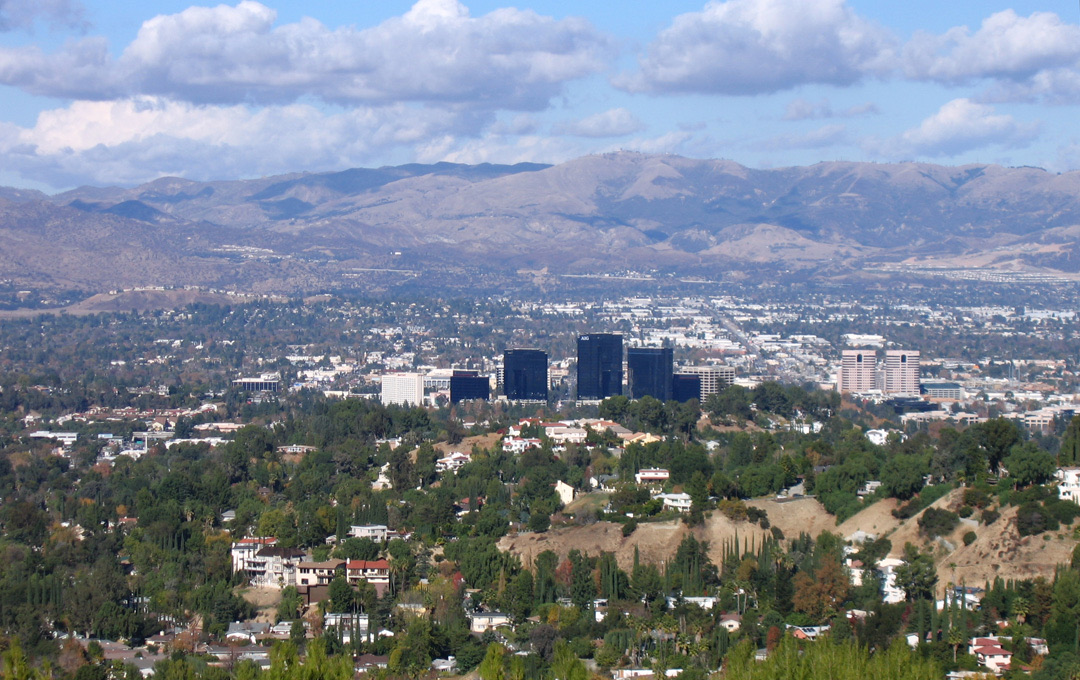
Drive west along Ventura Boulevard on a Saturday morning and the signs begin to change. The bakery cases fill with barbari and sangak, the produce stacks turn to fresh herbs by the armful, and the conversation in the queue slips between English and Farsi without anyone missing a beat. The Persians in Woodland Hills did not arrive all at once. They settled in over four decades, family by family, until this corner of the west San Fernando Valley became one of the most quietly Iranian places in America.
The Place
Woodland Hills sits at the western end of the San Fernando Valley, pressed against the Santa Monica Mountains where Los Angeles begins to thin out into canyon and chaparral. It is a neighbourhood of the city of Los Angeles rather than a separate town, though it has always felt like one, with its own commercial spine along Ventura Boulevard and its own civic identity around Warner Center.
The land has a planned, cultivated feel because it was planned. In 1922 a developer named Victor Girard Kleinberger bought 2,886 acres here and laid out a town he called Girard, planting some 120,000 trees to draw buyers to what had been dry valley scrub. The community was absorbed into Los Angeles and renamed Woodland Hills in 1945.
Today it is affluent and green and warm, sometimes ferociously so. On 6 September 2020 a thermometer in Woodland Hills hit 121 degrees Fahrenheit, the highest temperature ever recorded in Los Angeles County. By the early 2020s the population had grown to roughly 79,000.
How It Became Persian
The story of Persian Woodland Hills is, at root, the story of a single rupture and the long settling that followed it.
Before 1979: a thin foothold
There were Iranians in Los Angeles before the revolution, but not many. A small Persian presence had taken shape around Westwood from the 1960s, built largely of students, professionals and the children of well-off families sent abroad to study. It was a foothold, not yet a community.
The Valley at that point was something else entirely: tract homes, aerospace jobs, the suburban middle of mid-century Los Angeles. Woodland Hills was prosperous and overwhelmingly white. The Persian story here had not started.
1979 and the great departure
Then came the Iranian Revolution. The fall of the monarchy and the establishment of the Islamic Republic in 1979 sent hundreds of thousands of Iranians out of the country, and a striking share of them turned toward Southern California.
More than 40 per cent of Iranian immigrants to the United States settled in the Greater Los Angeles area, which became home to the largest Iranian community anywhere outside Iran. The enclave that formed first, in and around Westwood, earned a nickname that stuck: Tehrangeles.
The move over the hill
The first wave clustered on the Westside, but the Westside is expensive and cramped. As the community grew and as American-born children arrived, families looked over the hill into the Valley, where the same money bought a yard, a driveway and an extra bedroom.
Through the late 1980s and the 1990s, Iranian families moved in numbers into the west Valley, concentrating in three adjoining neighbourhoods: Encino, Tarzana and Woodland Hills. These became recognised hubs of the Iranian diaspora, secondary capitals of Tehrangeles built on space rather than density.
The pull was practical. Woodland Hills offered larger lots, strong schools and a settled suburban calm, while still sitting close enough to the Westside that the older community remained within reach. For many Iranian professionals, doctors, engineers, dentists, business owners, it was the natural next step up.
A community visible in the census
By 2000 the shift was no longer anecdotal. When the census asked Woodland Hills residents about their ancestry, Iranian came back as the single most common answer, reported by 8.8 per cent of residents, just ahead of German at 7.8 per cent. For a neighbourhood that had been almost entirely Anglo a generation earlier, that was a remarkable turn, recorded in the census ancestry data for Woodland Hills.
The numbers across the wider county tell the same story at scale. The American Community Survey has counted roughly 84,000 people of Iranian ancestry in Los Angeles County, and the city of Los Angeles holds the largest single concentration of Iranians in the United States. Woodland Hills is one of the places those figures actually live.
Many Irans, one neighbourhood
It is worth saying that “Persian” here covers more than one community. The Iranians who came to the west Valley included Muslims, Baha’is and Armenians, but the most visible and most rooted group has been Iranian Jews.
Los Angeles is home to an estimated 45,000 Persian Jews, more than twice the number remaining in Iran, and a great many of them put down roots in Encino, Tarzana and Woodland Hills. Their synagogues, schools and cultural centres became the institutional backbone of the west Valley’s Iranian life.
The Landmarks
Woodland Hills Market, 19964 Ventura Boulevard. This is the everyday heart of Persian Woodland Hills, a grocery, bakery and eatery rolled into one. The shelves carry fresh herbs by the bunch, certified halal poultry and fish, samovars and tea glasses for the home, and a bakery turning out traditional Persian bread on the premises. For many families the weekly shop here is as much ritual as errand.
Eretz Synagogue and Cultural Center, 6170 Wilbur Avenue, Tarzana. Founded by Jews who left Iran in the wake of the 1979 revolution, Eretz has served the west Valley’s Persian Jewish community for around four decades. It functions as both a traditional congregation and one of the largest Persian Jewish cultural centres in the state, hosting the lifecycle events, holidays and gatherings that hold the community together.
Orchid Grill and Kabob, 19649 Ventura Boulevard, Tarzana. Family owned and operated since 1995, Orchid is the kind of neighbourhood kabob house that grows up alongside a community rather than chasing it. The menu runs through the Persian canon of charbroiled kabobs, slow-cooked stews and saffron rice, and it has fed west Valley regulars for three decades.
Haichal Moshe, Encino. Just east along the Valley, this Persian synagogue was founded in 2004 by Rabbi Loloyan with the aim of building an inclusive congregation. It speaks to a second institutional generation: not the first refuge of the revolution years, but the deepening of a community that had decided to stay.
The Village at Westfield Topanga and Warner Center, around 6360 Topanga Canyon Boulevard. Warner Center is the west Valley’s commercial downtown, and its open-air shopping and dining village has become a default meeting ground. On weekends the cafes and restaurants fill with Persian families, the public square doing quietly what a town centre does.
El Camino Real and William Howard Taft high schools. These two public high schools have educated the American-born generation of Woodland Hills, including many children of Iranian immigrants. In a community that prizes education almost above everything, their academic reputations have been part of what kept Persian families anchored to the neighbourhood.
Los Angeles Pierce College. The community college on the Valley’s western edge has long been a first rung for newcomers and a practical option for local students alike, another of the institutions that made Woodland Hills a place to build a life rather than merely pass through.
Where They Came From
The Persians of Woodland Hills came overwhelmingly from urban Iran, and above all from Tehran. The capital was the centre of the educated, professional and merchant classes who had the means and the connections to leave after 1979, and it is their dialect and their habits that shaped Tehrangeles.
For the Iranian Jewish families who form so much of the west Valley community, the roots run through Tehran and through older Jewish centres such as Isfahan and Shiraz, cities with Jewish histories measured in centuries. Many had already moved to Tehran before they left Iran altogether.
What they carried was less a region than a class and a sensibility: a deep respect for schooling, an instinct for enterprise, and a determination that the next generation would do at least as well as the last. Woodland Hills, with its good schools and its room to grow, was where a great many of them chose to act on that.
Woodland Hills Today
The Persians in Woodland Hills are now well past the immigrant chapter. The arrivals of the 1980s have raised children and grandchildren here, and the community is layered: Farsi-speaking elders, bilingual parents, and a younger generation that is thoroughly Californian and still, in important ways, Iranian.
That generational depth shows up in ordinary places. It is in the Persian bakery counter on Ventura Boulevard, the synagogue calendar in Tarzana, the Nowruz tables set each spring, the doctor’s office and the dental practice with a Persian surname on the door. None of it announces itself loudly. It is simply woven into how the west Valley works.
It is an honest place, too, which means not everything is settled. The cost of Southern California has pushed some younger Iranians further out, toward the suburbs of the Conejo Valley and Orange County, and the heaviest Persian gravity in Los Angeles still sits on the Westside. But Woodland Hills holds. Four decades after the first families came over the hill looking for a yard and a good school, this stretch of the west Valley remains one of the most genuinely Persian neighbourhoods in the country.
For a wider view of how Iranians have settled across America, it is worth reading about the Persians in nearby Thousand Oaks, just over the county line in the Conejo Valley, as well as the communities in Houston, Texas, Atlanta, Georgia and Bellevue, Washington. The same Southern California valleys that drew Iranians also drew other Pacific and Asian diasporas, from the Koreans of Anaheim Hills to the Chinese of San Jose.
Frequently Asked Questions
Why are there so many Persians in Woodland Hills?
The Persians in Woodland Hills are part of the great Iranian migration that followed the 1979 revolution, which made Los Angeles home to the largest Iranian community outside Iran. As families outgrew the Westside through the late 1980s and 1990s, many moved over the hill into the west San Fernando Valley, where Woodland Hills offered larger homes, strong schools and room to grow.
What share of Woodland Hills is of Iranian ancestry?
In the 2000 census, Iranian was the single most commonly reported ancestry in Woodland Hills, named by 8.8 per cent of residents, just ahead of German at 7.8 per cent. Across Los Angeles County, the American Community Survey has counted roughly 84,000 people of Iranian ancestry.
Is the Persian community in Woodland Hills mostly Jewish?
It is one of the most prominent strands. Los Angeles is home to an estimated 45,000 Persian Jews, many of them settled in Encino, Tarzana and Woodland Hills, and their synagogues and cultural centres anchor much of the area’s Iranian life. The wider community also includes Iranian Muslims, Baha’is and Armenians.
Where can I find Persian food and groceries in Woodland Hills?
Woodland Hills Market at 19964 Ventura Boulevard is a combined Persian grocery, bakery and eatery with fresh herbs, halal meat and bread baked on the premises. Nearby in Tarzana, Orchid Grill and Kabob at 19649 Ventura Boulevard has served charbroiled kabobs and Persian stews since 1995.
What is Tehrangeles, and how does Woodland Hills fit in?
Tehrangeles is the nickname for Iranian Los Angeles, originally centred on Westwood, where a Persian community took shape from the 1960s and expanded sharply after 1979. Woodland Hills, along with Encino and Tarzana, became one of the west San Fernando Valley hubs of that diaspora, a secondary capital built on suburban space rather than density.
When did Iranians first settle in the Los Angeles area?
A small Persian presence existed around Westwood from the 1960s, made up largely of students and well-off families. Immigration increased several-fold around the 1979 Iranian Revolution, and the move into Woodland Hills and the wider west Valley followed mainly in the late 1980s and 1990s.
If your family’s story passed through Woodland Hills, or any of the places Persians have made home in America, Atlas of Home can trace that journey. From Tehran and the old Jewish quarters of Isfahan and Shiraz, to a bakery counter on Ventura Boulevard, to wherever you are now.