
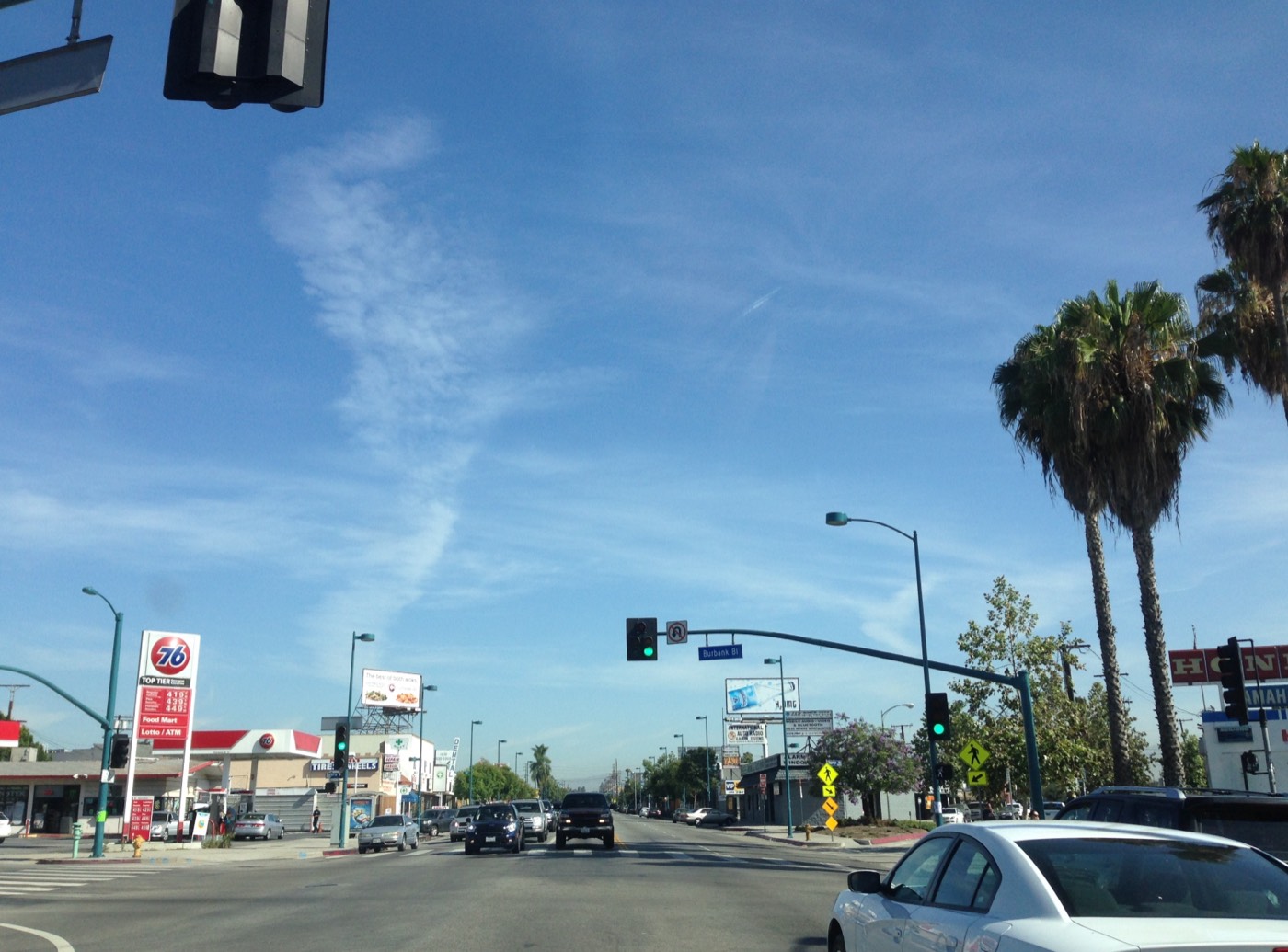
On a Saturday morning the queue at Taron Bakery on Sherman Way runs out the door, and almost every conversation in it is in Armenian. The smell of lahmajune and warm cheese boreg drifts onto the pavement. This is the everyday texture of the Armenians in North Hollywood, a community that has quietly turned the east San Fernando Valley into one of the largest Armenian centres in the United States, without the headlines that follow Glendale a few miles to the east.
The Place
North Hollywood sits in the southeast corner of the San Fernando Valley, founded by the Lankershim Ranch Land and Water Company in 1887 and known first as Toluca, then Lankershim, before it took the name North Hollywood in 1927. For decades it was wheat fields and peach orchards, then film back lots and post-war tract housing.
Today its old downtown is the NoHo Arts District, a theatre and gallery quarter formally established in 1992 and anchored by the North Hollywood Metro station that opened in 2000. Around that creative core sits a dense, working neighbourhood of apartment blocks and small businesses, and it is here, along Victory Boulevard, Sherman Way and Vineland, that the Armenian community has put down roots.
How It Became Armenian
The story of the Armenians in North Hollywood is really the story of Armenian Los Angeles spilling north and west out of Hollywood, then east out of Glendale, until the east San Fernando Valley became a community in its own right.
The Hollywood beginnings
The earliest large Armenian settlement in the region gathered in Hollywood, in the streets that later became Little Armenia. A wave arrived in the 1940s and settled there, in what is now the Armenian heart of Hollywood. By 1979 and 1980 roughly 9,500 Armenians came to the United States, and most of that group settled in Hollywood too.
As those families found their footing, many looked north across the Cahuenga Pass for more space and cheaper rents. The flat Valley grid, with its older apartment stock around North Hollywood and Van Nuys, offered exactly that.
The refugee waves of the 1970s and 1980s
Two upheavals abroad reshaped the community. The Lebanese Civil War, which began in 1975, pushed large numbers of Lebanese Armenians toward Los Angeles. Around the same period, political turmoil sent Iranian Armenians and Egyptian Armenians to the city as well.
Then came the Soviet door opening. In August 1987, as part of glasnost, the Soviet Union began approving exit visas for Armenians wishing to reunite with relatives in the United States. From October 1987 through March 1988 alone, about 2,000 Armenians arrived in Los Angeles County, and that flow of newcomers from the homeland continued through the 1990s.
These groups did not all settle in the same streets. Lebanese and Iranian Armenians, often arriving with capital and professional training, frequently chose the Valley, while many newcomers straight from Armenia were drawn to its more affordable apartments. North Hollywood absorbed a mix of both.
The Glendale spillover
By the early 1990s, Glendale had become the densest Armenian centre in the diaspora. Levon Marashlian, an Armenian history teacher at Glendale Community College, noted that Glendale’s Armenian population had grown larger than Hollywood’s by that time.
As Glendale’s Armenian community filled and grew more expensive, families looked over the hills into the Valley. North Hollywood, Valley Glen, Van Nuys, Panorama City and Sun Valley became the natural next step: close enough to keep the Glendale churches, schools and shops within reach, far enough to find a bigger flat or a first house.
The east Valley filled in the way Armenian neighbourhoods usually do, one bakery and one church at a time. By the 2000s the area had its own institutions, and the spillover had matured into a settled community distinct from both Glendale and Encino to the south.
A community comes of age
The clearest sign of that maturity arrived recently. In June 2021, State Assemblymember Adrin Nazarian announced state funding to bring the TUMO Center for Creative Technologies, the celebrated free tech and design school founded in Yerevan in 2011, to North Hollywood. Ground was broken on 12 February 2024, and the centre, the first TUMO in the United States, opened to teenagers in autumn 2025. That a flagship Armenian institution chose North Hollywood, rather than Glendale, tells you how far the community here has come.
The Landmarks
TUMO Los Angeles, 4146 Lankershim Boulevard. The first United States branch of the free Armenian after-school programme for ages 12 to 18, made possible by a 23.25 million dollar state grant secured by Adrin Nazarian. It teaches game development, animation, filmmaking, robotics and music at no cost, and its arrival in North Hollywood signalled the neighbourhood’s standing in Armenian Los Angeles.
Holy Trinity Armenian Church, 11960 Victory Boulevard. This congregation began its ministry on Palm Sunday in 2002, serving newer immigrants from Armenia in the North Hollywood area, and was officially chartered as a church in 2007. Its Saturday School, started in 2003, teaches Armenian language, history and faith to children aged 4 to 17.
Armenian Apostolic Church of North Hollywood, 13659 Victory Boulevard. A parish of the Western Prelacy organised in 2009, it gave the neighbourhood’s growing Apostolic faithful a home of their own on the same Victory Boulevard corridor, and hosts an annual community picnic.
Taron Bakery, 12901 Sherman Way. A neighbourhood institution where everything is handmade daily from time-honoured recipes, famous for its lahmajune and spicy cheese boreg. On weekend mornings the queue is one of the most reliable barometers of how Armenian this stretch of Sherman Way has become.
Dream Bakery, 12908 Sherman Way. Directly across the street, this European bakery folds Armenian, Russian, Georgian and Middle Eastern traditions into one counter, from Armenian flatbreads and beoreg to Russian piroshki and Georgian khachapuri, a small map of the routes the community travelled to get here.
The NoHo Arts District, around Lankershim and Magnolia Boulevards. The 1992 theatre and arts quarter is not an Armenian landmark, but it is the shared front room of the neighbourhood, where Armenian families now run cafes, studios and shops alongside the playhouses and recording studios that gave the district its name.
The Victory Boulevard corridor. More than any single address, the run of churches, markets and storefronts along Victory is the spine of Armenian North Hollywood, the street where you can worship, shop, eat and conduct daily life almost entirely in Armenian.
Where They Came From
The Armenians of North Hollywood did not come from one place, and that is the point. Some families trace their American story to the survivors who reached Hollywood in the 1940s. Many more arrived as refugees: Lebanese Armenians fleeing the civil war that began in 1975, Iranian Armenians leaving in the same turbulent years, and Egyptian Armenians among them.
A large share came directly from Soviet and then independent Armenia, beginning with the glasnost-era exit visas of 1987 and 1988 and continuing through the hard years that followed the 1991 independence and the Spitak earthquake recovery. These newcomers, speaking Eastern Armenian and often arriving with relatives already in Los Angeles, gave North Hollywood much of its current character.
What unites them is chain migration. Each group settled near family, and family pulled the next arrivals into the same Valley streets, which is how a scattering of households on Victory Boulevard became a community of churches, schools and shops.
North Hollywood Today
North Hollywood is a genuinely mixed neighbourhood. The 2000 census counted nearly 77,848 residents across its roughly six square miles, and the area is majority Latino, with a large white population that in the east Valley is heavily Armenian. The Armenians here are not a separate enclave so much as one of the threads woven through a working, immigrant district.
Community organisations now speak of roughly 100,000 Armenian Americans across the east San Fernando Valley, the band of neighbourhoods that includes North Hollywood, Valley Glen, Van Nuys, Panorama City and Sun Valley. North Hollywood sits near the heart of that band, with its own churches, bakeries and, now, its own TUMO.
It remains a place of mixed fortunes, both immigrant and professional. Newer arrivals still find their first apartment near Victory Boulevard, while established families have moved into houses, opened businesses and sent their children to schools in nearby Encino, Winnetka and North Hills. The community here is younger and less polished than Glendale’s, and that is its appeal. It shares a continuous Armenian Valley belt with neighbours like the Armenians in Encino to the south, the Armenians in Burbank to the east, and the foothill communities of Tujunga and Granada Hills. North Hollywood is where Armenian Los Angeles is still being built rather than simply maintained.
Frequently Asked Questions
How large is the Armenian community in North Hollywood?
There is no precise count for North Hollywood alone, but community groups estimate roughly 100,000 Armenian Americans live across the east San Fernando Valley, the band of neighbourhoods that includes North Hollywood, Van Nuys, Valley Glen, Panorama City and Sun Valley. North Hollywood sits near the centre of that area.
Why did Armenians settle in North Hollywood rather than Glendale?
Many did settle in Glendale first, but as it grew dense and expensive in the 1990s, families looked over the hills into the more affordable San Fernando Valley. The Armenians in North Hollywood are largely a spillover from both Hollywood and Glendale, drawn by cheaper apartments and more space.
Where did the Armenians in North Hollywood come from?
They came in waves: survivors who reached Hollywood in the 1940s, Lebanese Armenians fleeing the civil war that began in 1975, Iranian and Egyptian Armenians of the same era, and large numbers from Soviet and independent Armenia from 1987 onward. Chain migration drew each group toward relatives already in the Valley.
What is the TUMO Center in North Hollywood?
TUMO Los Angeles, at 4146 Lankershim Boulevard, is the first United States branch of the free Armenian-founded after-school technology and design programme. Funded by a 23.25 million dollar state grant secured by Adrin Nazarian, it broke ground in February 2024 and opened to teenagers in autumn 2025.
Where can you find Armenian food in North Hollywood?
Sherman Way is the heart of it. Taron Bakery at 12901 Sherman Way is known for handmade lahmajune and cheese boreg, while Dream Bakery across the street at 12908 Sherman Way blends Armenian, Russian and Georgian baking. The Victory Boulevard corridor adds markets and delis alongside the churches.
Which churches serve the Armenian community in North Hollywood?
Holy Trinity Armenian Church at 11960 Victory Boulevard, an Evangelical congregation that began in 2002 and was chartered in 2007, and the Armenian Apostolic Church of North Hollywood at 13659 Victory Boulevard, a Western Prelacy parish organised in 2009, both anchor Armenian life along Victory Boulevard.
If your family’s story passed through North Hollywood, or any of the places Armenians have made home in America, Atlas of Home can trace that journey. From the villages of historic Armenia and the long road through Beirut, Tehran and Yerevan, to a bakery queue on Sherman Way, to wherever you are now.