
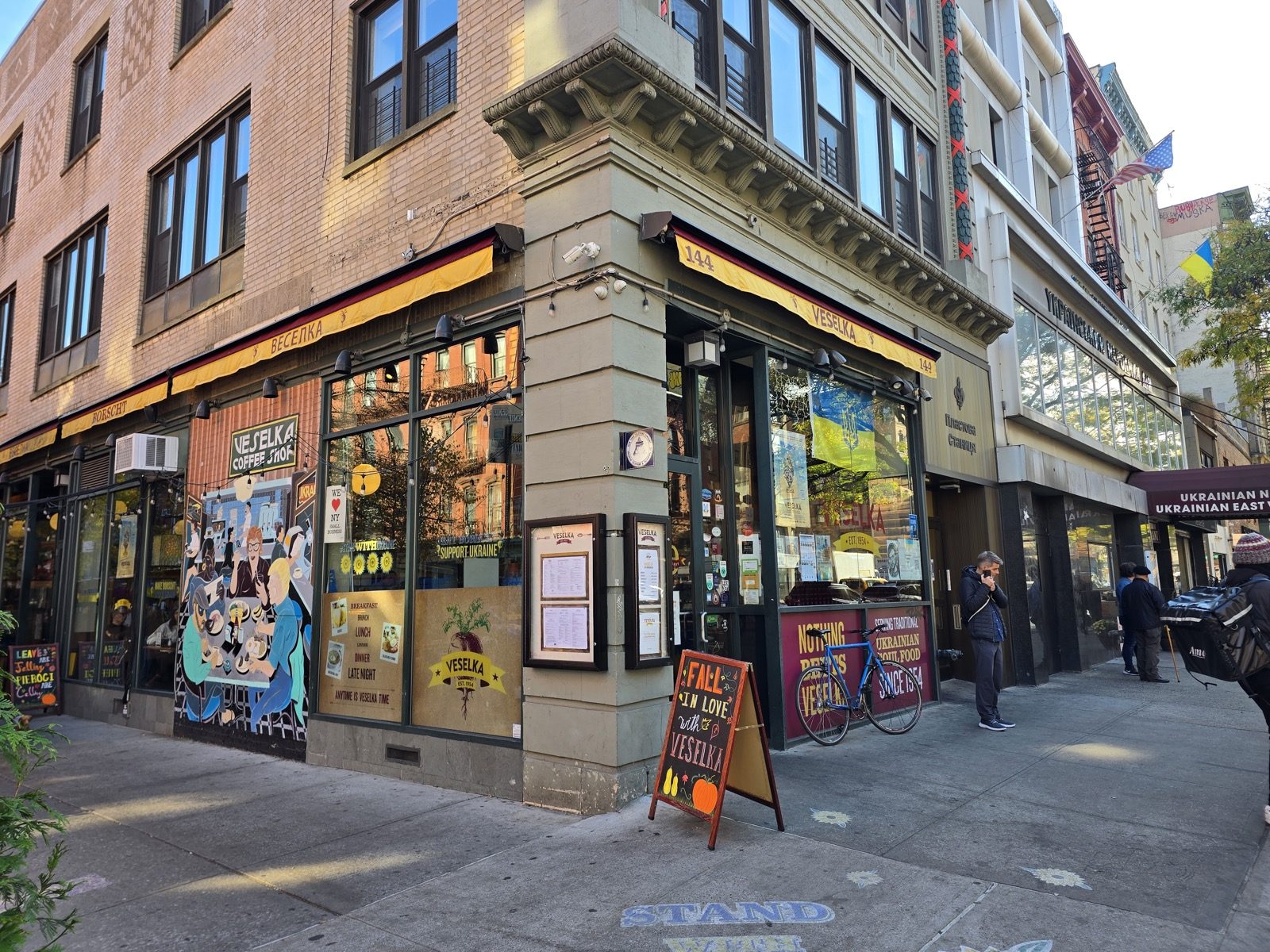
It is three in the morning on Second Avenue and the borscht is still hot. Behind the counter at Veselka, a cook ladles beet broth into a heavy bowl while a tourist photographs the Ukrainian flag taped to the window. Across the street, the gold-and-blue mosaic above the door of St. George Ukrainian Catholic Church catches the streetlight.
This is Little Ukraine, the seven blocks of the East Village that have been a Ukrainian neighbourhood since the 1870s. Somehow, against the rents and the wars and the years, it still is.
The East Village, The Place
Little Ukraine sits in the lower-middle of Manhattan, east of Cooper Square, north of Houston, south of 14th Street. The spine is Second Avenue, with East 7th Street as the main cross street. The neighbourhood is reached by the 6 train to Astor Place or the F to Second Avenue, and its housing is mostly five- and six-storey nineteenth-century tenements adapted by every wave that followed.
The Ukrainian core is the few blocks between Second and Third Avenues on East 6th and 7th Streets. It is small enough to walk in ten minutes and dense enough that you can pass a Ukrainian church, museum, scouting hall, restaurant, and volunteer kitchen on the same loop.
How the East Village Became Ukrainian
Before the Ukrainians
The first immigrant neighbourhood here was German. From the 1840s through the end of the nineteenth century, this whole stretch of Manhattan was Kleindeutschland, Little Germany, the largest German-speaking settlement outside of Berlin and Vienna. By 1855 it held more Germans than any city in the world after those two.
The Germans built beer halls and shooting clubs and Lutheran churches. They built the limestone YMCA at 140 Second Avenue that would later become the Ukrainian National Home. When the General Slocum steamboat caught fire on the East River in 1904 and killed more than a thousand Kleindeutschland women and children on a parish outing, the neighbourhood broke. Surviving German families moved uptown to Yorkville and their tenements emptied.
Into those tenements came everyone else. Eastern European Jews took Second Avenue. Hungarians settled along East Houston. Slovaks and Poles clustered near Tompkins Square. The neighbourhood became a layered map of late-nineteenth-century European arrivals, each group claiming a few blocks and a few churches.
The Ukrainians Arrive
The Ukrainians came in two big surges, more than half a century apart. The first wave began in the 1870s and ran hardest through the 1880s, 1890s, and 1910s. Almost all came from Galicia, the Austro-Hungarian province covering what is now western Ukraine: Lviv, Ternopil, Ivano-Frankivsk. They were peasant farmers and seasonal labourers, Greek Catholic by religion, leaving overcrowded land for American factories and docks.
By 1905 the community was large enough to need its own church. That year, a Ukrainian congregation bought the former Colgate Chapel on East 20th Street and re-dedicated it as St. George. In 1911 they outgrew it and bought the bigger Seventh Street Methodist Episcopal Church at 30 East 7th Street. The block has been Ukrainian ever since.
In 1918 a young Galician immigrant named Myron Surmach opened a small shop selling books, embroidery, and dry goods to his fellow Ukrainians. He called it Surma, after the Ukrainian battle horn. It would last almost a century. By the 1920s a Ukrainian National Home, a Ukrainian press, a Ukrainian credit union, and dozens of Ukrainian fraternal lodges had filled in around the church.
Little Ukraine at Its Peak
The second wave changed everything. After 1945, hundreds of thousands of Ukrainians sat in displaced-persons camps in occupied Germany and Austria, unwilling to return to a Stalinist Soviet Union that had absorbed their homeland. The United States Displaced Persons Act of 1948 cracked the door open. Around fifteen percent of those admitted under it were Ukrainians, most from the same western regions that had supplied the first wave.
The first DP boat reached New York harbour on 31 October 1948, with the arrivals on the front page of the Times the next morning. Many of those Ukrainian families went straight to East 7th Street, where the church and the existing community could place them.
Through the 1950s and 1960s, Little Ukraine reached its peak. Local estimates put the Ukrainian population of the East Village at around sixty thousand at the high-water mark. The neighbourhood acquired a Ukrainian credit union, two Ukrainian-language newspapers, a Saturday school where children learned to read Cyrillic, a butcher who could cure kovbasa, and bakeries that knew how to make paska bread for Easter.
In 1954 a former Plast scout named Wolodymyr Darmochwal and his wife Olha, both DPs, bought a candy shop and newsstand on Second Avenue and East 9th Street. They named it Veselka, the Ukrainian word for rainbow. In 1960 Darmochwal absorbed the lunch counter next door, and a Ukrainian diner was born.
In 1976 the Ukrainian National Women’s League of America founded the Ukrainian Museum, the first museum in the United States dedicated to Ukrainian art and folk craft. Two years later, in 1978, the city renamed the alley running past St. George as Taras Shevchenko Place, after the nineteenth-century Ukrainian poet. The same year, a new Byzantine-style church building rose on East 7th Street, designed by the Ukrainian-American architect Apollinaire Osadca.
The Change
What thinned the community was not politics but rent. In the 1980s and 1990s the East Village began to gentrify in earnest, swept up by the Manhattan property boom and the punk and art scenes that had bloomed in the same tenements. Ukrainian families began to leave. Some moved to Astoria and Greenpoint. Many more moved to the Ukrainian parishes in the New Jersey suburbs, especially Whippany in Morris County.
By the 2010s the East Village Ukrainian population had thinned to a few thousand. Surma closed in 2016 after ninety-eight years. Then the community came back into view. After Russia annexed Crimea in 2014, a new generation of Ukrainian arrivals reached New York. The full-scale invasion of February 2022 turned Little Ukraine into a rallying point.
The Landmarks of Ukrainian East Village
St. George Ukrainian Catholic Church (30 East 7th Street). The spiritual centre of Little Ukraine since 1911 and the reason the rest of the neighbourhood collected here. The current building, with its Byzantine domes and gold mosaics, was finished in 1978 to designs by Apollinaire Osadca. It is Eastern Catholic, answering to Rome but worshipping in the Byzantine rite. Every January 7 it fills for Orthodox-calendar Christmas.
Veselka (144 Second Avenue). Founded in 1954 by the Darmochwals as a candy shop, expanded into a diner in 1960, and run since 1967 by Tom Birchard, who married Darmochwal’s daughter at Rutgers and stayed in the family business when the marriage ended. Veselka turns out around three thousand handmade pierogi a day and gets through five hundred pounds of beets a week. After the February 2022 invasion its lunch trade doubled overnight. The 2024 documentary about it is titled Veselka: The Rainbow on the Corner at the Center of the World.
Ukrainian National Home (140-142 Second Avenue). The community’s main banquet hall, dance floor, and political meeting room since the 1940s. The 1830s building was a German YMCA before that, and in the 1960s its upstairs ballroom, briefly known as The Dom, hosted Andy Warhol’s Exploding Plastic Inevitable shows with the Velvet Underground. Today its ground floor holds the Ukrainian East Village Restaurant and Lys Mykyta bar.
The Ukrainian Museum (222 East 6th Street). Founded in 1976 by the Ukrainian National Women’s League of America, now housed in a building designed by Ukrainian-American architect George Sawicki and opened in 2005. Its collection of more than forty thousand objects of folk and fine art is the largest of its kind outside Ukraine. The pysanky workshops it runs every Lent draw hundreds of New Yorkers, not all of them Ukrainian.
Streecha Ukrainian Kitchen (33 East 7th Street). A basement varenyky kitchen across the street from St. George, staffed by volunteer parishioners. Every Friday morning a group of grandmothers folds sixteen hundred dumplings by hand to feed the weekend trade, with proceeds going back to the church. The kitchen closed briefly in 2024 for refurbishment and reopened the same year, a relief for everyone who had been quietly mourning it.
Taras Shevchenko Place. The one-block alley between East 6th and East 7th Streets, renamed in 1978 in honour of the Ukrainian national poet. The Ukrainian community pushed for the renaming through the 1970s, and in 2001 fought off a Cooper Union proposal to de-map the street altogether. A small bust of Shevchenko stands near the church.
Surma, the Ukrainian Shop (11 East 7th Street, 1918-2016). Opened by the Galician immigrant Myron Surmach to sell books, sheet music, vyshyvanky and pysanky supplies to the neighbourhood, run by three generations of the Surmach family. Surma was the place several generations of Ukrainian-American children went to buy their first embroidered shirt. It closed in 2016 after ninety-eight years, a ghost landmark now, but a meaningful one.
The Shevchenko Scientific Society (63 Fourth Avenue). A Ukrainian scholarly institution that re-founded its New York branch in 1947 with displaced-persons scholars who had fled Lviv. It holds one of the largest Ukrainian-language libraries and archives in North America. It is exactly the kind of institution Soviet rule had aimed at, in exile, kept alive on Fourth Avenue.
Where the East Village Ukrainians Came From
The first wave, the 1870s to 1914, was almost entirely Galician. They came from villages around Lviv, Ternopil, Ivano-Frankivsk and the Carpathian foothills, then a province of Austria-Hungary. Most were Greek Catholic, which is why the East Village got a Ukrainian Catholic parish and not an Orthodox one.
The post-war wave, the displaced persons of 1948 to the mid-1950s, came from a wider geography. The DPs in the German camps included people from Lviv and Ternopil still, but also Kyiv, Kharkiv, Poltava, and a strong contingent from Volhynia. Many were political dissidents who could not go home to Stalin’s Ukraine.
The third wave, after 1991, came from independent Ukraine: Kyiv, Odesa, Lviv, Kharkiv, often educated young people on student or work visas. The fourth came after February 2022, a war-driven displacement from Kyiv, Kharkiv, Mariupol, and the eastern oblasts under Russian fire. Each wave has slightly reshaped the East Village community, but the western-Ukrainian, Greek Catholic root is still its core.
The East Village Today
Little Ukraine is smaller than it was. Most of the families who built it have moved out to Astoria, Greenpoint, Whippany, or the New Jersey suburbs. The tenements they left are now studios renting for twenty-five hundred dollars a month. Restaurants come and go on Second Avenue with the speed of any Manhattan strip. If you walked the seven blocks blindfolded you would not necessarily know you were in a Ukrainian neighbourhood.
And yet. The Ukrainian flag hangs in the window of nearly every business on the block. St. George holds its Christmas service in Ukrainian on January 7 and packs the pews. The Ukrainian Museum is open six days a week. Veselka, which had been wondering about its future for a decade, is now arguably the single best-known Ukrainian restaurant in North America. Streecha is still rolling varenyky in its basement on Friday mornings.
The full-scale invasion in February 2022 brought a kind of urgency back to the neighbourhood that nobody would have asked for. St. George and the Ukrainian National Home became donation drop-off points. Volunteers organised medical-supply shipments out of church basements. New arrivals, refugees from Kyiv and Kharkiv, started turning up at the parish office looking for housing.
It is a complicated, layered moment. The community is more diasporic than concentrated now, more suburban than Manhattan. But the corner of Second Avenue and 7th Street remains the place every Ukrainian in the tri-state area knows how to find. Three generations after the displaced-persons boats, four generations after the Galician peasants, the East Village still answers the phone in Ukrainian.
Frequently Asked Questions
Why did Ukrainians settle in the East Village?
The first Ukrainian arrivals in the 1870s and 1880s were Galician peasants drawn to lower Manhattan by cheap tenement housing and factory work in what was then Kleindeutschland, the German immigrant district. After the German community thinned in the early 1900s, Ukrainians filled in the blocks around East 7th Street and built a parish, a Ukrainian National Home, and a network of fraternal lodges that anchored the neighbourhood. The post-1948 displaced-persons wave settled there because the institutions were already in place.
Are Ukrainians still in the East Village today?
Yes, although the residential population is much smaller than it was at its 1950s peak of around sixty thousand. Most Ukrainian families have dispersed to Astoria, Greenpoint, and the New Jersey suburbs, especially Whippany. But the core institutions remain on the original blocks: St. George Ukrainian Catholic Church, the Ukrainian Museum, Veselka, Streecha, and the Ukrainian National Home. The 2022 Russian invasion brought new refugees and renewed visibility to the neighbourhood.
What are the most famous Ukrainian landmarks in the East Village?
The headline landmark is Veselka, the 1954 Ukrainian diner at 144 Second Avenue, now a New York institution. St. George Ukrainian Catholic Church at 30 East 7th Street is the spiritual heart of the community, with its current Byzantine-style building dating from 1978. The Ukrainian Museum at 222 East 6th Street, the Ukrainian National Home at 140 Second Avenue, and Streecha Ukrainian Kitchen at 33 East 7th Street round out the main landmarks.
Where in Ukraine did the East Village Ukrainians come from?
The earliest and largest wave, from the 1870s through 1914, came from Galicia in what is now western Ukraine, especially the regions of Lviv, Ternopil, and Ivano-Frankivsk. The post-WWII displaced-persons wave came from across Ukraine, including Volhynia, Kyiv, and Kharkiv, but the western Ukrainian Greek Catholic tradition remained the community’s core. More recent waves from 1991 onward and after 2022 have brought arrivals from Kyiv, Odesa, Kharkiv, and the eastern oblasts.
When did Ukrainians first arrive in the East Village?
Ukrainian immigration to the East Village began in the 1870s with peasant migrants from Austro-Hungarian Galicia and intensified through the 1880s, 1890s, and 1910s. The first Ukrainian Catholic parish in New York City was organised here in 1905. The community then grew dramatically after 1948, when the Displaced Persons Act allowed tens of thousands of Ukrainian refugees from Soviet-occupied Europe to settle in the United States.
If your family’s story passed through Little Ukraine, or any of the Galician, Volhynian or central Ukrainian villages that fed it, Atlas of Home can trace that journey. From a Carpathian foothill to East 7th Street, to wherever you are now.