
On a Saturday in east Cobb County, the parking lot of a strip mall off Chastain Meadows fills with families carrying canvas bags toward the spice aisles, and a temple bus rolls south toward Riverdale, and somewhere on Terrell Mill Road a waiter is folding napkins before the dosa rush. This is the quiet shape of the Indian community in Marietta, Georgia: not a single enclave with a gate and a sign, but a web of homes, classrooms and kitchens stitched across one of metro Atlanta’s most desirable suburbs.
The Place
Marietta is the county seat of Cobb County, a city of roughly 60,000 people anchored by a historic square that has stood since the town was chartered in 1834. It was named for Mary Cobb, wife of U.S. Senator Thomas Willis Cobb, and for most of its life it was a railroad and courthouse town northwest of Atlanta.
What outsiders call “Marietta” is often larger than the city limits. The Marietta postal area spreads east across affluent zip codes like 30062, 30067 and 30068, the part of the county locals simply call east Cobb. There the median household income runs well above the county figure, and more than half of households earn six figures.
That prosperity, and the schools that come with it, is the reason so many Indian families chose this corner of Georgia.
How It Became Indian
The Indian story in Marietta is really the Atlanta story, told one cul-de-sac at a time. Metro Atlanta had only a handful of Indian families in the 1960s. By the time the region’s Indian population was being counted in the tens of thousands, the city had become one of the South’s quiet magnets for educated immigrants from the subcontinent.
The First Arrivals
The earliest Indians to reach Atlanta came as students and physicians in the late 1960s and 1970s, after the 1965 Immigration and Nationality Act opened the door to professionals. They were doctors filling residencies at Atlanta hospitals, engineers, and graduate students at Georgia Tech and Emory.
These were small numbers, measured in the hundreds, scattered across the inner suburbs. There was no Indian grocery to speak of, no temple. Families drove hours, or had spices mailed from relatives in New York, to cook the food of home.
Cobb County in those years was not yet a destination for them. Marietta was a town of antebellum homes and a Lockheed aircraft plant, growing as a bedroom suburb but not one that newcomers from India sought out. The Indian families who would later fill its school zones were, for the most part, not yet in Georgia at all.
The Temple Years
The community’s first true landmark arrived in the 1980s. The Hindu Temple of Atlanta was established in 1984 in Riverdale, south of the city, and opened its main shrine to Lord Venkateswara around 1990. For Indian families across the metro, including those settling in Cobb, it became the anchor of religious and cultural life, a South Indian temple where weddings, naming ceremonies and festivals could finally happen on Georgia soil.
Through these years the Indian population of Atlanta was still concentrated closer to the city and along the I-85 corridor in DeKalb and Gwinnett, near the Forsyth and Fulton suburbs where the Indian families of Suwanee were putting down roots. Cobb County, on the northwest side, was a newer frontier.
The Tech Boom and the Move to Cobb
The decisive wave came in the 1990s and 2000s. The revision of the H-1B visa in 1990 and the technology boom that followed brought a generation of young Indian software engineers to American cities, and Indians came to make up the large majority of H-1B holders. Atlanta, with its telecom, banking and logistics employers, took its share.
Many of these new arrivals were Telugu speakers from Andhra Pradesh and Telangana and Gujaratis, alongside Tamil, Malayali and North Indian families. They came in their twenties and thirties, often drawing salaries from the first day that made the old immigrant struggle a memory rather than a reality.
As they had children, the calculus shifted from apartment to house, and from house to school district. East Cobb’s public schools, some of the highest ranked in Georgia, drew them north and west across the metro, just as top schools pulled families to the Indian community of Alpharetta on the opposite side of the city.
Settling East Cobb
By the 2010s, Indian families were a familiar presence in the subdivisions of east Cobb and the corridors around Roswell Road and Johnson Ferry. Cobb County’s Indian population reached roughly 22,000 residents, about 2.9 percent of the county, a share well above both the Georgia and national averages.
Within the county the largest concentrations sit in Smyrna and Kennesaw, but a great many of those families carry a Marietta mailing address and send their children to Marietta-area schools. The pattern echoes the school-led migrations that built the Indian community of Cumming and the Indian families of Sugar Hill in neighbouring Forsyth and Gwinnett. The community here is suburban by design: dispersed, professional, and organised less around a single street than around temples, grocers and the academic calendar.
You can read the pattern in the small things. A Diwali sale at a Kennesaw grocery. A south Indian classical music recital in a community hall. A weekend cricket match on a Cobb County park field, fathers in whites, children chasing the ball into the outfield. None of it announces itself loudly, and that is rather the point.
The Landmarks
Hindu Temple of Atlanta, 5851 GA Highway 85, Riverdale. Though it sits south of the city, this is the spiritual home for many Cobb families. Established in 1984 and built in South Indian Pandya style, with two towering gopuram spires and shrines to Venkateswara and Shiva, it is among the oldest and most visited Hindu temples in the United States.
BAPS Shri Swaminarayan Mandir, 460 Rockbridge Road NW, Lilburn. Inaugurated in 2007 after just seventeen months of construction and over a million volunteer hours, this hand-carved stone mandir on Atlanta’s east side is a destination for Gujarati families across the metro, including those who drive in from Cobb for festivals and worship.
Patel Brothers, 2646 George Busbee Parkway NW, Kennesaw. The Kennesaw branch of the national Indian grocery chain serves the northwest metro, its aisles stocked with lentils, fresh produce, sweets and frozen staples. For east Cobb families it removed the last excuse to drive across town for an authentic kitchen.
Vatica Indian Cuisine, 1475 Terrell Mill Road, Marietta. A long-running favourite in the 30067 zip, Vatica is the kind of unflashy neighbourhood restaurant where a weekend lunch buffet draws a steady mix of Indian families and curious neighbours.
Suvidha Indo-Pak Groceries, 2821 Chastain Meadows Parkway NW, Marietta. Tucked into the Stonebridge Promenade shopping centre, this Indo-Pak grocer stocks halal meat, spices, vegetables and lentils, a one-stop shop for the staples of a Marietta Indian household.
Chaska, 3101 Roswell Road, Marietta. On Roswell Road in the heart of east Cobb, Chaska serves the street food and regional dishes that anchor casual Indian dining in the suburb.
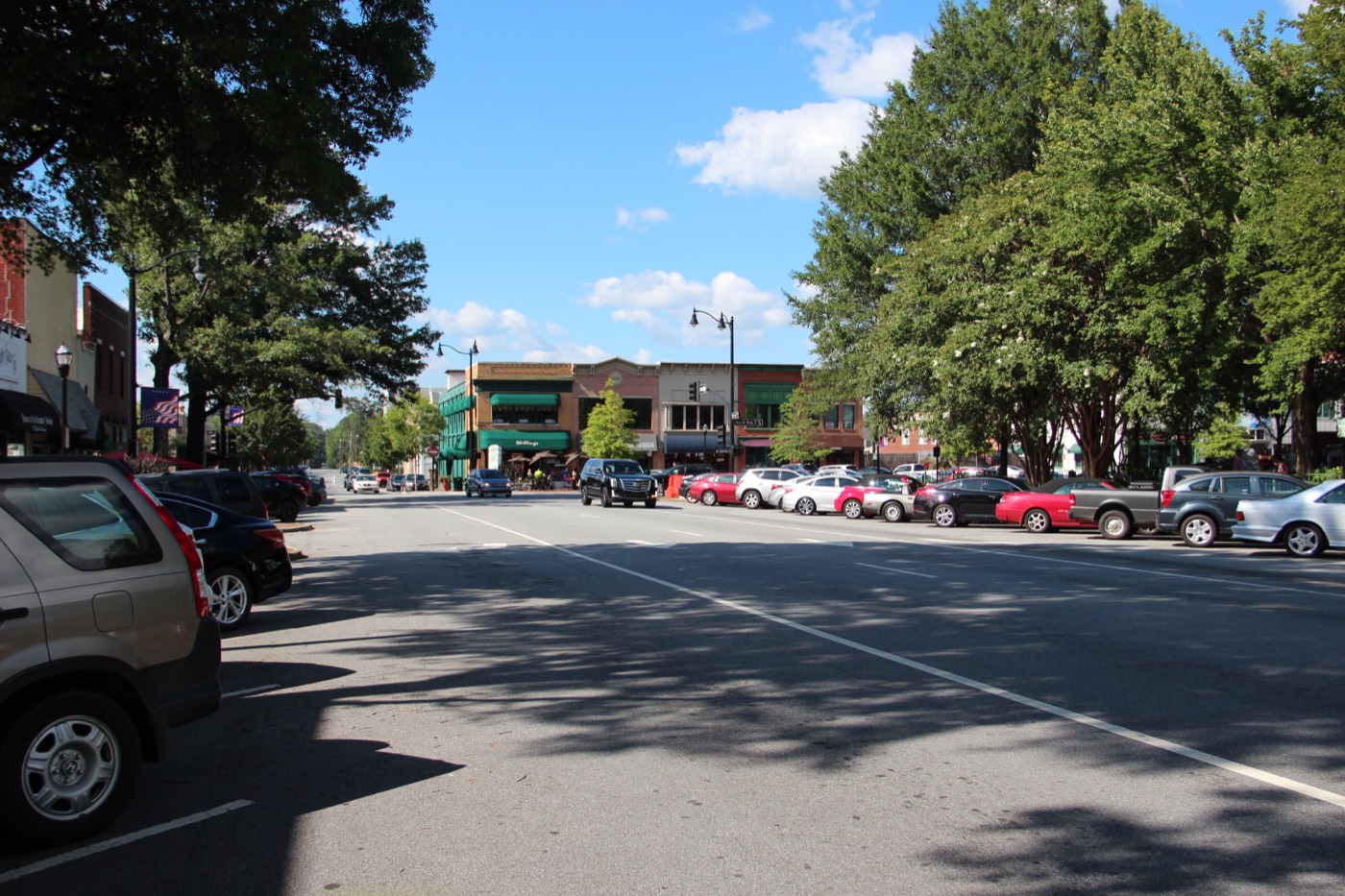
Marietta Square, downtown Marietta. The 19th-century courthouse square, with its boutiques, restaurants and summer events, is the civic heart shared by all of Marietta’s residents. It is where Indian families and their neighbours meet on the same sidewalks, a reminder that this community lives inside the wider town rather than apart from it.
Where They Came From
Marietta’s Indian families trace their roots across the subcontinent, but a few origins recur. Telugu speakers from Andhra Pradesh and the newer state of Telangana are a large presence, part of the engineering and IT migration that defined Atlanta’s tech years.
Gujaratis form another major thread, drawn by the same professional opportunities and tied to the Swaminarayan tradition that built the Lilburn mandir. Tamil, Malayali and North Indian families round out the mix, alongside the doctors and academics of the earlier waves.
What unites them is less a single home region than a single set of priorities: a stable profession, a house in a good district, and schools that would carry the next generation further still.
Marietta Today
The Indian community in Marietta today is best understood as the western, suburban wing of a large and established metro Atlanta diaspora. It is professional, comfortable and dispersed, its centre of gravity the highly rated public schools of east Cobb rather than any one commercial strip.
It is worth being honest about scale. Within the narrow city limits of Marietta the recorded Indian population is modest, a few hundred residents by recent census estimates. The larger story belongs to the Marietta postal area and to Cobb County as a whole, where the Indian community numbers in the tens of thousands and the cultural weight is felt in restaurants, grocers, classrooms and temple parking lots.
For families weighing east Cobb against the more concentrated Indian suburbs on the north and east side of the metro, the trade is clear. Marietta offers the schools, the green subdivisions and the historic square, with a community that is real but woven quietly through the fabric of the town. It is a different model of belonging, and for thousands of families it has been the right one.
Frequently Asked Questions
Is there a large Indian community in Marietta, Georgia?
Within Marietta’s official city limits the Indian population is fairly small, a few hundred residents. But the wider Marietta postal area and Cobb County hold a much larger Indian community, with the county recording roughly 22,000 Indian residents, so the Indian presence around Marietta is substantial even if it is dispersed.
Why do Indian families move to the Marietta area?
The main draw is east Cobb’s public schools, including Walton, Pope and Lassiter, which rank among the best in Georgia. Combined with safe, affluent subdivisions and proximity to Atlanta’s professional jobs, this makes the Marietta area attractive to Indian families prioritising education.
Where do Indians in Marietta worship?
Many attend the Hindu Temple of Atlanta in Riverdale, established in 1984, or the BAPS Shri Swaminarayan Mandir in Lilburn, opened in 2007. Both sit elsewhere in the metro, and Cobb families travel to them for festivals, weddings and weekly worship.
Where can you buy Indian groceries near Marietta?
Options include Patel Brothers in nearby Kennesaw and Suvidha Indo-Pak Groceries on Chastain Meadows Parkway in Marietta, among several smaller Indian and Indo-Pak grocers serving the northwest metro with spices, produce, sweets and frozen staples.
What regions of India are most represented around Marietta?
Telugu speakers from Andhra Pradesh and Telangana and Gujaratis are strongly represented, reflecting the IT and engineering migration of the 1990s and 2000s, alongside Tamil, Malayali and North Indian families. The Indian community in Marietta is diverse rather than tied to one home region.
How does Marietta compare to Alpharetta or Johns Creek for Indian families?
Alpharetta, Johns Creek and Suwanee on the north side have larger and more concentrated Indian populations with dedicated commercial corridors. Marietta and east Cobb offer top schools and a more dispersed community, appealing to families who want excellent education without an enclave feel.
If your family’s story passed through Marietta, or any of the places Indians have made home in America, Atlas of Home can trace that journey. From a village in Andhra Pradesh or Gujarat to a subdivision in east Cobb, to wherever you are now.