
Drive west of Miami International Airport, past the cargo warehouses and the logistics yards, and the strip malls begin to speak a particular Spanish. The accent is crisp, the coffee is served in tiny cups with an arepa on the side, and the bakery cases are stacked with pandebono still warm from the oven. This is the world the Colombians in Doral, Florida, have built over four decades: a city of glass office towers and palm-lined boulevards where a Bogotano accountant and a Medellin entrepreneur can feel, for a few square miles, very much at home.
The Place
Doral sits in northwest Miami-Dade County, hemmed in by the airport to the east, the Everglades buffer to the west, and a grid of expressways that carry freight to and from Latin America. It is one of the youngest cities in Florida, incorporated only in 2003, and one of the most prosperous, with a median household income well above the county average.
For most of the twentieth century this was swampland and golf course. Today it is roughly thirteen square miles of master-planned subdivisions, corporate parks, and a newly minted urban core called Downtown Doral. The city is overwhelmingly Latin American: more than eight in ten residents identify as Hispanic.
Within that majority, two communities loom largest. Venezuelans have arrived in such numbers since the 2000s that locals nicknamed the city “Doralzuela.” But the Colombians came first, and they came as professionals.
That distinction matters across South Florida, where each city has its anchor nationality: the Venezuelan community in Weston further north, the Cuban families of Pinecrest to the south, and the Jewish community of Aventura on the coast. Doral is, first and most enduringly, Colombian.
How It Became Colombian
A golf resort in the swamp
Doral began as a real estate gamble. In the late 1950s, the New York developer Alfred Kaskel and his wife Doris bought roughly 2,400 acres of marshland in western Dade County for a reported $49,000. They drained it, built a country club, and stitched their two names together: Doris and Alfred became Doral.
The Doral Country Club opened in 1962 and its Blue Monster course soon became a fixture on the professional golf tour. For decades the surrounding land stayed mostly empty, a resort marooned among warehouses near the airport. The residential city came much later.
The first Colombian wave
Colombians had been settling in Miami since the 1960s, but the numbers swelled in the 1980s and accelerated through the 1990s. The push was violence at home: the cartel wars, the bombings, the extortion and kidnappings that made Bogota, Medellin, and Cali dangerous for anyone with money or visibility.
Crucially, the Colombians who reached South Florida were not, by and large, the rural poor. Many came from the big cities, carried university degrees, and arrived as legal immigrants with capital and professional credentials. They were doctors, engineers, accountants, and business owners looking for somewhere stable to restart.
It is a different chapter of the same diaspora that shaped the older Colombian community in Jackson Heights, Queens, where the migration was more working-class and the streetscape more vertical. Doral’s Colombians chose the suburb, the car, and the office park.
Why Doral, specifically
Early Colombian arrivals clustered in older Miami neighbourhoods and in suburbs like Kendall. But as Doral’s residential subdivisions opened in the 1980s and 1990s, the new townhouses and gated communities offered exactly what an educated, upwardly mobile immigrant family wanted: new construction, good schools, low crime, and proximity to the airport that connected them to home.
Proximity mattered in another way. Doral was being marketed to entrepreneurs with business across Latin America, and its warehouses became a logistics hub for trade with the region. For Colombian importers, freight forwarders, and small manufacturers, a base in Doral put them minutes from the runways that carried their goods.
The result was a community that built outward from work as much as from home. Colombian-owned customs brokerages, shipping companies, and trade firms set up in the office parks; Colombian families bought the houses nearby; and Colombian bakeries and restaurants opened to feed them.
From subdivision to city
By the late 1990s Doral’s residents, many of them Latin American professionals, were frustrated. They paid high county taxes but felt they received little in return, and growth was racing ahead of services. They organised, lobbied, and pushed for self-government.
In January 2003, after a seven-year campaign, 85 percent of voters approved incorporation. That June, 92 percent ratified the city charter and elected the first mayor and council. Doral became a city run, in large part, by the immigrant families who had filled it, with Colombians prominent among the business owners and civic figures who shaped its early years.
The population numbers tell the story of that growth. Doral counted about 3,100 residents in 1990, roughly 20,000 by 2000, and nearly 76,000 by the 2020 census. The Colombians grew with it, and at the last full count made up around 11 percent of the city.
The Landmarks
Pan Pa Ya, 10425 NW 41st Street. A Colombian bakery and restaurant whose glass cases are a primer in the country’s breads: pandebono, almojabanas, buñuelos, and pan de queso. Families line up on weekend mornings for breakfast, and the alfajores and tres leches keep them coming back in the afternoon. It is the kind of place where the menu needs no translation for the regulars.
Las Caleñitas Restaurant & Bakery, 3887 NW 107th Avenue, Suite 105. The name nods to Cali, and the kitchen leans into the food of the Colombian interior: bandeja paisa heaped with beans, chicharron, and a fried egg; empanadas; and a bakery counter for the walk-in crowd. It is a neighbourhood anchor for the city’s western subdivisions.
Fajas MYD, 9577 NW 41st Street. Colombia is famous for its shapewear, the fajas worn after surgery and under clothes, and Doral has become a retail and distribution point for the industry. Storefronts like this one sell directly to local customers and ship across the country, a small reminder that the city is a node in Colombian commerce as much as Colombian cuisine.
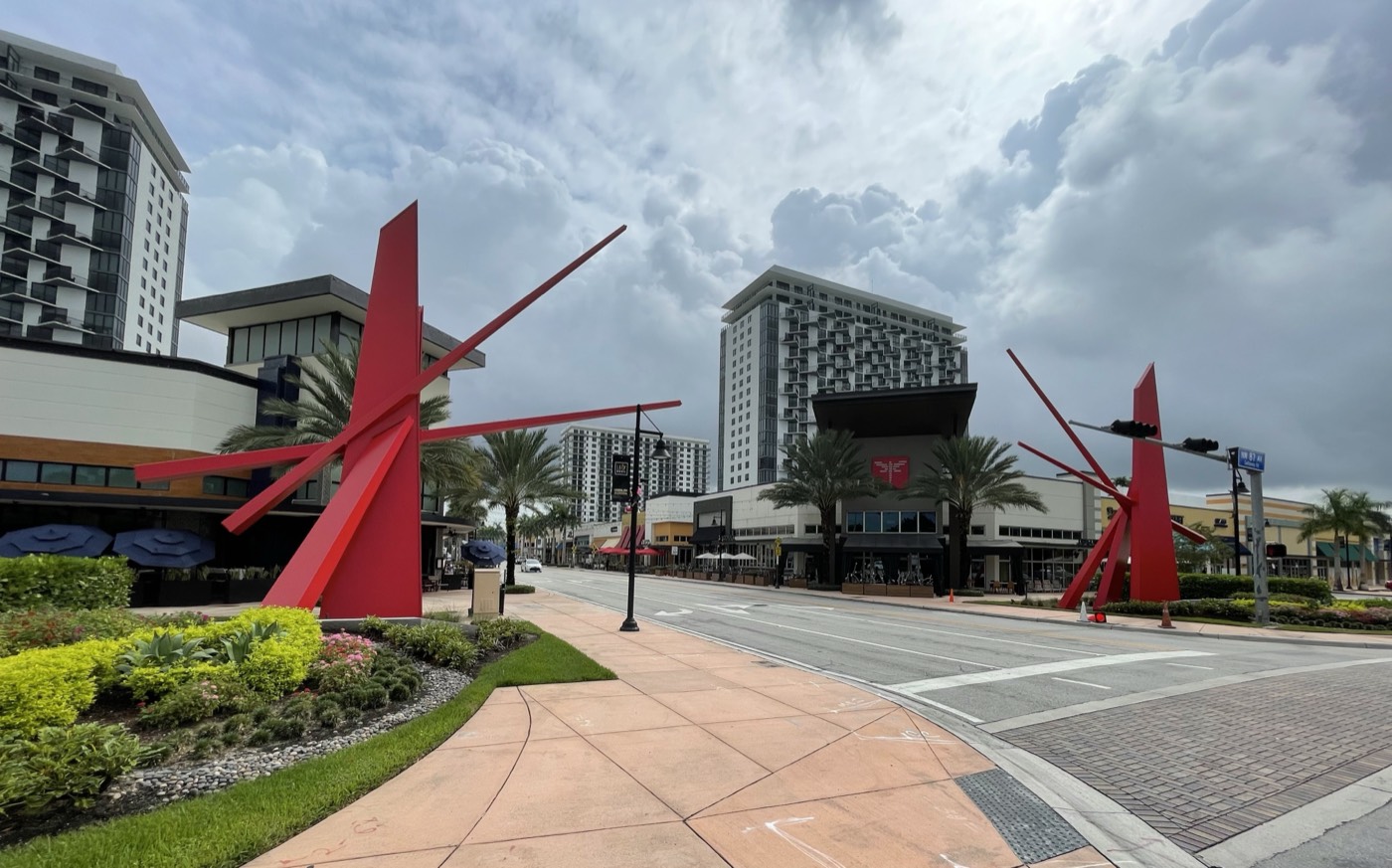
Downtown Doral, around NW 53rd Street and NW 84th Avenue. The city’s planned urban centre, a cluster of mid-rise residences, offices, and ground-floor cafes built over the past fifteen years. On evenings and weekends it fills with families from across Latin America, the Spanish of a dozen countries overlapping at the outdoor tables, Colombian among the loudest.
CityPlace Doral, 8300 NW 36th Street. An open-air shopping and dining complex with dancing fountains and plazas that host concerts and seasonal festivals. It functions as a public square for a city that grew up without one, and its restaurants and shops reflect the Latin American families who fill its sidewalks.
Doral Central Park, 3000 NW 87th Avenue. The city’s flagship green space, where the Fourth of July fireworks draw the whole city and where weekend football and picnics run in a steady Latin American rhythm. For Colombian families it is the kind of communal ground, open and free, that knits a dispersed community together.
Trump National Doral, 4400 NW 87th Avenue. The old Kaskel resort, bought out of bankruptcy by the Trump Organization in 2012 for about $150 million and renamed. Its Blue Monster course remains the city’s oldest landmark, the seed from which everything else, including the Colombian neighbourhoods, eventually grew.
Where They Came From
The Colombians of Doral are largely a big-city diaspora. They came from Bogota, from Medellin in the coffee-growing Antioquia highlands, and from Cali in the Valle del Cauca, with smaller numbers from Barranquilla and the Caribbean coast. Many were already urban professionals before they left.
What pushed them was the long arc of Colombian violence: the cartel wars of the 1980s, the bombings and kidnappings of the early 1990s, and the guerrilla and paramilitary conflict that bled into the 2000s. For families with means, leaving was a way to protect both their children and the careers they had built.
What pulled them to Doral was opportunity of a precise kind. The city offered new houses, safe streets, strong schools, and an airport that kept Colombia a three-hour flight away. For the importers and entrepreneurs among them, it also offered the warehouses and trade links that turned a Miami suburb into a base for doing business with home.
Doral Today
Doral today is among the most prosperous immigrant-built cities in Florida, a place of corporate headquarters, gated communities, and a downtown still under construction. Colombians remain woven through it: in the bakeries and restaurants, certainly, but more so in the office parks, the customs brokerages, the medical offices, and the city council chambers.
The community now shares the city with a far larger Venezuelan population, the wave that earned Doral its “Doralzuela” nickname. The two communities overlap easily, sharing language, food, and faith, but they are distinct, and the Colombians can fairly claim to have laid much of the groundwork the later arrivals built upon. The Colombian story here is older and quieter, a tale of professionals who came to work rather than refugees who came to flee.
It is also a story still being written. Younger Colombian Americans raised in Doral are bilingual, college-educated, and as likely to be found in a finance office downtown as behind a bakery counter. They keep the accent and the arepas, and they keep the airport close, but Doral is unmistakably home.
Frequently Asked Questions
How many Colombians live in Doral, Florida?
At the 2020 census, residents of Colombian ancestry made up roughly 11 percent of Doral’s population of about 76,000. That makes Colombians one of the two largest Latin American groups in the city, after Venezuelans, and the Colombians in Doral, Florida, are widely considered its oldest established Hispanic community.
Why did so many Colombians settle in Doral?
Colombians began arriving in South Florida in large numbers in the 1980s and 1990s, mostly urban professionals fleeing cartel and guerrilla violence. They were drawn to Doral by its new housing, low crime, good schools, and its proximity to Miami International Airport, which made it both a comfortable suburb and a logistics base for trade with Latin America.
Is Doral the same as “Doralzuela”?
“Doralzuela” is a nickname reflecting the large Venezuelan community that arrived in the 2000s. It refers to the same city of Doral but highlights the Venezuelan presence. The Colombian community is distinct and predates the Venezuelan wave, having helped establish many of the businesses and neighbourhoods that newer arrivals later joined.
Where can you find Colombian food in Doral?
Doral has a dense concentration of Colombian bakeries and restaurants, including Pan Pa Ya on NW 41st Street and Las Caleñitas on NW 107th Avenue. They serve staples like bandeja paisa, empanadas, and freshly baked pandebono and buñuelos, and they anchor the daily life of the Colombians in Doral, Florida.
When did Doral become a city?
Doral incorporated as a city in 2003, after a seven-year campaign by residents frustrated with county taxes and unchecked growth. Voters approved incorporation in January 2003 and ratified the city charter that June. Many of the business owners and civic leaders who shaped the new city were Latin American immigrants, Colombians prominent among them.
What do Colombians in Doral do for work?
Many Colombians in Doral are professionals and entrepreneurs: accountants, doctors, engineers, and owners of trade, import, and logistics firms that take advantage of the city’s location near the airport. Others run the bakeries, restaurants, and retail businesses that serve the wider Latin American community, including Colombia’s well-known shapewear industry.
If your family’s story passed through Doral, or any of the places Colombians have made home in America, Atlas of Home can trace that journey. From a flat in Bogota or a barrio in Medellin, to a townhouse near the Doral warehouses, to wherever you are now.