
Drive west out of Washington on Route 50 and the office parks start to thin into something quieter: tidy townhouse rows, a Saravanaa Bhavan filling up at lunch, a wooded eight-acre temple set back from a two-lane road. This is Chantilly, and the Indians in Chantilly, Virginia have spent twenty-five years turning a Civil War crossroads into one of the densest South Asian suburbs in the mid-Atlantic.
The Place
Chantilly sits in western Fairfax County, about 25 miles from Washington along Interstate 66 and Route 50, just south of Washington Dulles International Airport. It takes its name from the Chantilly Plantation, a mansion built around 1817 by Charles Calvert Stuart and his wife Cornelia, who borrowed the name from a French estate once linked to her family.
For most of its history this was farmland and a battlefield. The Battle of Chantilly, also called Ox Hill, was fought here on 1 September 1862, and two Union generals died in the rain. The mansion that gave the place its name is long gone, but the name stuck to the crossroads, then to the suburb that grew around it.
Then, after 1980, the development came fast. Today Chantilly is a census-designated place of roughly 24,000 people with a median household income near $138,000, and the farmland is mostly memory.
How It Became Indian
The story of Indian Chantilly is really the story of two things meeting: a tech and defence economy that needed engineers, and a generation of Indian professionals trained to fill exactly those jobs.
The corridor that pulled them in
Chantilly sits at the western edge of the Dulles Technology Corridor, the band of office parks, telecom firms, defence contractors and data centres that runs along the Dulles Toll Road out from the airport. The National Reconnaissance Office, which designs America’s spy satellites, has its headquarters here.
That mix of work, systems integration, cybersecurity, networking, government contracting, ran on cleared and credentialed engineers. Northern Virginia pulls in tens of billions of dollars in federal contracts each year, and a large share of the people writing the code and standing up the networks came from India.
The Dulles Technology Corridor did not just provide jobs. It set the texture of daily life: the commute, the office parks, the badge readers, the long hours that made a reliable nearby grocery and a temple within fifteen minutes feel less like luxuries and more like necessities.
When the late-1990s fibre boom turned nearby Loudoun County into the world’s busiest data-centre hub, Chantilly sat right on the seam between Fairfax and Loudoun, close enough to the action and still affordable enough to buy a townhouse and raise children.
The first wave
The earliest Indian arrivals were classic skilled migrants of the 1990s and early 2000s: engineers and IT consultants on H-1B visas, many from southern India and the western states, drawn by contracts at firms clustered around Dulles. They tended to rent first, near the office parks, and to find each other.
A community needs an anchor, and in March 2000 Chantilly got one. The Rajdhani Mandir opened on an eight-acre wooded site, a temple serving Hindu, Jain and Buddhist worshippers across the whole Washington region.
The growth years
The change in the numbers is hard to overstate. In 2000, non-Hispanic white residents made up about 69 percent of Chantilly. By 2020 that figure had fallen to 36 percent, while the Asian share climbed from roughly 16 percent to over 33 percent. A Fairfax Times report in 2016 noted that the local Indian community had grown some 750 percent since 2001.
Much of that growth was the second-stage migration that defines Indian suburbia in America: a family rents an apartment near the job, the children do well at school, the parents save, and within a few years they buy a house in a good attendance zone. Chantilly, with strong Fairfax County schools and a short commute to the contractors, was exactly the kind of place that math pointed to.
It also became a relay point. As Loudoun County’s Indian population exploded, families flowed between Chantilly and the newer communities just over the county line. The link to Indian South Riding, immediately west across the Loudoun border, and to Indian Brambleton further out, is the link of cousins and carpools.
The wider Dulles cluster
Chantilly does not sit alone. It belongs to a string of Indian suburbs running up the corridor, each with its own character but a shared rhythm of temple, grocery and weekend cricket.
To the north, Indian Herndon was one of the earliest landing spots in this part of Virginia, close to the airport and the first big tech campuses. Further out, Indian Ashburn grew up around Data Center Alley itself. Families move among all of them, and a child raised in Chantilly may well have grandparents visiting from Herndon and an uncle in Ashburn.
Just south sits Indian Aldie, part of the same outward push of new construction and new arrivals across the Loudoun line.
The Landmarks
Rajdhani Mandir, 4525 Pleasant Valley Road. Opened in March 2000 on an eight-acre wooded plot, this is the spiritual centre of gravity for the area’s Hindus, and one of the major temples in the whole Washington region. It houses deities including Venkateswara, Shiva, Ganesh and Hanuman alongside Jain and Buddhist figures, and runs daily aarti, Sunday classes for children and a calendar of festivals.
Indian Spice Food Market, 24650 Southpoint Drive. A grocery and kitchen rolled into one, the kind of place where a family does the weekend shop and walks out with a bag of hot snacks. The shelves carry the lentils, rice, spices and halal meat that make a Chantilly kitchen run.
Punjabi By Nature, Sully Place Shopping Center. Tucked into one of Chantilly’s everyday strip centres, it serves the north-Indian standards, choley, saag, and the rest, to a crowd that knows exactly what it wants. It is the kind of unglamorous, dependable restaurant that signals a community has truly settled in.
Saravanaa Bhavan, Chantilly Crossing. When this all-vegetarian South Indian institution opened a Chantilly branch in 2026, it confirmed what the demographics already showed: a customer base large enough to support dosa and idli at restaurant scale, not just at home.
Westfield High School. The big Fairfax County public high school serving Chantilly families, with an enrolment near 2,700 and a student body roughly a quarter Asian. It is the practical reason many Indian families chose this side of the county: a known school in a known district.
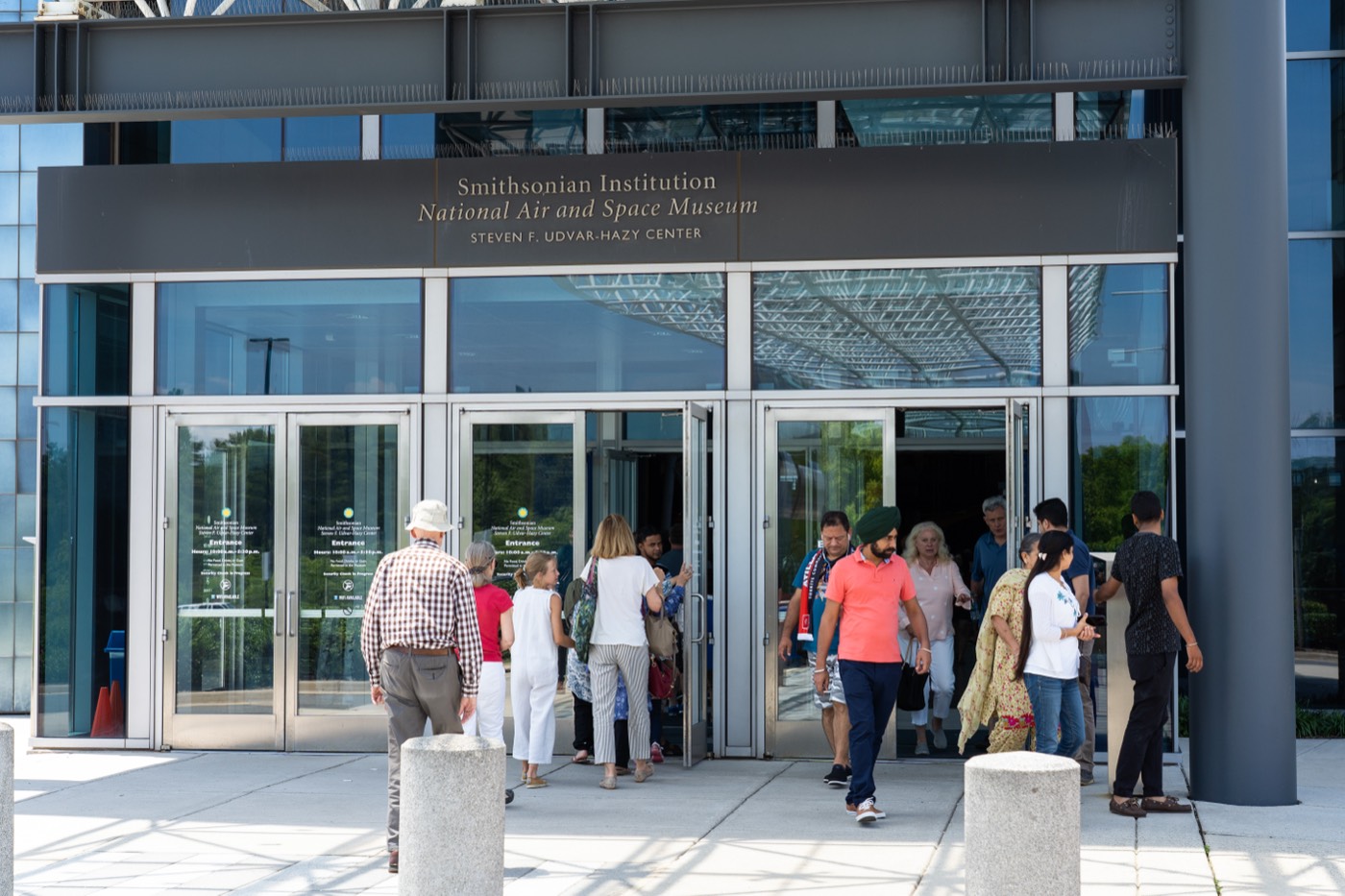
Steven F. Udvar-Hazy Center. The National Air and Space Museum’s vast annex, opened in 2003 beside Dulles, holds the space shuttle Discovery and an SR-71 Blackbird under its hangar roof. For Chantilly’s engineering families it is the local landmark that best matches the spirit of the work: aerospace, ambition, machines.
Lake Fairfax cricket field. Not in Chantilly proper but the regional home of the game, built in 1997 and one of the few grounds in Northern Virginia large enough for international standards. On summer weekends the Washington Cricket League’s teams, many drawn from Chantilly and its neighbours, fill grounds across the county.
Where They Came From
Chantilly’s Indians come overwhelmingly from the educated, English-speaking middle class of urban India, the same pool that fed the American tech industry from the 1990s onward. Telugu-speaking families from Andhra Pradesh and Telangana are strongly represented, alongside Tamils, Gujaratis, Punjabis and a broad mix from the metros.
The pull was specific. These were people whose degrees in computer science and engineering mapped directly onto the contracts being awarded around Dulles, and whose visas were sponsored by firms that needed exactly those skills.
Once a few families were established, the rest followed the way it always does: a colleague vouches for a town, a relative sponsors a sibling, a temple draws worshippers from forty miles around, and a grocery makes the whole arrangement feel like home.
The result is a community held together less by a single home region than by a shared trajectory. People who would have had little reason to meet in India, a Tamil software architect, a Telugu data engineer, a Gujarati systems analyst, became neighbours in Chantilly because the corridor wanted all of them at once.
Chantilly Today
Today Chantilly is a working suburb, not a showpiece. Its Indian life runs through grocery runs, temple festivals, cricket leagues, tuition centres and the long daily commute to the contractors and data centres of the corridor. Diwali brings lights to townhouse windows and crowds to Rajdhani Mandir.
It is also a place in motion. As Loudoun County built out, some families pushed west into newer subdivisions, and the boundary between Chantilly’s Indian community and those of South Riding, Brambleton and Aldie blurred into one continuous suburban belt. The data-centre boom that helped draw people here is now reshaping the land around them, with new projects breaking ground on former county parcels.
What endures is the everyday infrastructure of a settled community: a temple a generation old, restaurants confident enough to go all-vegetarian, schools full of second-generation children who will carry some version of this place with them. Chantilly was a battlefield, then farmland, then office parks. Now it is, among other things, home.
Frequently Asked Questions
How many Indians live in Chantilly, Virginia?
Chantilly has a population of roughly 24,000, and people of Asian descent make up over 33 percent of residents, with Indians forming a large share of that group. The Indians in Chantilly, Virginia have grown dramatically since 2001, when the local Indian community was a small fraction of its present size.
Why did so many Indians move to Chantilly?
Chantilly sits on the Dulles Technology Corridor, a hub of IT, telecom, cybersecurity and government-contracting work that drew skilled Indian engineers from the 1990s onward. Strong Fairfax County schools and relatively affordable townhouses then made it a place where families chose to settle and raise children.
Is there a Hindu temple in Chantilly?
Yes. The Rajdhani Mandir at 4525 Pleasant Valley Road opened in March 2000 on an eight-acre wooded site and is one of the major Hindu temples in the Washington region. It serves Hindu, Jain and Buddhist worshippers and runs daily worship, children’s classes and festivals.
Where do Indians in Chantilly shop and eat?
Indian groceries such as the Indian Spice Food Market on Southpoint Drive supply spices, produce and halal meat, while restaurants like Punjabi By Nature in Sully Place and the all-vegetarian Saravanaa Bhavan in Chantilly Crossing serve the community. Larger South Asian supermarkets sit just over the line in neighbouring Loudoun towns.
How is Chantilly connected to other Indian suburbs nearby?
Chantilly is part of a continuous belt of Indian communities along the Dulles corridor, linked to Herndon to the north and to South Riding, Brambleton and Aldie just across the Loudoun County line. Families routinely move among them and share temples, groceries and cricket grounds.
What is Chantilly known for besides its Indian community?
Chantilly is home to the National Reconnaissance Office and the Steven F. Udvar-Hazy Center, the National Air and Space Museum annex that houses the space shuttle Discovery. It was also the site of the 1862 Battle of Chantilly during the Civil War.
If your family’s story passed through Chantilly, or any of the places Indians have made home in America, Atlas of Home can trace that journey. From the cities of Andhra Pradesh, Tamil Nadu and Gujarat to a townhouse in the Dulles corridor, to wherever you are now.