
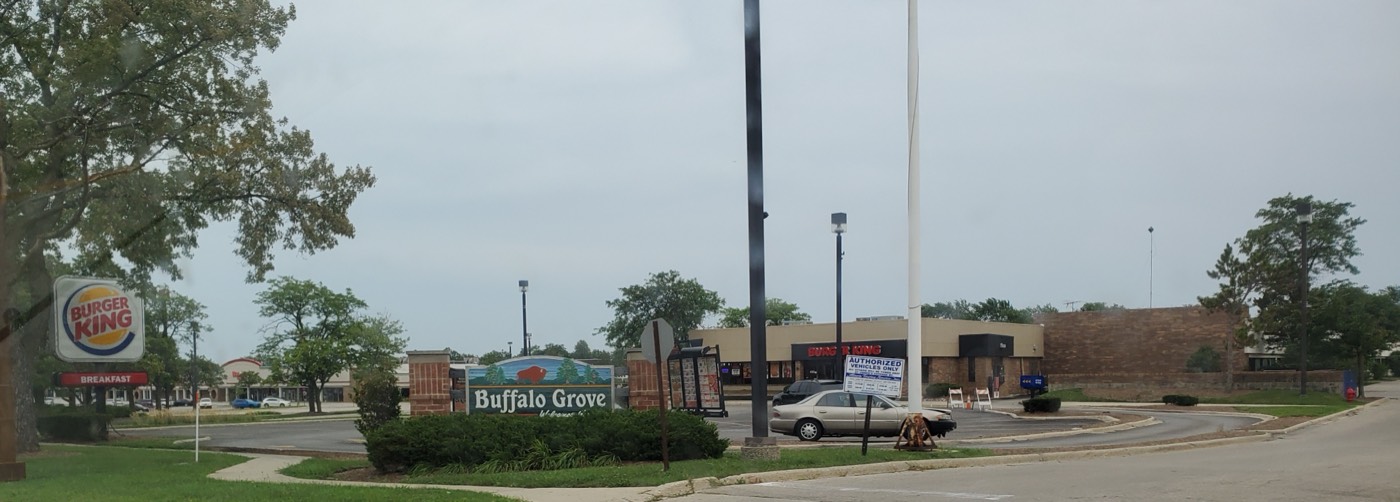
On a Saturday morning in Buffalo Grove, the parking lot off Lake Cook Road fills with families collecting cartons of biryani, and by evening the same families may be driving south toward Lemont, where a temple sits on a hillock above the Des Plaines valley. The Indians in Buffalo Grove are not a recent novelty in this prosperous corner of suburban Chicago. They are one of the reasons the village now sounds, on any given block, like a small slice of Hyderabad, Ahmedabad and Chennai folded into the American Midwest.
The Place
Buffalo Grove is a village straddling Lake and Cook Counties, roughly 30 miles northwest of downtown Chicago and about 20 miles north of O’Hare. It was farmland for most of its history, settled by New Englanders and then, in the 1840s, by German families such as the Raupps, and it stayed agricultural long after the city to the south had filled in.
Incorporation came only in 1958, and the real transformation arrived with the postwar housing booms of the 1980s and 1990s. Today around 43,000 people live here, the median household income sits near $129,000, and more than two-thirds of adults hold a bachelor’s degree. It is, by almost any measure, an affluent and heavily educated place.
How It Became Indian
The Indian presence in Buffalo Grove is best understood as a slow migration outward from the older South Asian core of Chicago, pulled north and west by jobs, schools and space.
From Devon Avenue to the suburbs
For decades the centre of Indian life in the Chicago region was Devon Avenue on the city’s far North Side, where the grocers, sari shops and sweet houses first clustered. As families established themselves through the 1980s, many began doing what earlier immigrant generations had done before them: trading the dense city street for a quiet suburban subdivision with a lawn and a good school district.
Buffalo Grove, sitting along the corridor that runs through Wheeling, Schaumburg and Hoffman Estates, was a natural landing point. It was close enough to the corporate campuses of the northwest suburbs, and it offered exactly the thing chain migration tends to chase: schools with reputations that travel back to relatives still in India.
The H-1B generation
The sharpest acceleration came in the late 1990s and the 2000s, with the wave of skilled-worker migration that reshaped Indian America. Engineers, IT consultants, physicians and pharmacists arrived on H-1B visas to staff the Chicago area’s hospitals, software firms and corporate back offices, and a striking share of them settled in the northwest suburban belt.
Buffalo Grove drew the professional end of that wave. It was close to employers without being in the thick of them, the housing stock was solid, and the commute to the Loop or to the suburban office parks was tolerable. Word travelled, as it always does, through family and through community networks, and one household became a dozen.
A community that compounds
Once a critical mass formed, the growth became self-reinforcing. Grocers opened to serve the new arrivals, restaurants followed the grocers, and temples and cultural associations gave the community a calendar of its own. By the 2020s, the village’s Asian population had climbed to roughly 28 percent, with Indians making up the largest single component of it.
This is the pattern repeated across the Chicago suburbs, from the Indian community in Schaumburg to the families who settled in Hoffman Estates and the larger concentration around Indians in Naperville to the southwest. Buffalo Grove is one node in a wider lattice of suburban Indian settlement, distinct but never isolated.
It is worth noting that Indians were not the first community to make this village their own. Buffalo Grove has long been home to a substantial Jewish population, and the story of the Jews in Buffalo Grove runs parallel to this one. The two communities now share the same schools, the same parks and, increasingly, the same sense that this unassuming village is a place worth committing to.
The Landmarks
The Indian map of Buffalo Grove is partly local and partly regional, a set of anchors in the village stitched to the larger institutions of Chicago-area Hindu and South Asian life.
Nawabi Hyderabad House, 800 W Lake Cook Road. This biryani specialist has become a fixture for the village’s South Indian and Hyderabadi families, and for the wider region’s appetite for dum biryani done properly. On weekends the takeaway counter runs steadily, a reliable sign that a community has put down roots when its everyday food is this easy to find.
The Hindu Temple of Greater Chicago, 10915 Lemont Road, Lemont. Opened to the public on 4 July 1986 and set on a hillock about 28 miles from downtown, this complex houses the Rama Temple alongside the Ganesha-Shiva-Durga shrine. For Buffalo Grove families it is the great regional gathering point, the place for Ram Navami, Janmashtami and the big festival weekends.
The Buffalo Grove Park District Diwali celebration, Community Arts Center. Each autumn the village’s own park district stages a free Diwali evening of live entertainment, children’s crafts and a rangoli competition. That a suburban Midwestern park district now runs a festival of lights is, in its quiet way, the clearest measure of how thoroughly Indian life has been woven into the civic fabric here.
Annapoorna Foods, 20502 Milwaukee Avenue, Deerfield. Just over the village line, this South Indian grocer keeps Buffalo Grove kitchens stocked with the dals, idli batter and curry leaves that the big chain supermarkets never carry well. Open late, seven days a week, it is the kind of everyday errand store that makes a community feel permanent.
Patel Brothers, the regional anchor grocer. Founded in Chicago in 1974 by Mafat and Tulsi Patel and now the largest Indian grocery chain in the country, Patel Brothers is the wholesale heart of Indian cooking across the Chicago suburbs. Buffalo Grove families reach its corridor locations for the bulk rice, spices and frozen specialities that anchor a week of home cooking.
Adlai E. Stevenson High School, Lincolnshire. Part of Buffalo Grove sits in this nationally ranked district, which sits in the top tier of Illinois public schools and pulls from sixteen communities. For many Indian families, the chance to send a child here was the deciding factor in choosing the village at all.
Buffalo Grove High School, District 214. The village’s own comprehensive high school, ranked among the better public schools in Illinois, is the other half of the education story. Between the two districts, Buffalo Grove offers exactly the academic reputation that has long drawn Indian professional families to the northwest suburbs.
Where They Came From
The Indian families of Buffalo Grove are not from one place, and that is part of the texture here. Gujarati families, many with roots in the entrepreneurial networks that also built the Patel Brothers grocery empire, sit alongside Telugu-speaking households from Hyderabad and Andhra, Tamil families from the south, and Punjabi and North Indian arrivals.
What unites them is less a single region than a single moment: the professional migration of the 1990s and 2000s, when Indian engineers, doctors and IT specialists moved in numbers into the American suburbs. The northwest Chicago belt, with its hospitals, corporate campuses and software consultancies, gave that generation somewhere to land.
Many came by way of Devon Avenue or a first apartment in the city, then moved out as careers stabilised and children reached school age. The result is a community defined more by occupation and ambition than by any one ancestral district, though the languages of home still sort themselves out at the temple and the grocery counter.
Buffalo Grove Today
Walk the village now and the Indian presence is unmistakable but unshowy. There is no single Indian high street here the way there is on Devon Avenue. Instead the community has diffused into the ordinary suburban grain: a biryani house in a strip mall, a grocer over the line in Deerfield, a Diwali night on the park district calendar, and a steady flow of cars toward Lemont on festival weekends.
The schools tell the same story in numbers. Districts that once served the children of German farmers and postwar commuters now educate the children of engineers and physicians from Hyderabad and Ahmedabad, and the minority enrolment at Stevenson alone runs past half. Cricket has crept into the parks, classical dance recitals fill community halls, and the smell of festival cooking carries across cul-de-sacs every October.
It is not a flashy transformation, and that is rather the point. Buffalo Grove was always a place people chose for the long game: good schools, safe streets, a sensible distance from the city. The Indian families who chose it for exactly those reasons have, over a single generation, become inseparable from what the village is. Learn more about the village’s wider history through the Buffalo Grove entry on Wikipedia, and about the regional temple at the Hindu Temple of Greater Chicago.
Frequently Asked Questions
How many Indians live in Buffalo Grove, Illinois?
Buffalo Grove has roughly 43,000 residents, of whom about 28 percent are Asian, and Indians make up the largest single share of that group. The Indians in Buffalo Grove are concentrated among professional families drawn by the schools and the village’s position in the northwest Chicago corridor.
Why did so many Indian families move to Buffalo Grove?
The main draws were highly ranked schools, affordable-for-the-quality housing, and proximity to the hospitals, corporate campuses and IT firms of the northwest suburbs. The skilled-worker migration of the 1990s and 2000s brought engineers, doctors and IT professionals who settled here in growing numbers.
Where do Indians in Buffalo Grove worship?
The great regional anchor is the Hindu Temple of Greater Chicago in Lemont, which houses the Rama Temple and opened in 1986. Buffalo Grove families travel there for major festivals such as Ram Navami, Janmashtami and Diwali, alongside other temples across the Chicago suburbs.
Where can you find Indian food and groceries in Buffalo Grove?
Nawabi Hyderabad House on Lake Cook Road is a well-known biryani spot in the village, while Annapoorna Foods just over the line in Deerfield serves South Indian grocery needs. Patel Brothers, the Chicago-founded national chain, anchors bulk Indian grocery shopping across the corridor.
Are Buffalo Grove’s schools good for Indian families?
Yes. Part of the village feeds into Adlai E. Stevenson High School, one of the top-ranked public high schools in Illinois, while Buffalo Grove High School in District 214 also ranks well. Strong schools are repeatedly cited as the central reason Indian professional families choose the village.
How does Buffalo Grove fit into the wider Chicago Indian community?
Buffalo Grove is one node in a band of Indian suburban settlement that includes Schaumburg, Hoffman Estates and, further south, Naperville. Families move freely among these towns for groceries, temples and social events, with Buffalo Grove forming the northern edge of that lattice.
If your family’s story passed through Buffalo Grove, or any of the places Indians have made home in America, Atlas of Home can trace that journey. From a first apartment off Devon Avenue or a village in Gujarat, to a Diwali night on the Buffalo Grove park district calendar, to wherever you are now.