
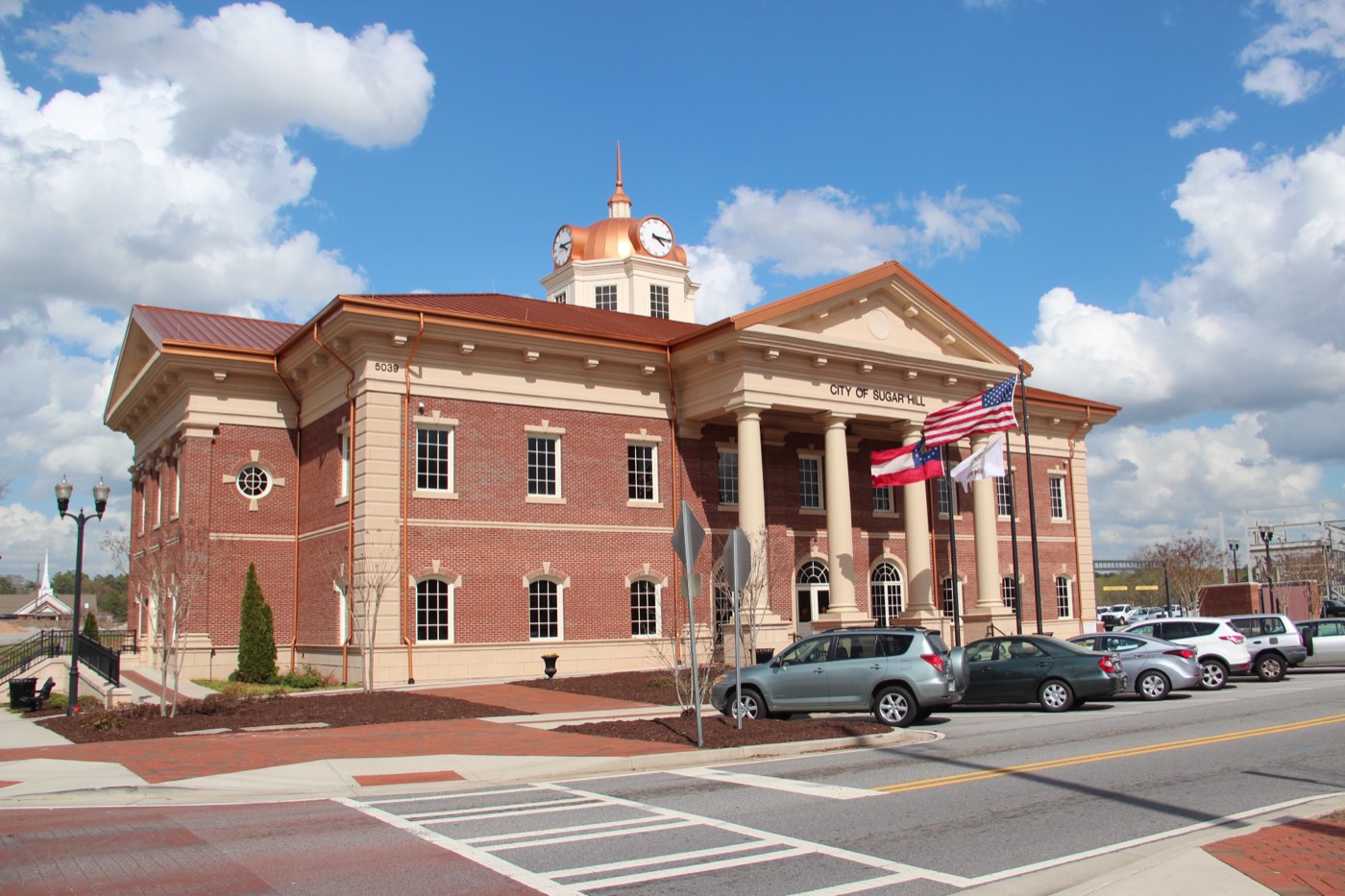
Drive north on Interstate 985 out of the Atlanta sprawl and the billboards begin to change. Somewhere past Suwanee, English shares the roadside with Gujarati and Telugu, advertisements for diamond jewellers and South Indian sweet shops. This is the corridor that carries you into Sugar Hill, a once sleepy north Gwinnett town now home to a fast growing community of Indians in Sugar Hill, Georgia, drawn by good schools, big houses, and the gravitational pull of one of the South’s largest Hindu temples just down the road.
The Place
Sugar Hill sits in northern Gwinnett County, tucked between Buford to the northeast and Suwanee to the southwest, about 36 miles from downtown Atlanta. Local tradition says the name came from a wagon that spilled a shipment of sugar on a hill, and the town was officially incorporated on 24 March 1939.
For most of the twentieth century it was a quiet place of churches, gold mining lore, and the slow shadow of Lake Lanier, which was created nearby in the 1950s. Today it is Gwinnett’s fourth largest city, its population climbing from 25,076 at the 2020 census to roughly 28,600 by 2024.
The city has reinvented itself around a walkable downtown anchored by The Bowl at Sugar Hill and a 150,000 square foot civic and recreation hub locals call the E Center. It is in this newer, prosperous Sugar Hill that Indian families have steadily put down roots.
How It Became Indian
Sugar Hill did not become a destination for Indian families on its own. It became one as part of a much larger story, the transformation of north Gwinnett County into one of the most significant centres of Indian American life in the South.
The Gwinnett wave
For decades, metro Atlanta’s Indian community clustered closer in, around Decatur and the older international corridors inside the Perimeter. That changed through the 1990s and 2000s, as Gwinnett County’s combination of new subdivisions, low costs, and strong public schools pulled Asian families steadily north and east.
By the 2020s, Gwinnett County was roughly 13 per cent Asian, and the Indian share within that figure had become one of the largest single national-origin groups. The county’s signature suburbs, Johns Creek, Suwanee, Duluth, became shorthand among Indian families across the South for good schools and big homes.
Sugar Hill sat just past the edge of that core, on the Lanier side of the corridor. As prices in Suwanee’s tightly held neighbourhoods climbed, the next generation of buyers looked a few exits further north and found Sugar Hill.
The H-1B generation
The families arriving were rarely the first in their lineage to leave India. Many had landed first in the technology corridors of New Jersey, Texas, or the older parts of Atlanta, moving to Gwinnett for a second act once green cards and promotions allowed it.
They came as software engineers at companies along the Georgia 400 and I-85 technology belt, as physicians and pharmacists, as managers and accountants. They came, above all, with school-age children, and they chose their addresses the way Indian parents have chosen them everywhere in America, by the boundary lines of the local schools.
The schools rewarded the calculation. The Lanier cluster, which gathers Lanier High, Lanier Middle, and a handful of elementary schools including Sugar Hill Elementary, has earned state and national recognition, and parts of Sugar Hill also feed into North Gwinnett High School, ranked among the very best public high schools in Georgia. For families weighing one north Atlanta suburb against another, those rankings settled the argument.
The temple anchor
If schools pulled families to Sugar Hill, faith helped them stay. In August 2007, after only 17 months of construction and 1.3 million volunteer hours, the BAPS Shri Swaminarayan Mandir opened in nearby Lilburn, the largest traditionally built Hindu mandir in the United States.
Assembled from more than 34,000 hand carved pieces of Turkish limestone, Italian marble, and Indian pink sandstone, it gave the whole of north metro Atlanta a spiritual centre of gravity. For families in Sugar Hill, a Sunday drive to Lilburn became a weekly ritual, and the Lilburn mandir became proof that the community had truly arrived.
A corridor takes shape
As the population grew, so did the infrastructure of daily Indian life along the Buford and Suwanee corridor. Patel Brothers, the national South Asian grocery chain, opened a 35,000 square foot store off Peachtree Parkway, putting curry leaves, fresh paneer, and 25-pound bags of basmati within an easy drive of Sugar Hill kitchens.
South of the temple, the AMS Global Mall in Norcross, billed as the first indoor South Asian mall in North America, offered more than 60 shops and restaurants, from sari boutiques and gold jewellers to a paan stall and a food court that runs from Punjabi to South Indian. Sugar Hill families did not need to live inside an enclave. The enclave came to meet them along the highway.
The Landmarks
BAPS Shri Swaminarayan Mandir, 460 Rockbridge Road NW, Lilburn. The largest hand carved Hindu mandir in the country and the spiritual anchor for Indian families across north Gwinnett, including Sugar Hill. Free and open daily, it draws worshippers, school field trips, and curious neighbours alike, and its festival celebrations swell with families from up and down the corridor.
AMS Global Mall, 5675 Jimmy Carter Boulevard, Norcross. The first indoor South Asian mall in North America, with more than 60 stores and a food court. For Sugar Hill families it is the place for wedding shopping, festival outfits, gold, and a plate of dosa, all under one roof.
Patel Brothers, 3230 Caliber Street, Suwanee. A 35,000 square foot grocery just off Peachtree Parkway that has become the pantry for the corridor’s Indian households. On weekends the parking lot fills with families stocking up on lentils, spices, and the produce that supermarket chains never carry.
The E Center, downtown Sugar Hill. The city’s 150,000 square foot recreation and civic hub. Its gym, pool, and gathering spaces have become a shared backdrop of suburban life, where Indian kids swim and play alongside every other community in the city.
The Bowl at Sugar Hill, downtown. The amphitheatre and green at the heart of the reinvented downtown, host to concerts and city festivals. It is the kind of civic commons where second-generation Indian American teenagers grow up as much Georgians as anything else.
Lanier High School, Sugar Hill. Opened in 2010 and bringing a high school back within Sugar Hill’s boundaries, it serves the Lanier cluster that draws many Indian families to the area. Its classrooms reflect the corridor’s diversity, and its academic results are part of why parents choose these zip codes.
Suwanee Town Center Park, Suwanee. A short drive south, the park hosts the Suwanee Asian Festival and Diwali celebrations that bring together Indian, Chinese, Korean, and Southeast Asian families. For many Sugar Hill residents it is the closest thing to a shared public square for festival season.
Where They Came From
The Indian families of Sugar Hill do not trace to a single village or region. They reflect the broad sweep of post-1965 Indian migration to America, skilled professionals from across the subcontinent.
There are Gujarati families, many of them connected to the BAPS Swaminarayan tradition that built the Lilburn mandir, alongside large numbers of Telugu and Tamil families from south India who arrived through the technology industry. Punjabi, Malayali, and north Indian Hindi-speaking households round out the mix.
What they share is the path more than the origin: an engineering or medical degree, an early American posting in a technology or healthcare hub, and a deliberate move to Gwinnett once the children reached school age. Sugar Hill, with its newer homes and the Lanier cluster schools, offered a relatively affordable foothold in a county that Indian families already trusted.
Sugar Hill Today
Sugar Hill in the mid 2020s is a town still becoming itself. It is not an Indian enclave in the way that older neighbourhoods elsewhere are, and no one would mistake its downtown for a Little India. The Indian presence is woven into a genuinely mixed city that is roughly half white, with substantial Black, Hispanic, and Asian populations sharing the same subdivisions and schools.
What you see instead is the texture of an arriving community. Diwali lights on cul-de-sac houses in November. Cricket whites on a Saturday field. Carpool lines outside Lanier cluster schools full of children with names from across the subcontinent. Weekend traffic flowing south toward the temple, the grocery, and the mall.
For the families who chose it, Sugar Hill represents a particular kind of American success, the quiet, suburban, school-zoned kind. It is close enough to the institutions of the larger Indian community in Johns Creek and Suwanee to feel connected, and far enough north to feel like the next frontier. As prices keep rising across north Gwinnett and into Cumming and Alpharetta, Sugar Hill’s appeal as the affordable end of a prized corridor only grows.
Frequently Asked Questions
Is there a large Indian community in Sugar Hill, Georgia?
Sugar Hill has a growing Indian community as part of the broader Indian American presence across north Gwinnett County, which is roughly 13 per cent Asian. The town is not an established enclave like Johns Creek or Suwanee, but Indian families have settled here steadily, drawn by schools and relative affordability.
Why are Indian families moving to Sugar Hill?
The main draws are the Lanier cluster public schools, newer and more affordable homes than neighbouring Suwanee, and proximity to Indian institutions along the corridor. The BAPS temple in Lilburn, Patel Brothers in Suwanee, and Global Mall in Norcross are all an easy drive away.
Where do Indians in Sugar Hill worship?
Many attend the BAPS Shri Swaminarayan Mandir in Lilburn, the largest traditionally built Hindu temple in the United States, opened in 2007. Other temples and gurdwaras across metro Atlanta also serve the corridor’s Indian families.
Where can I find Indian groceries and food near Sugar Hill?
The Patel Brothers store on Caliber Street in Suwanee is the main grocery anchor, and the AMS Global Mall in Norcross offers South Asian shops and a food court. The Buford and Suwanee corridor also has numerous Indian restaurants and grocers.
What schools serve Indian families in Sugar Hill?
Sugar Hill is served by the Lanier cluster of Gwinnett County Public Schools, including Lanier High School, Lanier Middle School, and Sugar Hill Elementary. Parts of the city also fall in the North Gwinnett cluster, one of the highest ranked in the state.
How does Sugar Hill compare to Johns Creek or Suwanee for Indian families?
Johns Creek and Suwanee have larger, more established Indian populations and higher home prices. Sugar Hill offers a more affordable foothold in the same prized north Gwinnett corridor, which is why it appeals to families looking for value within reach of those communities.
If your family’s story passed through Sugar Hill, or any of the places Indians have made home in America, Atlas of Home can trace that journey. From a village in Gujarat or a city in Andhra Pradesh, to a house on the Lanier side of Gwinnett County, to wherever you are now.