
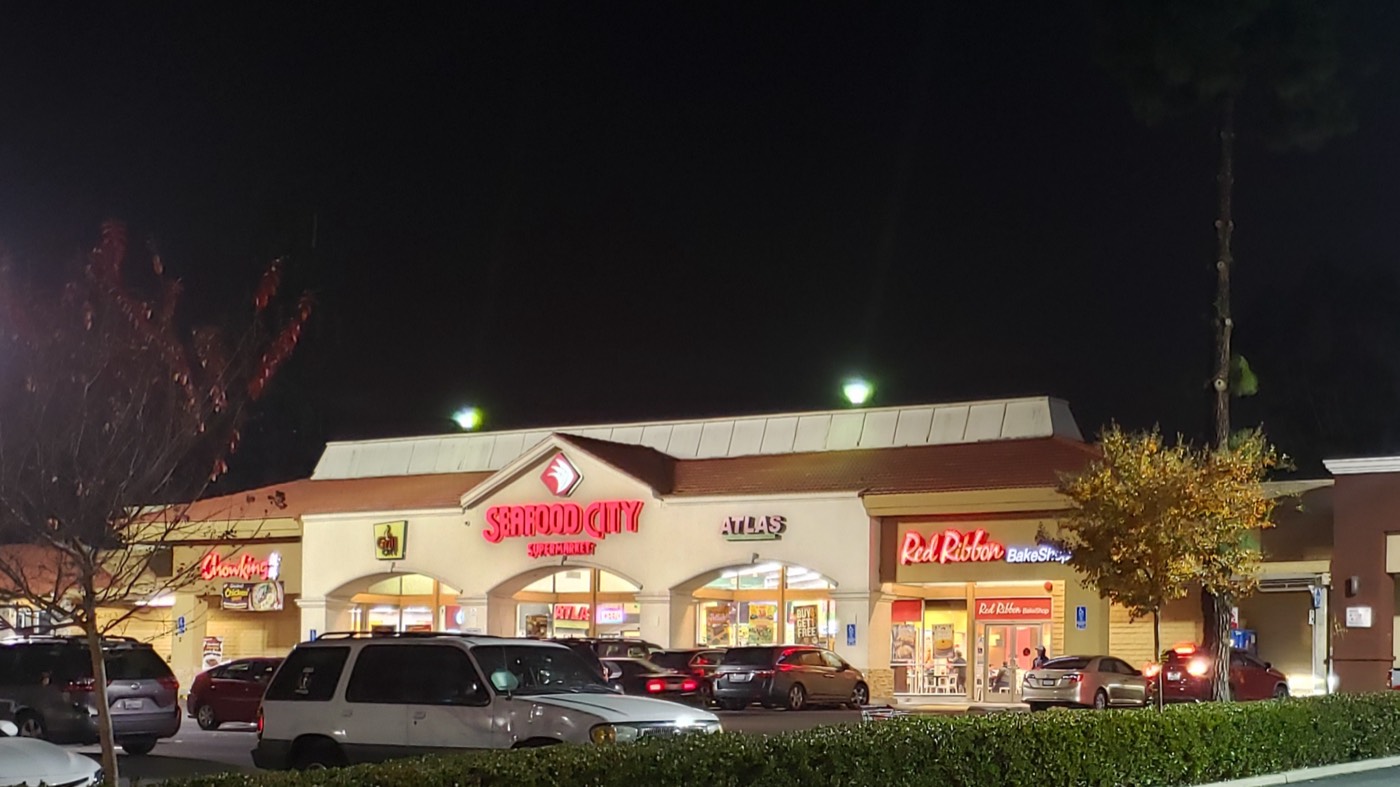
On a Saturday morning along Amar Road, two shopping plazas face each other across the asphalt, and both of them speak Tagalog. One holds a Seafood City, the other an Island Pacific, and between the cart returns and the bakery counters you can hear the small talk of a province transplanted whole. This is the heart of the Filipinos in West Covina, a community that has quietly made an affluent San Gabriel Valley suburb into one of Los Angeles County’s true Filipino centres.
It did not happen with a banner or a ribbon cutting. It happened one family, one nursing job, one balikbayan box at a time, until the south side of a city named after a sewage dispute had become, in everything but the official signage, a Little Manila of its own.
The Place
West Covina sits roughly nineteen miles east of downtown Los Angeles, a city of about 109,000 people wrapped around the Interstate 10 and State Route 60 freeways in the San Gabriel Valley. It was incorporated in 1923, oddly enough to stop the neighbouring city of Covina from building a sewage farm nearby, and then it exploded.
Between 1950 and 1960 it was one of the fastest growing cities in the United States, its population rising more than a thousand per cent as orange groves gave way to tract homes and the Eastland shopping centre. For decades it was a postwar white suburb of cul-de-sacs and good schools.
That West Covina is gone. By 2020 non-Hispanic white residents had fallen to under eleven per cent, while Asian residents had climbed to more than thirty. The hillside streets of the south side, in the 91792 zip code near Walnut, are where the Filipino story concentrated.
How It Became Filipino
The Filipino presence in the San Gabriel Valley is older than most of its strip malls. Filipino labourers were working the valley’s citrus groves and vineyards in the early twentieth century, part of the manong generation that built infrastructure across rural California long before anyone thought of suburbs out here.
The 1965 turn
The community West Covina knows today is a child of one law. The Immigration and Nationality Act of 1965, taking full effect at the end of the decade, abolished the national-origins quotas that had throttled Asian immigration for forty years. Filipino arrivals surged, and one in four Filipino immigrants to the United States settled in the Los Angeles area.
Many of the first to come under the new rules were professionals: nurses, doctors, accountants, engineers. The Philippines had built an English-language, American-style nursing education system, and American hospitals were short-staffed. That match sent tens of thousands of Filipino nurses to California, and a great many of them needed a comfortable, affordable suburb with good schools to raise children in.
Fanning out from the old enclaves
For years Filipino Los Angeles had clustered near downtown, in the area west of the river that would be formally recognised as Historic Filipinotown in 2002. But the community never stayed put. As segregation ended and incomes rose, Filipino families fanned outward into a constellation of suburbs: Carson, Cerritos, Eagle Rock, Diamond Bar, Walnut, and West Covina among them.
West Covina had what these families wanted. It was middle to upper middle class, with a 2023 median household income near 99,000 dollars, hillside homes the size you could never get near downtown, and school districts that drew Filipino parents the way magnets draw iron filings. By 2017 more than 10,000 Filipino Americans lived in the city, the largest single group in the south part of town.
The Amar Road corridor
Commerce followed the families. The decisive cluster grew along Amar Road near Azusa Avenue, where a short public street called Manila Way loops through what locals simply call the Filipino Center. Seafood City and Island Pacific anchored two facing plazas, and around them filled in the full ecology of a homeland economy: turo-turo eateries, balut sellers, money-remittance counters, air-cargo offices that ship balikbayan boxes back to the provinces, Filipino dentists, hair salons, and car brokers.
Across the same decades the community grew civic muscle. In 2018 Letty Lopez-Viado became the first Filipino American elected to the West Covina City Council, and in December 2020 she was sworn in as the city’s first mayor of Filipino and Mexican descent, her mother from the Philippines and her father from Mexico. Residents had also begun lobbying, so far without official success, to have the Amar Road district formally designated a Little Manila.
The corporate stamp
The clearest sign that West Covina had become a Filipino capital came in 2019, when Jollibee, the beloved Manila fast-food giant, opened its North American support headquarters at 100 North Barranca Street, in the tallest building in the San Gabriel Valley, just off the 10. The 28,000-square-foot office runs operations for Jollibee, Chowking, and Red Ribbon across the continent. A company that could have planted its flag anywhere planted it here, in the suburb where its customers already lived.
The Landmarks
Seafood City Supermarket, 1525 Amar Road. The gravitational centre of Filipino West Covina. Its bakery turns out pandesal and ube confections, the seafood counter is stocked for kare-kare and sinigang, and the front-of-store food court is where Saturday errands turn into long conversations. For thousands of families it is the first stop of the weekend.
Island Pacific Supermarket, 1512 East Amar Road. Directly across from Seafood City, Island Pacific carries homeland brands like Barrio Fiesta and Josephine Empanada and keeps the same long hours. The two facing markets, rivals and neighbours at once, are the reason this stretch of Amar Road reads as a single Filipino district.
Jollibee, 1561 East Amar Road. Steps from the supermarkets, this is the everyday Jollibee where Chickenjoy and Jolly Spaghetti feed the after-school crowd. The chain runs a second West Covina location at 147 Barranca Street, near the corporate headquarters that made the city the brand’s North American home.
The Original Barrio Fiesta of Manila, beside Island Pacific on Amar Road. A sit-down restaurant for the dishes that take time, crispy pata and kare-kare and the slow-cooked classics, planted right next to the market so a grocery run and a family dinner can be the same trip.
St. Christopher Catholic Church, 629 South Glendora Avenue. The spiritual home of a heavily Catholic community. Its Filipino Ministry organises the city’s Simbang Gabi, the nine dawn Masses leading to Christmas, when the church fills before sunrise and the parking lot afterward smells of bibingka and puto bumbong.
The Filipino Center at Manila Way and Amar Road. The short looping street off Azusa Avenue that gives the district its spine, ringed by the sari-sari-style shops, remittance offices, and cargo companies that keep West Covina tethered to towns across the Philippines.
Eastland Center, near Eastland Drive off the 10. The 1957 shopping centre that helped build the postwar suburb, since reinvented around a Target. It is not a Filipino landmark, but it is the older West Covina that the Filipino West Covina grew up inside, and it anchors the same daily errands.
Where They Came From
West Covina’s Filipinos do not trace to a single province. The post-1965 professional wave drew broadly from across the archipelago, with strong threads from Metro Manila and the Tagalog-speaking provinces of Luzon, from the Ilocano north that has long sent migrants to California, and from the Visayas in the central islands.
The common thread was rarely geography. It was education and English, the credentials of nurses and engineers and accountants that the United States was actively recruiting, and the chain that followed once one family was established: a sister petitioned, then her husband, then ageing parents, until a single hospital hire became a clan of twenty across three West Covina streets.
That breadth is why the community here feels national rather than provincial. The Tagalog spoken in more than six thousand area households is the lingua franca of a population that came from everywhere in the islands and chose, together, to land in the same eastern corner of the valley.
West Covina Today
Today the Filipinos in West Covina are settled, established, and second-generation deep. The children of the nurses and engineers have grown up between two supermarkets and a Jollibee, attending well-regarded schools, some of them in the Walnut Valley Unified district that reaches into the city’s south side and routinely ranks among California’s best. Many of those children are now raising children of their own here.
It is an honest middle-class success story, not a museum. There is no official Little Manila plaque, the campaign for one still unresolved, and the district lives as commerce and habit rather than monument. The community shares the south side with a large Latino majority, and West Covina remains a working suburb where the Filipino character is woven through the city rather than fenced off in a quarter.
What endures is the rhythm. The pre-dawn Simbang Gabi crowds in December, the Saturday markets, the cargo boxes bound for the provinces, the Filipina-Mexican mayor who once led the council, the headquarters tower glinting off the 10. West Covina never needed a sign to announce what it had become. The community wrote it into the everyday, and the everyday holds.
Frequently Asked Questions
Where do Filipinos live in West Covina?
The Filipino community in West Covina is concentrated on the south side of the city, particularly the 91792 zip code near Walnut, with its commercial heart along Amar Road near Azusa Avenue. Filipinos make up the largest single group in that part of town.
Why is there such a large Filipino community in West Covina, California?
After the 1965 Immigration and Nationality Act opened Asian immigration, Filipino professionals, especially nurses, settled across Los Angeles and fanned out into affordable, well-schooled suburbs. West Covina offered hillside homes, strong schools, and good freeway access, and chain migration did the rest, building the Filipinos in West Covina into a community of more than 10,000.
Is there a Little Manila in West Covina?
Unofficially, yes. The Amar Road corridor near Manila Way is widely called the Filipino Center or Little Manila, anchored by the Seafood City and Island Pacific supermarkets. Residents have lobbied for an official Little Manila designation, but the city has not formally adopted one.
What Filipino markets and restaurants are in West Covina?
Facing each other on Amar Road are two major Filipino supermarkets, Seafood City at 1525 Amar Road and Island Pacific at 1512 East Amar Road. Nearby are Jollibee, the Original Barrio Fiesta of Manila, and a cluster of turo-turo eateries, bakeries, and remittance and cargo offices.
Why is Jollibee’s headquarters in West Covina?
Jollibee opened its North American support headquarters at 100 North Barranca Street in 2019, in the tallest building in the San Gabriel Valley just off Interstate 10. The location reflects how central West Covina and the surrounding valley had become to the Filipino American market the brand serves.
How does West Covina relate to other Filipino communities in California?
West Covina is part of a wider Filipino Los Angeles that includes Historic Filipinotown and suburbs like Carson and Eagle Rock. Further afield it echoes the great Filipino centres of Daly City near San Francisco and National City near San Diego, and the East Coast hub of Virginia Beach.
If your family’s story passed through West Covina, or any of the places Filipinos have made home in America, Atlas of Home can trace that journey. From a province in the islands to a hillside street off Amar Road, to wherever you are now.