
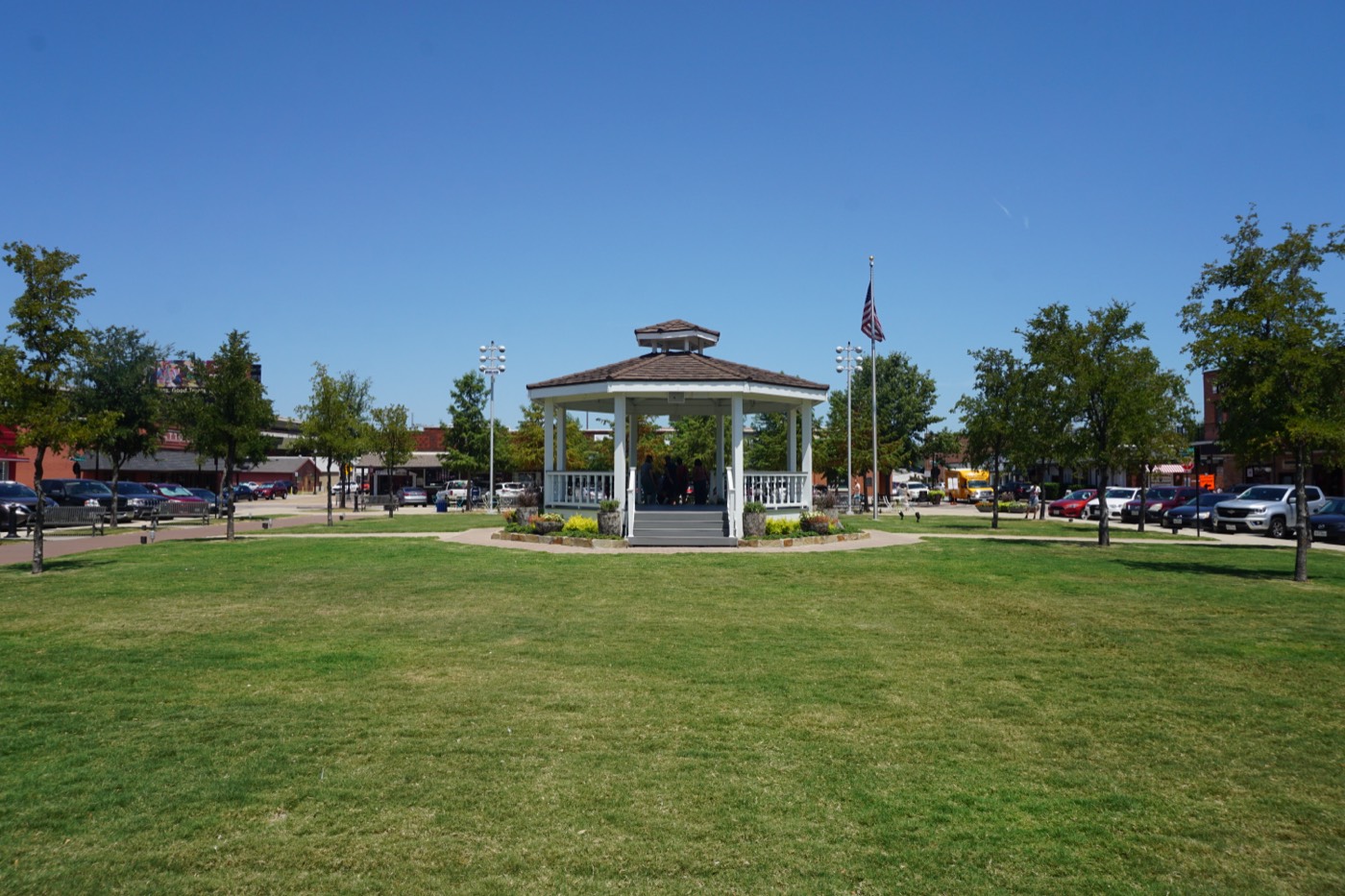
Drive north on Old Denton Road through Carrollton, Texas, and the signs change before the landscape does. Hangul fills the strip-mall marquees, Korean fried chicken shares a parking lot with shaved-ice cafes, and a Super H Mart anchors a plaza that two decades ago was a dying Mervyn’s. The Koreans in Carrollton have built the largest Korean community in Texas, and the southern United States looks here when it wants a taste of Seoul.
The Place
Carrollton sits about twenty miles north of downtown Dallas, straddling the line where Dallas County meets Denton County in the sprawl of the Dallas-Fort Worth metroplex. It is a city of roughly 130,000 people, comfortable and suburban, with good schools and easy highway access to the region’s tech and finance corridors.
For most of its history it was an ordinary North Texas commuter town, neither rich nor poor. What sets it apart now runs along a single road. The stretch of Old Denton Road near the President George Bush Turnpike has become a dense Korean commercial district, and locals simply call it Koreatown.
How It Became Korean
The Korean presence in the Dallas area did not start in Carrollton. It started closer to the city, along Royal Lane and Harry Hines Boulevard, where the first wave of Korean immigrants opened wholesale shops, beauty-supply businesses and restaurants in the 1970s and 1980s. That older Dallas Koreatown grew up around the Asian wholesale trade, and the 88th Texas Legislature formally designated it Koreatown Dallas in 2023.
But as Korean families prospered, they did what most American immigrant families do once they can. They moved to the suburbs, chasing space, safety and schools. It is the same suburban arc that produced the Korean community of Annandale, Virginia outside Washington and the Koreans of Fort Lee, New Jersey across the Hudson from Manhattan. Carrollton, with its affordable land and strong public education, drew them north.
The Mervyn’s That Became H Mart
The turning point came with a single failed shopping centre. When a Mervyn’s department store on Old Denton Road closed in 2006, the surrounding retail plaza was emptying out and the city worried about blight.
In 2007 a group of Korean investors led by Edward Choi bought the struggling centre and brought in a Super H Mart, the Korean American grocery giant. The bet was simple: a destination grocer would draw shoppers from across the metroplex and revive the whole plaza. It worked almost immediately.
H Mart became the anchor that everything else grew around. Korean restaurants, bakeries and service businesses began filling the storefronts beside it, and word spread that Carrollton was where you went for authentic Korean food and groceries.
The Plaza Keeps Growing
Success bred more building. Around 2014, developer NewQuest Properties redeveloped roughly 154,000 square feet of surrounding retail, adding food courts, specialty shops and a 50,000-square-foot 99 Ranch Market, the Chinese American grocery chain, just down the road.
The boom along Old Denton Road did not stop at groceries and restaurants. It pulled in luxury condominiums and mixed-use projects, drawing more Korean and South Asian businesses into the corridor and turning a single anchored plaza into a sprawling district.
By the 2020s, residents counted more than a hundred Korean and other Asian restaurants clustered along this strip, a concentration that rivals far larger metros. Carrollton had quietly become one of the best places to eat Korean food outside Korea.
The corridor’s food is not limited to Korea, either. The plazas serve cuisine and entertainment from Japan, China, Thailand, Vietnam and beyond, so that a single afternoon can move from a Korean barbecue grill to a Vietnamese pho counter to a Taiwanese bubble-tea cafe. That pan-Asian density is part of what makes the district a regional destination rather than a purely Korean enclave.
A Community, Not Just a Commercial Strip
The businesses came first, but families and institutions followed. More than 4,000 Carrollton residents identify as Korean, according to U.S. Census figures, and many more shop and worship in the city while living in neighbouring Plano, Lewisville and Dallas. The pull of the same North Texas schools and tech corridors that drew them also built the large Indian community in nearby Plano, another immigrant suburb of the metroplex.
Korean churches multiplied across the city, spanning Presbyterian, Baptist and other congregations, becoming the social and spiritual backbone of the community in the familiar pattern of Korean America. The city has discussed giving its Koreatown a formal designation: conversations between Carrollton and the Korean consulate began in 2023, though as of this writing no formal state designation has been adopted for the Carrollton district itself.
The Landmarks
H Mart Carrollton, 2625 Old Denton Road. The anchor that started it all. The Super H Mart that opened in 2007 in the old Mervyn’s space remains the gravitational centre of the district, its food court and aisles drawing Korean shoppers from across the metroplex on weekends.
99 Ranch Market, Old Denton Road corridor. The 50,000-square-foot Chinese American grocer added during the NewQuest redevelopment around 2014. Its arrival signalled that the corridor had grown beyond a single store into a pan-Asian shopping destination, with Korean and Taiwanese specialties stocked side by side.
Bros Korean BBQ, Sushi & Shabu, 2625 Old Denton Road, Suite 700. An all-you-can-eat tabletop grill that fuses Korean barbecue with Japanese sushi and shabu shabu, the kind of hybrid that thrives in a district dense enough to support specialists and crowd-pleasers alike.
Don Sarang Original Korean BBQ, 2630 Old Denton Road, Suite 140. A long-running all-you-can-eat barbecue house on the strip, where the countertop grills and endless banchan draw both Korean regulars and curious newcomers from the wider Dallas suburbs.
Moodaepo Korean BBQ, 3044 Old Denton Road, Suite 133. A barbecue restaurant built around premium marinated short ribs, spicy pork belly and brisket grilled at the table, part of the dense cluster that makes the corridor a barbecue destination in its own right.
K Towne Plaza, Old Denton Road. One of the named retail plazas in the district, the sort of multi-tenant Korean centre that packs restaurants, cafes, salons and service businesses under one roof, the everyday infrastructure of Carrollton’s Koreatown.
Korean Church of the Lord, Carrollton. A Presbyterian (PCA) congregation that reflects the community’s deep church life. For Korean Carrollton, the church is where language, food and generation meet, and where new arrivals find their footing.
Where They Came From
Carrollton’s Koreans are overwhelmingly a secondary migration, not a direct one. The community grew less from boats and planes arriving straight from Seoul than from Korean families relocating within the United States, often from the older Dallas Koreatown along Harry Hines Boulevard or from larger hubs like Koreatown in Los Angeles and Atlanta.
Their roots trace back to South Korea, with the bulk arriving after the 1965 immigration reforms that opened the United States to Asian migration. Seoul and the surrounding Gyeonggi region, along with port cities like Busan, supplied many of the first families.
What pulled them specifically to Carrollton was the same calculus that built the suburb itself: cheaper land than coastal cities, no state income tax, a booming Texas economy, and schools good enough to satisfy famously education-focused Korean parents. The H Mart anchor did the rest, giving the community a commercial heart to gather around.
Education matters more here than the brochures admit. The Carrollton-Farmers Branch Independent School District and the neighbouring Lewisville district draw Korean families the way good schools draw immigrant families everywhere, and the district’s strongest campuses, from its Early College High School to top-rated elementary schools like McCoy and Kent, are a quiet part of why Korean parents choose to stay. For many families the decision was practical to the decimal point: a house in a strong attendance zone, a short drive to H Mart, and a Korean church within reach.
Carrollton Today
Today the Old Denton Road corridor is busy day and night. Korean fried-chicken joints, dessert cafes serving bingsu, karaoke rooms, billiard halls, spas and bakeries crowd the plazas, and on weekends the H Mart parking lot fills with families speaking Korean, English and the blend in between.
It is also a district that is still building. The success along Old Denton Road has pulled in luxury condominiums and mixed-use developments, and the city has marked Korean civic moments, from National Liberation Day of Korea to cultural exchanges, as the community’s public profile has grown. Carrollton is no longer simply a place where Koreans happen to shop; it is a place that increasingly sees its Korean identity as part of its civic story.
The community is also processing harder days. In May 2026, a shooting at a Carrollton shopping centre in the Koreatown area left two people dead and three wounded, and Korean American leaders across the metroplex urged unity and healing in its aftermath. It was a reminder that this district is not a theme park but a living neighbourhood, with all the joy and grief that implies.
Carrollton’s Koreatown remains, for now, a commercial and cultural anchor rather than an officially designated one. But the families who shop, worship and eat along Old Denton Road have already made the designation real in the only way that ultimately matters. They have built a place that feels like home, and a corner of North Texas that sounds and tastes unmistakably Korean.
Frequently Asked Questions
Where do the Koreans in Carrollton, Texas live and gather?
The Korean community in Carrollton centres on the Old Denton Road corridor near the President George Bush Turnpike, where the H Mart-anchored plazas form the district locals call Koreatown. Many Koreans live in Carrollton itself and in neighbouring Plano, Lewisville and Dallas, but they shop, dine and worship along this strip.
How large is the Korean community in Carrollton?
More than 4,000 Carrollton residents identify as Korean according to U.S. Census figures, in a city of about 130,000. The Koreans in Carrollton form the largest Korean community in Texas and the southern United States once the wider shopping and worshipping population is counted.
How did Carrollton get its Koreatown?
It began in 2007 when Korean investors led by Edward Choi bought a failing shopping centre with a closed Mervyn’s on Old Denton Road and brought in a Super H Mart. The grocer revived the plaza, drew Korean businesses around it, and the corridor grew into a Koreatown over the following years.
What is the difference between Koreatown Dallas and Koreatown Carrollton?
Koreatown Dallas is the older district along Royal Lane and Harry Hines Boulevard, formally designated by the Texas Legislature in 2023. Carrollton’s Koreatown is the newer suburban hub along Old Denton Road, built around H Mart and home to the metroplex’s densest cluster of Korean restaurants.
What are the best Korean restaurants in Carrollton?
The Old Denton Road corridor holds more than a hundred Korean and Asian restaurants, including barbecue houses like Don Sarang, Moodaepo and Bros Korean BBQ. The area is widely considered one of the best destinations for Korean food in the United States outside the West Coast.
Is there a Korean grocery store in Carrollton?
Yes. The Super H Mart on Old Denton Road, opened in 2007, is the anchor of the district, and a large 99 Ranch Market was added nearby around 2014. Together they make Carrollton a major Asian grocery destination for the entire Dallas-Fort Worth area.
If your family’s story passed through Carrollton, or any of the places Koreans have made home in America, Atlas of Home can trace that journey. From Seoul and Busan to a plaza on Old Denton Road, to wherever you are now.