
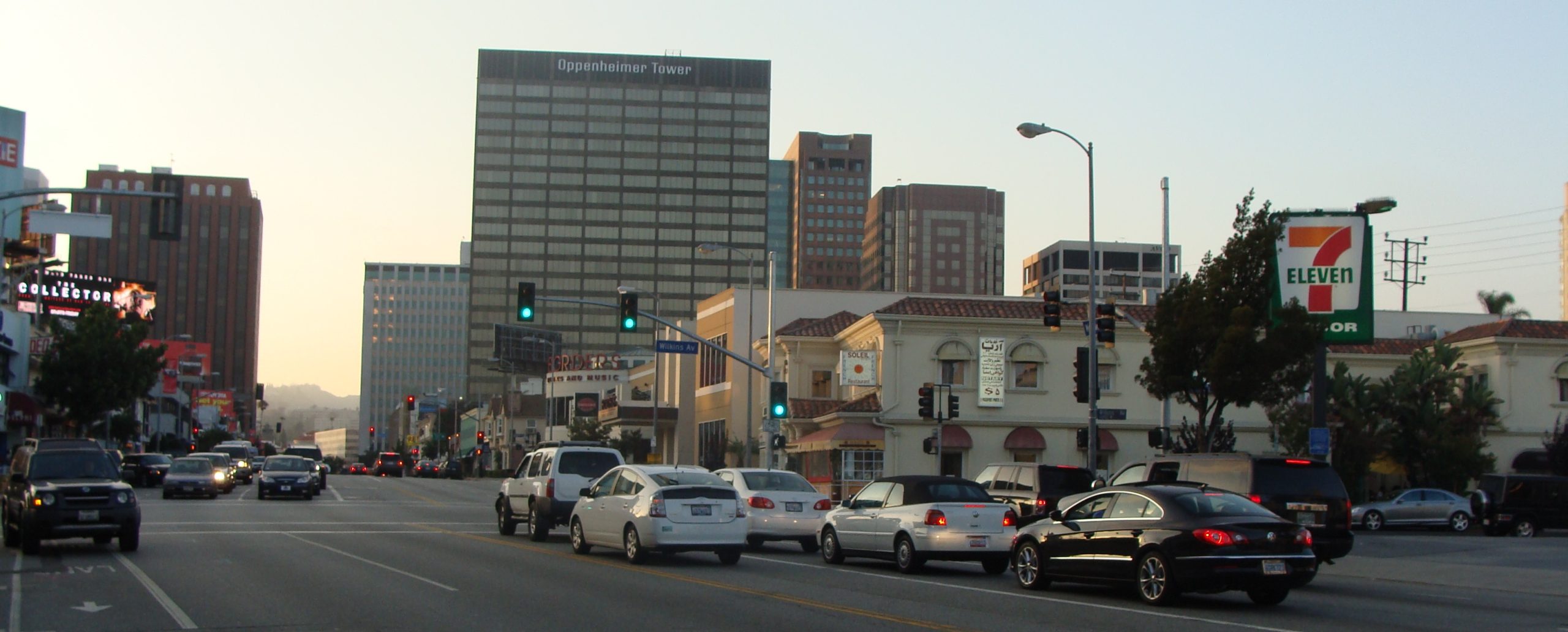
They call it Tehrangeles. Not officially, although a small green sign on Westwood Boulevard now says Persian Square, and the city of Los Angeles made it law in 2010. But long before that, if you walked the stretch of Westwood between Wilshire and Pico on a Friday evening, you knew where you were.
The smell of saffron and grilled lamb. Farsi spilling out of the bookshop next to the kabob house. A radio in a parked car tuned to 670 AM. Greater Los Angeles holds an estimated 500,000 to 600,000 people of Iranian descent, the largest Persian community anywhere outside of Iran itself, and this is the corridor where the story began.
Tehrangeles, The Place
Tehrangeles is not a single neighbourhood so much as a constellation. The commercial heart is a half-mile of Westwood Boulevard running south from Wilshire toward Pico, with Persian Square pinned at the corner of Wilkins Avenue. From there it spreads outward in every direction. Beverly Hills to the east, Brentwood to the west, and a long arc north and over the Santa Monica Mountains into Encino, Tarzana, Woodland Hills, and Calabasas.
Westwood itself was master-planned in the late 1920s by the Janss Investment Company. Mediterranean rooflines, clay tile, paseos. UCLA opened on the hill above in 1929, and the village below it was built to serve the campus. Eight decades later, the architecture is mostly the same. The signage is what changed.
How LA Became Persian
Before the Persians
For most of the twentieth century, Westwood was an Anglo college town. Janss Investment Company had imposed strict design controls and, less openly, restrictive covenants. The boulevard south of Wilshire became known by the 1950s for its movie theatres, its diners, its bookshops. A burger and a Budweiser at Truman’s on the corner of Westwood and Wilshire cost forty cents.
A first, small wave of Iranian students arrived in the 1960s and early 1970s, sent abroad by middle-class families and by the Pahlavi state’s scholarship programmes. UCLA was a natural draw. So was UCLA Medical Center, where many of them stayed on as residents and physicians. They were a few thousand people. Nobody yet called it Tehrangeles.
The Persians Arrive
Then came January 1979. The Shah left Tehran for the last time on the sixteenth. Ayatollah Khomeini returned from Paris on the first of February. By April the Islamic Republic had been declared, and within weeks the first wave of departures had begun.
The trigger for the Jewish community came in May, when Habib Elghanian, a businessman and philanthropist who had led the Tehran Jewish Society, was executed by firing squad on charges of spying for Israel. Wealthy Iranian families read the verdict and started packing. Bahá’ís, whose faith the new constitution refused to recognise as a religion at all, packed faster. Secular professionals followed. Armenians and Assyrians too.
The numbers are staggering. Iran’s Jewish population fell from roughly 80,000 in 1978 to under 20,000 within a decade, and the United States absorbed most of those who left. Somewhere between 60,000 and 80,000 Iranian Jews settled in greater Los Angeles. They came with savings, with English, often with professional credentials, and with the urgency of people who knew they were not going home.
Westwood was the obvious landing zone. UCLA was already a known address back in Tehran. The pre-1979 professional community could vouch for new arrivals at apartment buildings on Veteran and Kelton. Apartments south of Wilshire were cheaper than Beverly Hills but close enough to walk. And the boulevard had vacant retail.
Tehrangeles at Its Peak
By the mid-1980s the transformation of Westwood Boulevard was visible from the street. Persian bookshops opened first. Then groceries selling barberries, dried limes, and Iranian rice in twenty-pound sacks. Then kabob houses, sandwich shops, jewellers, travel agencies, accountants whose signs read in Farsi and English.
The community arriving in the 1980s was not poor. Many had been doctors, engineers, merchants, or bazaar families in Tehran, Isfahan, and Shiraz. The Iranian-American business class in Los Angeles concentrated quickly into real estate, jewellery, apparel, and entertainment. By 1996 more than half of Iranian-American professionals in Los Angeles were self-employed.
The religious institutions reorganised around the new arrivals. Sinai Temple at Wilshire and Beverly Glen, founded in 1906 as Southern California’s first Conservative synagogue and an Ashkenazi congregation for most of its life, saw its membership reshape over two decades into roughly half Persian. Iranian Bahá’í communities formed in Westwood and the Valley. Shia Muslim Iranians built mosques and prayer halls in the Valley and in West LA. Iranian Christians, mostly Armenian and Assyrian, slotted into existing churches in Glendale.
By the 1990s Iranian-American media in Los Angeles was its own ecosystem. Dozens of Persian-language television and radio operations were broadcasting at one point or another, beaming back into Iran via satellite. KIRN 670 AM, which signed on as Radio Iran in 2001, is still the only twenty-four-hour Farsi-language broadcast licensed by the FCC. Pars TV and Voice of America’s Persian service became fixtures of immigrant living rooms.
The official designation came on 26 February 2010. City Councilmember Paul Koretz introduced the motion. The intersection of Westwood Boulevard and Wilkins Avenue became Persian Square, with a small green sign and a plaque. The community had spent thirty years building the place. The city was, in effect, signing the deed.
The Change
If Tehrangeles had a second act, it began with politics. In June 2009, when the disputed Iranian presidential election triggered the Green Movement protests in Tehran, the boulevard filled with green ribbons and rolling demonstrations. Westwood became one of the world’s loudest diaspora amplifiers for what was happening at home.
Then in September 2022, after the death of Mahsa Jina Amini in the custody of Iran’s morality police, it happened again. Tens of thousands of Iranian Angelenos marched downtown to City Hall under the slogan “Woman, Life, Freedom.” A junction in West LA was later named for Amini. A new generation, born in California to parents who had fled in 1979, found a political identity their parents had mostly buried.
The community itself has also moved. The wealthiest Iranian families long ago moved out of Westwood proper into Beverly Hills, Brentwood, Bel Air, and over the hill into Encino and Calabasas. Westwood Boulevard is now where the community shops and eats rather than where it sleeps. Younger Iranian Americans, second and third generation, live across the metro from Irvine to Glendale. The boulevard stayed. It just became more like an embassy than a home.
The Landmarks of Persian LA
Persian Square (Westwood Boulevard and Wilkins Avenue). The intersection officially named by the City of Los Angeles in February 2010. The sign itself is modest. What it marks is not. The Nowruz street festival, when Westwood Boulevard closes between Wilkins and Ohio for music, dancing, and a public Haft-sin table, anchors here every spring.
Saffron and Rose Ice Cream (1387 Westwood Boulevard). Founded in 1974 by Ali Kashani-Rafye, known to the boulevard as Haji, using his father’s recipes from Tehran. Saffron, rosewater, pistachio, faloodeh. It is Westwood’s oldest ice cream shop and the single most-recognised Iranian business in the country. Still family-run.
Attari Sandwich Shop (1388 Westwood Boulevard). The anchor of Attari Plaza, the small open-air courtyard that has functioned for three decades as Tehrangeles’ unofficial town square. Tongue sandwiches, gondi, ash reshteh. Tables under jacaranda. The place where, at any hour, somebody is arguing politics in Farsi over tea.
Shamshiri Grill (1712 Westwood Boulevard). Opened in 1982, moved to Westwood in 1984, and one of the kabob houses that taught Los Angeles what koobideh, joojeh, and barg were supposed to taste like. The bread comes out of the tanoor oven in waves all night.
Shaherzad Restaurant (1422 Westwood Boulevard). A white-tablecloth Persian dining room with a complimentary basket of fresh sangak bread to start, named for the storyteller of the Thousand and One Nights. The menu is essentially a survey of the cooking of Tehran, Tabriz, and Isfahan, served the way Iranian families serve it on a Friday.
Sinai Temple (10400 Wilshire Boulevard). The 1960 Westwood facility of Southern California’s first Conservative congregation. After 1979, so many Iranian Jewish families joined that the membership rebalanced to roughly half Ashkenazi and half Persian. It is one of the largest Iranian Jewish congregations in the diaspora and a centre of Iranian-American Jewish public life.
KIRN 670 AM. Not a building you walk into so much as a signal you tune to. The only full-time Farsi-language commercial radio station in the United States, broadcasting from the Hollywood Hills to the Persian-speaking population from Santa Monica to Calabasas. News, political talk, music, traffic, weddings, deaths.
Where the LA Persians Came From
The single largest tributary into Tehrangeles was Tehran itself. The capital was where most professional families lived in 1979, and the capital was where the revolution moved fastest. Doctors from north Tehran. Bazaar merchants from the central districts. Government engineers and teachers. They became the bulk of the Westwood community.
The second major source was Isfahan, with its centuries-old Armenian Christian quarter at New Julfa and its long-established Jewish community. Then Shiraz, which sent a particularly significant share of the Iranian Jewish exodus to Los Angeles.
Tabriz, the Azeri-speaking capital of East Azerbaijan, sent Armenians and Azeri Iranians. Mashhad, Iran’s holiest Shia city, sent a smaller but distinct Jewish population whose history of forced conversion under the Qajar shahs had already produced one earlier diaspora. Smaller numbers came from Kerman, Hamadan, Yazd, and Kermanshah.
The religious map of Tehrangeles is broader than any other Iranian diaspora outside Israel. Iranian Jews are the largest single religious community in LA Persian life, roughly 50,000 strong. Shia Muslims, secular and observant, form the largest Iranian Muslim population.
There is a significant Bahá’í community, refugees from a faith Iran has criminalised since 1979. Armenian and Assyrian Christians fill out the picture. A handful of Zoroastrians, descended from the pre-Islamic religion of Iran, keep their fire temples running in the Valley.
Tehrangeles Today
The boulevard is still working. Saffron and Rose still has a line on a Sunday afternoon. Attari Plaza is still where the Friday evening conversations happen, the older men in dark jackets, the younger ones in their phones. Sangak still comes out of the oven. The Farsi on the windows has not been painted over.
What has changed is the demographic geography. The Iranian community that built this corridor is now largely a community of homeowners in Beverly Hills, Brentwood, and Encino, who drive in. The Westwood Boulevard apartments that absorbed the 1979 generation now house UCLA students, Korean and Chinese newcomers, and a thinning Iranian-American renter base. The boulevard is the commercial spine of a community that has spread across half the metro area.
The political role is what is most clearly alive. Nowruz still brings the boulevard to a standstill every March. The 2022 Mahsa Amini movement showed that Tehrangeles can still mobilise tens of thousands in a single afternoon. The next generation, raised on Roosh, on Persian rap, on Andre Agassi and the Kardashians and Shervin Pishevar, knows the story their parents tell about the night they left Tehran. They are not the same as their parents. But they know the address.
Frequently Asked Questions
Why did Persians settle in Tehrangeles?
Iranians settled in Westwood Boulevard’s Tehrangeles after the 1979 Islamic Revolution because a small Iranian student and professional community already existed around UCLA, apartments south of Wilshire Boulevard were affordable, and chain migration from earlier arrivals pulled relatives and friends to the same corridor. By the mid-1980s Iranian-owned businesses had reshaped the boulevard between Wilshire and Pico into the largest Persian commercial district outside Iran.
Is Tehrangeles still Persian today?
Westwood Boulevard between Wilshire and Pico is still the commercial and cultural heart of Persian Los Angeles, with Iranian restaurants, bookshops, bakeries, and grocers operating along the corridor. The Iranian-American community has largely moved out into Beverly Hills, Brentwood, Encino, and the western San Fernando Valley as homeowners, but they still come back to Westwood to shop, eat, and gather, especially for Nowruz and political demonstrations.
What are the most famous Persian landmarks in LA?
The best-known landmarks are Persian Square at Westwood Boulevard and Wilkins Avenue, Saffron and Rose Ice Cream at 1387 Westwood Boulevard, Attari Sandwich Shop and Attari Plaza at 1388 Westwood Boulevard, Shamshiri Grill at 1712 Westwood Boulevard, Shaherzad Restaurant at 1422 Westwood Boulevard, and Sinai Temple at 10400 Wilshire Boulevard. KIRN 670 AM, the only twenty-four-hour Farsi-language radio station in the United States, is also a defining institution of Tehrangeles life.
Where in Iran did the LA Persians come from?
The largest share came from Tehran, with major contributions from Isfahan, Shiraz, Tabriz, and Mashhad. The community brought with it the full religious diversity of pre-revolutionary Iran: a very large Jewish population estimated at around 50,000 in Los Angeles, plus Shia Muslims, Bahá’ís, Armenian and Assyrian Christians, and a small Zoroastrian community.
When did Persians first arrive in LA?
A small Iranian student and professional community formed around UCLA in the 1960s and early 1970s. The mass arrival followed the 1979 Iranian Revolution, when the overthrow of the Shah and the establishment of the Islamic Republic drove an estimated 300,000 Iranians to the United States, with a disproportionate concentration settling in greater Los Angeles. The city officially recognised the intersection of Westwood Boulevard and Wilkins Avenue as Persian Square on 26 February 2010.
If your family’s story passed through Tehrangeles, through Tehran or Shiraz or Isfahan, or through any of the places the Iranian diaspora made home in the long decades after 1979, Atlas of Home can trace that journey. From the names on a Tehran apartment block, to a sandwich shop on Westwood Boulevard, to wherever you are now.