
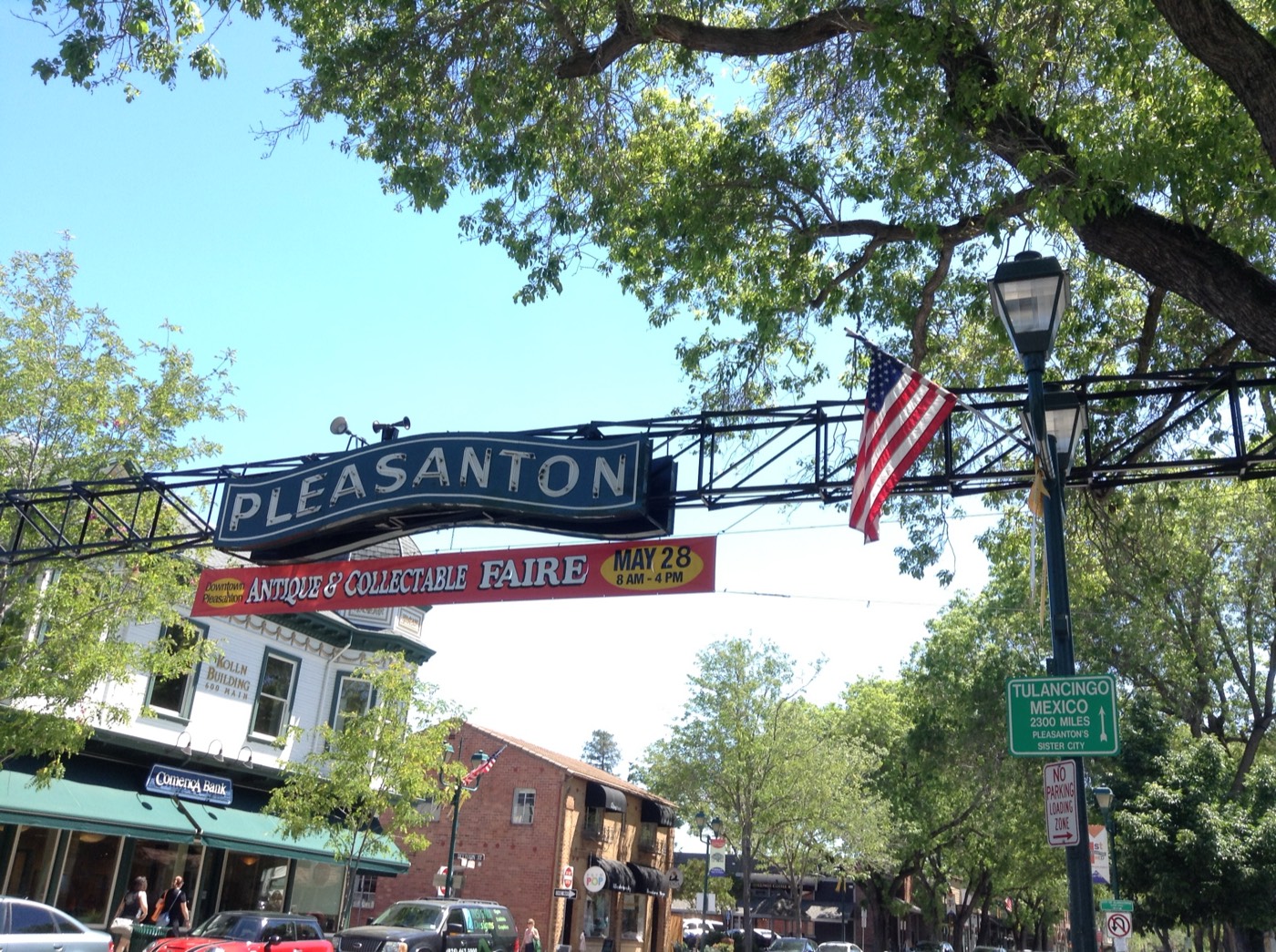
On a Saturday morning at the Pacific Pearl centre off Stoneridge Drive, the queue for the 85 Degrees C bakery cafe runs out the door, trays of sea-salt coffee and taro buns moving fast, while across the lot the 99 Ranch Market fills with families weighing live crab and choosing barbecue pork by the pound. This is one of the everyday rhythms of the Chinese in Pleasanton, California, a community that arrived with the Tri-Valley’s tech economy and quietly made this Alameda County suburb one of the most Chinese towns in the East Bay.
The Place
Pleasanton sits about 25 miles east of Oakland, tucked in the Tri-Valley where Interstate 580 meets Interstate 680, with Dublin to the north and San Ramon just over the Contra Costa line. It incorporated in 1894 as a ranching and vineyard town, and for most of its history it was a quiet rural valley far removed from the Bay’s industrial waterfront.
That changed in the 1980s, when the Hacienda Business Park and the Stoneridge Shopping Center turned Pleasanton into a centre of regional commerce, and by the middle of that decade it was among the fastest-growing cities in California. Today it is a place of well-kept subdivisions, top-rated schools and a preserved Main Street, with a median household income far above the national figure.
How It Became Chinese
Pleasanton’s Chinese community is young, measured against the century-old Chinatowns of San Francisco or Oakland. It is a story written almost entirely in the last forty years, and it tracks the arc of the Tri-Valley’s transformation from farmland into a satellite of the technology economy.
The valley opens up
The foundation was laid in part by the national laboratories nearby. Lawrence Livermore and Sandia, just east in Livermore, employed thousands of scientists and engineers and drew technical talent from across the country and abroad. When BART extended service and the Hacienda Business Park rose in the 1980s, Pleasanton suddenly had the jobs, the housing and the freeway access to absorb the overflow of the wider Bay Area’s growth.
The 1965 Immigration and Nationality Act had already reshaped who could come to the United States, opening the door to skilled migrants from Asia. The professionals who arrived under it, and the families they brought, increasingly looked east from crowded Silicon Valley toward the Tri-Valley’s newer, more affordable housing and its reputation for schools.
The tech decades
Through the 1990s and 2000s Pleasanton kept growing its employment base, anchored by large employers such as Workday, which is headquartered here, along with Oracle, Kaiser Permanente, Roche Molecular Systems, Thermo Fisher and 10x Genomics. These are exactly the kinds of firms that recruit engineers, data scientists and researchers, and a significant share of that workforce is Chinese and Chinese American.
For an engineer working in Pleasanton or commuting over the Sunol Grade to San Jose, the calculation was straightforward. The houses were larger and newer than in Cupertino or Fremont, the commute was manageable, and the schools were among the best in the state. Family by family, the Chinese share of Pleasanton climbed.
A community of three cities
The Chinese story here does not stop at the city line. Pleasanton, Dublin and San Ramon function as a single Tri-Valley community, sharing grocers, restaurants, weekend Chinese schools and tutoring centres across municipal borders. A family in Pleasanton might shop at the Dublin 99 Ranch, dine in San Ramon and send children to a Mandarin class that draws from all three towns.
It is a pattern distinct from the older Indian community that settled in Pleasanton in large numbers, a community we trace in our piece on the Indians in Pleasanton, California. The two groups share the same subdivisions and schools, but their institutions, grocers and gathering places run on parallel tracks.
The numbers today
By the 2020 census Pleasanton’s population was just under 80,000, and Asian residents had become the single largest group in the city, at roughly 44 per cent, ahead of White residents at about 36 per cent. Within that Asian population of around 27,500, Chinese residents number close to 7,800, the second-largest Asian origin group after Indians.
Those figures place Pleasanton alongside the South Bay’s established Chinese strongholds. The community here is smaller and newer than the one in Fremont, just down Interstate 680, or the long-settled enclave we describe in Cupertino across the bay, but it has the same profile: educated, professional and oriented around family and schooling.
The Landmarks
Pacific Pearl, El Charro Road and Stoneridge Drive. This Asian-themed centre opened in July 2018 and is the closest thing the Tri-Valley Chinese community has to a downtown of its own. Anchored by Pleasanton’s second 99 Ranch Market, its 112,000 square feet hold a dense run of eateries, dessert bars, salons and tutoring academies that draw families from across the valley.
99 Ranch Market, 4299 Rosewood Drive. The original Pleasanton branch of the Taiwanese-American supermarket chain opened in the Rose Pavilion in 2010, the city’s first full Asian grocery. Live seafood tanks, a roast-meat counter and aisles of Chinese, Taiwanese and pan-Asian staples made it an instant anchor, and it remains the everyday provisioning hub for thousands of households.
85 Degrees C Bakery Cafe, Pacific Pearl. Part of the cult Taiwanese chain famous for sea-salt coffee and fresh-baked buns, the Pleasanton location turned a parking lot into a weekend destination. The tray-and-tongs ritual at the bread counter is a small piece of Taipei transplanted to the Tri-Valley.
Mumu Hot Pot, Pacific Pearl. One of several Chinese and pan-Asian restaurants that opened with the centre, Mumu brought build-your-own hot pot to a town that, a generation earlier, had little Chinese dining beyond the standard takeaway. On cold evenings the steam-fogged windows say everything about how the community eats.
Stoneridge Shopping Center, 1 Stoneridge Mall Road. The regional mall that helped define Pleasanton’s modern economy in the 1980s is now a weekend gathering place for Chinese families across the Tri-Valley, its food court and shops part of the ordinary geography of suburban Chinese American life here.
Amador Valley High School, 1155 Santa Rita Road. Consistently ranked the top public high school in Alameda County and among the best in California, Amador Valley is one of the magnets that drew Chinese families to Pleasanton in the first place. Its academic intensity and Asian-heavy enrolment reflect a community that organises much of its life around education.
Foothill High School, 4375 Foothill Road. Pleasanton’s second powerhouse high school, Foothill ranks among the top schools in the state and the Bay Area. Between the two campuses, the city’s reputation for schooling is a large part of why so many Chinese professional families chose to put down roots here.
Where They Came From
The Chinese of Pleasanton did not come from a single village or province in the way that earlier waves of Cantonese migrants built San Francisco’s Chinatown. They came as a professional diaspora, drawn by jobs rather than by chain migration from one ancestral district.
Many trace their roots to mainland China, arriving as graduate students and engineers from cities such as Beijing, Shanghai and the technology hubs of the Yangtze and Pearl River deltas, then settling once they found work in Bay Area firms. Others are Taiwanese, a presence reflected in the Taiwanese chains, the bakeries and the 99 Ranch Market itself, which began in Southern California as a Taiwanese-American venture.
A further strand came not directly from Asia but from elsewhere in California, second-step migrants who first landed in Cupertino, Fremont or San Jose and moved east to the Tri-Valley for space and schools once careers were established. The common thread is education and the technology economy, not a shared hometown.
Pleasanton Today
Pleasanton today is a town where the Chinese presence is woven into ordinary life rather than concentrated in a single visible district. There is no archway, no Chinatown gate, no historic core of family associations. The community shows itself instead in the supermarkets, the bakeries, the boba shops, the tutoring academies and the heavy Chinese enrolment in the schools.
It also surfaces in shared civic moments. The Pacific Pearl centre hosts a free Lunar New Year celebration with lion dances, taiko drumming and Chinese dance, the kind of public festival that signals a community confident enough to mark its calendar in the open. Downtown’s preserved Main Street, meanwhile, remains the town’s older civic heart, a reminder that Pleasanton was a ranching valley long before it was a tech suburb.
For all its comfort, the community here is still being written. It is barely two generations old, its institutions newer than its families, and its centre of gravity spread across three cities rather than anchored to one corner. What the Chinese of Pleasanton have built is not a Chinatown but something newer and more suburban: a dispersed, prosperous, school-focused community that treats the whole Tri-Valley as home. It echoes the quieter, education-driven Chinese settlements we have traced in places like Saratoga, in the hills above Silicon Valley.
Frequently Asked Questions
How many Chinese people live in Pleasanton, California?
The 2020 census recorded roughly 7,800 Chinese residents in Pleasanton, the second-largest Asian origin group in the city after Indians. They are part of an Asian population of about 27,500, which makes Asian residents the single largest group in the city at around 44 per cent.
Why did so many Chinese families move to Pleasanton?
The Chinese in Pleasanton came largely with the Tri-Valley’s technology economy, taking jobs at firms such as Workday, Oracle and Roche and at the nearby national laboratories. Newer, more spacious housing than the South Bay and the reputation of Pleasanton’s schools drew professional families east from places like Cupertino and Fremont.
Is there a Chinatown in Pleasanton?
No. There is no traditional Chinatown with an archway or historic core. The Chinese in Pleasanton are dispersed across modern subdivisions, and the community’s everyday hubs are shopping centres such as Pacific Pearl and the 99 Ranch markets rather than a single ethnic district.
Where do Chinese residents shop and eat in Pleasanton?
The main hubs are the Pacific Pearl centre off Stoneridge Drive, anchored by a 99 Ranch Market, and the original 99 Ranch on Rosewood Drive. Pacific Pearl holds restaurants such as Mumu Hot Pot and the 85 Degrees C bakery cafe, with more Chinese and pan-Asian dining spread across nearby Dublin and San Ramon.
How does Pleasanton compare with Fremont or Cupertino for Chinese families?
Pleasanton’s Chinese community is smaller and newer than Fremont’s or Cupertino’s, but shares the same professional, education-focused profile. Many families moved to the Tri-Valley specifically for larger homes and top-ranked schools while staying within commuting range of Silicon Valley.
What schools draw Chinese families to Pleasanton?
Pleasanton Unified School District is one of California’s highest-performing. Amador Valley High School is regularly ranked the best in Alameda County, and Foothill High School ranks among the top in the state, and these schools are a major reason so many Chinese professional families chose Pleasanton.
If your family’s story passed through Pleasanton, or any of the places Chinese families have made home in America, Atlas of Home can trace that journey. From a graduate-school arrival in Beijing or Taipei, to a house near Amador Valley High and a Saturday at 99 Ranch, to wherever you are now.