
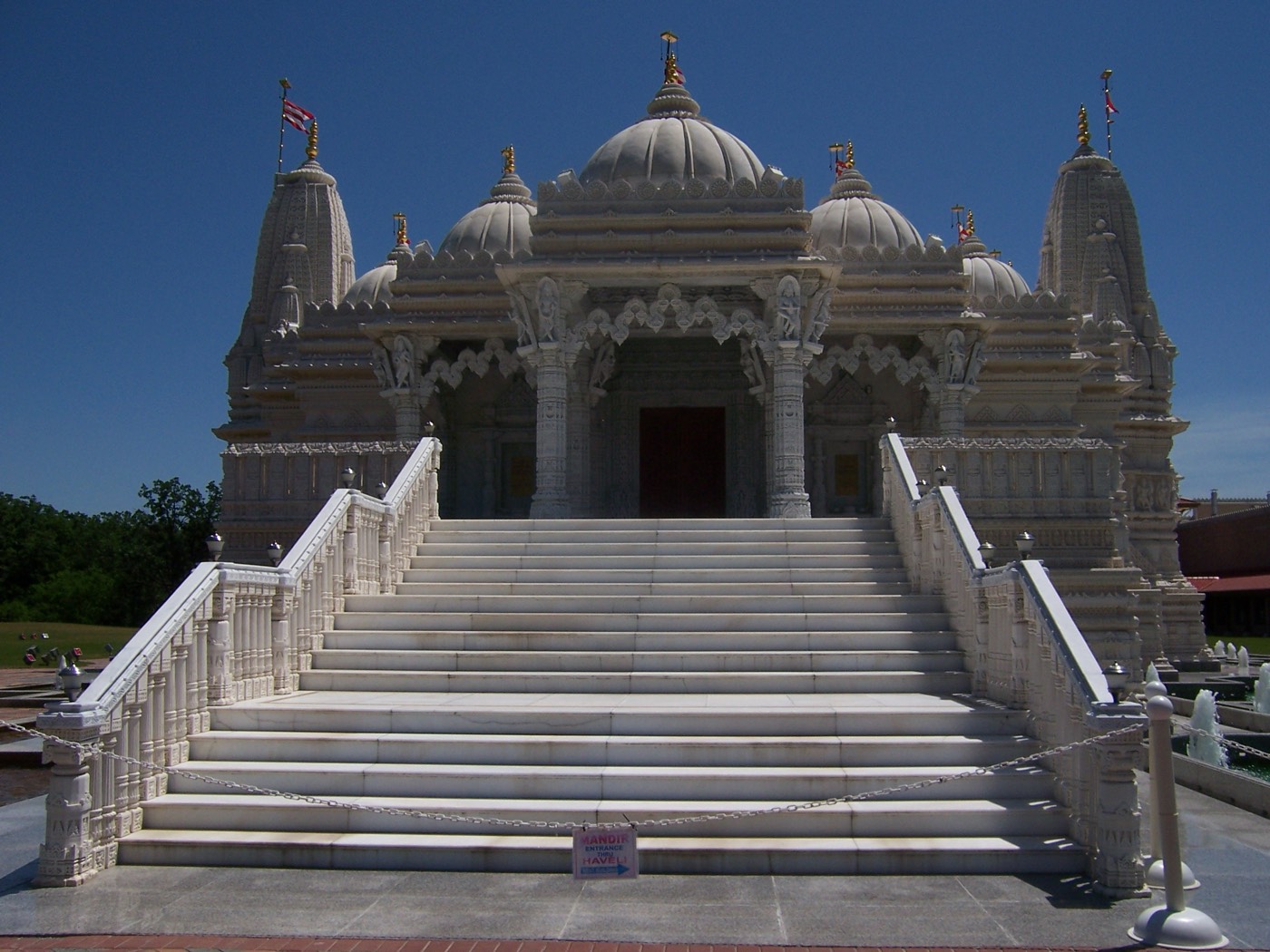
Drive north on Illinois Route 59 through the flat farm-edge of the northwest suburbs and the horizon does something it has no business doing. A skyline of white domes and pinnacles rises out of the prairie, hand-carved and impossibly intricate, as though a corner of Gujarat had been set down whole between the cornfields and the commuter rail. That is the first thing most people learn about the Indians in Bartlett, Illinois: that this quiet village of forty thousand became, almost overnight in 2004, home to one of the largest Hindu temples in North America.
The Place
Bartlett sits about thirty-five miles northwest of downtown Chicago, an unusual village that spreads across three counties at once: Cook, DuPage, and Kane. It began as a railroad stop, named for Luther Bartlett, a Massachusetts farmer who in 1873 gave land and money toward a train depot on the line out of the city.
For more than a century it stayed a small farming community. Then came the 1980s, when subdivisions swept across the old fields and the population multiplied. By the 2020 census Bartlett counted just over 41,000 residents, and roughly one in six was Asian, a share that has kept climbing.
It is comfortable, leafy, and unhurried, the kind of place people move to for the schools and the quiet. What sets it apart is who has been moving in.
How It Became Indian
Bartlett’s Indian story is younger than most. There was no early-twentieth-century settlement here, no first wave of mill workers or shopkeepers. The community arrived with the suburban boom itself, drawn outward from older Indian footholds closer to the city.
The Devon Avenue starting line
For decades, the centre of Indian Chicago was Devon Avenue on the city’s North Side, a strip of sari shops, sweet shops, and grocers that served new arrivals after the 1965 Immigration and Nationality Act lifted the old national-origin quotas. Engineers, doctors, and pharmacists came first, settling in the city and the inner ring of suburbs.
As those families prospered and had children, they did what prospering American families do. They went looking for bigger houses and better schools, and the search pushed them steadily west and northwest, out toward Schaumburg, Hoffman Estates, and beyond.
It was a quiet kind of migration, measured not in boatloads but in mortgages. A pharmacist in West Rogers Park became a homeowner in the suburbs; that homeowner’s college roommate followed, and a cousin after that. The community moved the way water moves, outward and along the path of least resistance, until the northwest corridor was thick with Indian families.
The northwest corridor fills in
By the 1990s the corridor along Interstate 90 had become the heart of Indian suburban Chicago. Schaumburg and Hoffman Estates drew thousands of families to corporate jobs and roomy split-levels, and the grocers and restaurants followed.
Bartlett, a short drive farther out, caught the overflow. Families who had outgrown an apartment in Schaumburg found newer, larger homes in Bartlett’s fresh subdivisions, close enough to keep shopping at the familiar stores in Hanover Park and along Golf Road.
This was the late stage of a classic suburban arc. The subdivisions that had gone up in Bartlett during the 1980s building boom were maturing into established neighbourhoods just as Indian families were ready to buy into them. The timing was almost perfect: new housing stock, good schools, and an easy reach to the jobs and grocers already clustered to the east.
The mandir changes everything
The decision that defined the community came from the BAPS Swaminarayan Sanstha, a Hindu denomination rooted in Gujarat with a worldwide network of temples. In the late 1990s the organisation acquired twenty-seven acres along Route 59 in Bartlett and set out to build a traditional stone mandir there.
It opened on 7 August 2004. The arrival of so significant a religious centre acted like a magnet, especially for Gujarati families, for whom BAPS is a spiritual and social anchor. A house within reach of the mandir became a thing many sought, and Bartlett’s Indian population, already growing, took on a distinctly Gujarati character.
What had been an accident of suburban overflow became, after 2004, a destination in its own right.
A second-generation home
The families who settled here through the 2000s and 2010s were, by and large, established. They were not starting over. They were raising American-born children in a village chosen for its calm streets and its strong public schools, with a stone temple twenty minutes from the front door.
That sequence, prosperity first and then community-building, is why Bartlett feels less like an immigrant enclave and more like a settled suburb that happens to be substantially Indian. The struggle had largely happened elsewhere, a generation before.
The Landmarks
BAPS Shri Swaminarayan Mandir, 1851 S. IL Route 59 (Pramukh Swami Road), Bartlett. This is the heart of it all. Built of hand-carved Italian marble and Turkish limestone, the stone was quarried in Europe, shipped to India for carving by some two thousand artisans, then reassembled in Bartlett like a 40,000-piece jigsaw. The mandir stands 78 feet high with 16 domes and 151 pillars, the largest temple of its kind in Illinois.
The mandir’s Diwali and Annakut festival, Route 59, Bartlett. Each autumn the temple stages a multi-day Festival of Lights that draws well over ten thousand visitors from across the country. The centrepiece is the Annakut, literally a “mountain of food,” a towering offering of more than a thousand vegetarian dishes prepared by volunteers and arranged before the deities for the Hindu new year.
Patel Brothers, 2410 Army Trail Road, Hanover Park. A short drive from Bartlett’s southern edge sits a branch of the chain that became shorthand for Indian grocery in America. Patel Brothers was founded in 1974 by two brothers from a village in Gujarat, and its Hanover Park shelves, stacked with dals, spices, and fresh produce, are where many Bartlett kitchens get restocked each week.
Siri Grocery, S. Route 59, Bartlett. For everyday Indian provisions without the longer trip, families turn to neighbourhood grocers within the village itself, stocking the rice, flours, snacks, and frozen staples that a suburban Indian household runs through.
Annapurna Simply Vegetarian, Hoffman Estates. A few miles away, this pure-vegetarian restaurant is a fixture for the region’s many Gujarati and South Indian families, serving a Gujarati thali alongside a long roster of dosas. In a community where vegetarianism runs deep, an all-veg kitchen is not a niche, it is the default.
Bartlett High School, 701 W. Schick Road, Bartlett. Part of Elgin Area School District U-46, the second-largest district in Illinois, the school anchors the village’s reputation for education. It enrols roughly two thousand students, ranks among the stronger public high schools in the state, and reflects the diversity of the families who chose Bartlett for its classrooms.
The Metra station, downtown Bartlett. The Milwaukee District West line still stops where Luther Bartlett gave land for a depot in 1873. For commuting professionals, including many Indian engineers and IT workers, it remains the daily thread back to jobs in the city and the inner suburbs.
Where They Came From
Bartlett’s Indian community leans heavily Gujarati, and that is no coincidence. The pull of a BAPS mandir, an institution born in Gujarat and central to Gujarati religious life, drew families with roots in that western Indian state more powerfully than any job posting could.
But the chain reaches back further than the mandir. The first arrivals to the Chicago area after 1965 were professionals from across India, and Gujaratis were prominent among them, often connected to the very networks that built businesses like Patel Brothers.
So the path runs from villages and towns in Gujarat, through Devon Avenue and the inner suburbs, out along the I-90 corridor, and finally into Bartlett’s subdivisions, with the mandir on Route 59 acting as the final point of gravity.
It is worth saying that not every Indian family in Bartlett is Gujarati, and not every one is part of BAPS. South Indian families, Punjabis, and others live here too, and the broader Indian Chicago story takes in many communities. But the gravitational centre of Bartlett specifically, the thing that distinguishes it from a dozen similar suburbs, is the Gujarati and Swaminarayan presence anchored by that single extraordinary building.
Bartlett Today
Today the Indians in Bartlett are simply part of the village’s fabric, not set apart from it. The temple draws tourists and architects and school groups, but for the families nearby it is just where they worship, volunteer, and gather for festivals. The children move through U-46 schools, the parents commute on the Metra or drive the corridor to corporate parks.
The full Indian commercial strip still lives a few miles south and west, in Schaumburg and Hanover Park rather than in Bartlett proper. Bartlett is the residential heartland, the place of homes and the mandir, with the shopping a familiar errand away. It is a pattern repeated across affluent Indian suburbs from Naperville on Chicago’s western flank to dozens of others nationwide.
What Bartlett offers, and what keeps drawing people, is the rare combination: quiet, well-schooled suburban America with a piece of Gujarat carved in marble at its edge. For a community that built its life in two acts, prospering first and rooting second, that is very close to the point.
Frequently Asked Questions
How many Indians live in Bartlett, Illinois?
Bartlett’s population was just over 41,000 at the 2020 census, of which roughly 17 to 18 percent was Asian, a category in which Indians form a large share. The Indian community has grown steadily, especially since the BAPS mandir opened in 2004, and skews heavily Gujarati.
Why is there such a large Indian community in Bartlett?
The community grew from the westward spread of Indian families out of Chicago and the inner suburbs, then concentrated after the BAPS Shri Swaminarayan Mandir opened on Route 59 in 2004. The temple acted as a magnet for Gujarati Hindu families seeking to live near it.
What is the famous Hindu temple in Bartlett, Illinois?
It is the BAPS Shri Swaminarayan Mandir, at 1851 S. IL Route 59 in Bartlett. Built of hand-carved Italian marble and Turkish limestone with 16 domes and 151 pillars, it is the largest temple of its kind in Illinois and one of the most significant Hindu temples in North America.
When did the BAPS Mandir in Bartlett open?
The mandir opened on 7 August 2004. Its stone was quarried in Italy and Turkey, carved in India by about two thousand artisans, and shipped to Bartlett as some 40,000 individual pieces that were assembled on the 27-acre site.
Where do Indians in Bartlett shop and eat?
Many shop at the Patel Brothers grocery in nearby Hanover Park and at neighbourhood Indian grocers within Bartlett, and dine at vegetarian restaurants such as Annapurna Simply Vegetarian in Hoffman Estates. The broader Indian commercial corridor sits just south and west, around Schaumburg and Hanover Park.
How are the schools in Bartlett?
Bartlett is served by Elgin Area School District U-46, the second-largest in Illinois. Bartlett High School enrols about two thousand students and ranks among the stronger public high schools in the state, one of the main draws for Indian families choosing the village.
If your family’s story passed through Bartlett, or any of the places Indians have made home in America, Atlas of Home can trace that journey. From a village in Gujarat to the white domes rising over Route 59, to wherever you are now.